How Your Backhand Rubber Affects Your Forehand Performance
This is something many players have been asking me to write: how does the backhand rubber affect the forehand?
1. Backhand Rubber and Forehand Support
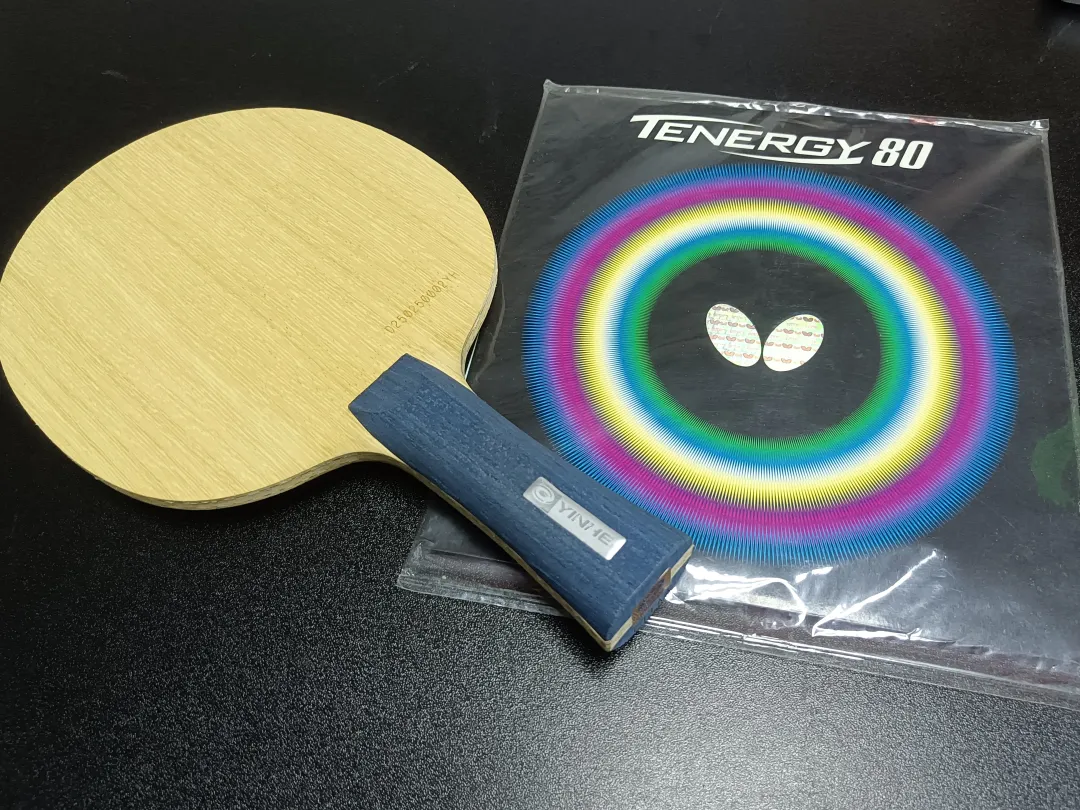
Let us start with the simplest example. Keep the forehand rubber constant and choose between T05FX and T80 on the backhand. If the backhand rubber is softer — say, T05FX — the forehand will loop and drive through more easily. If the backhand is relatively harder — say, T80 — the forehand becomes more solid, with a higher absolute power ceiling.
The catch is: can you actually drive through it? For example, a common setup is forehand Hurricane 3 at 40 degrees, backhand Hurricane 3 at 37 degrees — a reasonable pairing for most amateurs. If you push the backhand up to 39 degrees, the backhand gets harder to penetrate, but so does the forehand — even though the forehand rubber itself has not changed. A friend who is a former national player runs forehand 42 degrees and backhand 40 degrees — that is simply beyond what average amateurs can handle.
2. Backhand Weight: Light vs. Heavy
The effect here is similar to point one. A lighter backhand rubber means the forehand swings more freely and naturally. A heavier, more solid backhand means the forehand can really dig in, but looping and driving becomes more tiring.
Players with balanced forehand and backhand — like Liang Jingkun or Hugo Calderano — can handle harder rubbers on both sides. If your backhand is mainly a transition stroke and you rely on the forehand for points, prioritize the forehand: choose a softer, lighter backhand rubber to let the forehand shine.
Of course, everyone responds differently. Always calibrate based on your own feelings.
3. Backhand Thickness: Thin vs. Thick
This overlaps with the previous two points. Choosing between 1.9mm and 2.1mm D09c on the backhand: 1.9mm makes the forehand easier to penetrate and speeds up your swing exchanges. 2.1mm makes the forehand notably more solid with better dwell, and the raw power ceiling rises.
Beyond the effect on the forehand, you still have to decide what suits your backhand. Can you actually drive through 2.1mm? Does it feel too heavy? If your backhand style is mainly blocking, redirecting, and passive defense, 1.9mm makes sense — easier to penetrate and lighter. If you rely on topspin and spin generation on the backhand, go 2.1mm.
4. German Rubber vs. Japanese Rubber on the Backhand
We can only compare traditional tacky-free German rubber against Butterfly flagship sheets, since many current Japanese-style rubbers — like Joola Rhyzen CMD — actually play more like German rubber anyway.
Generally, Butterfly flagship rubbers have sponges with more elasticity and resilience. On the backhand, they provide stronger forehand support than most tacky-free German rubbers. For example, a V22 on the backhand provides less forehand support than a T80 on the backhand.
With a Butterfly backhand, the forehand loop has more penetration, and the dwell feels richer. With a tacky-free German rubber on the backhand, the forehand power output is often somewhat lower — but the forehand becomes easier to penetrate. Easier penetration means better swing speed, ball exit speed, and margin for error.
In general, when you find something easier to penetrate, your on-table rate goes up. That has a real impact in match play.
One last point: for inner carbon fiber blades, the backhand rubber has a relatively larger effect on the forehand. For outer carbon fiber blades, the effect is somewhat smaller.