Yinhe Big Dipper Review: A Budget Hybrid That Out-Spins Rubbers Twice Its Price
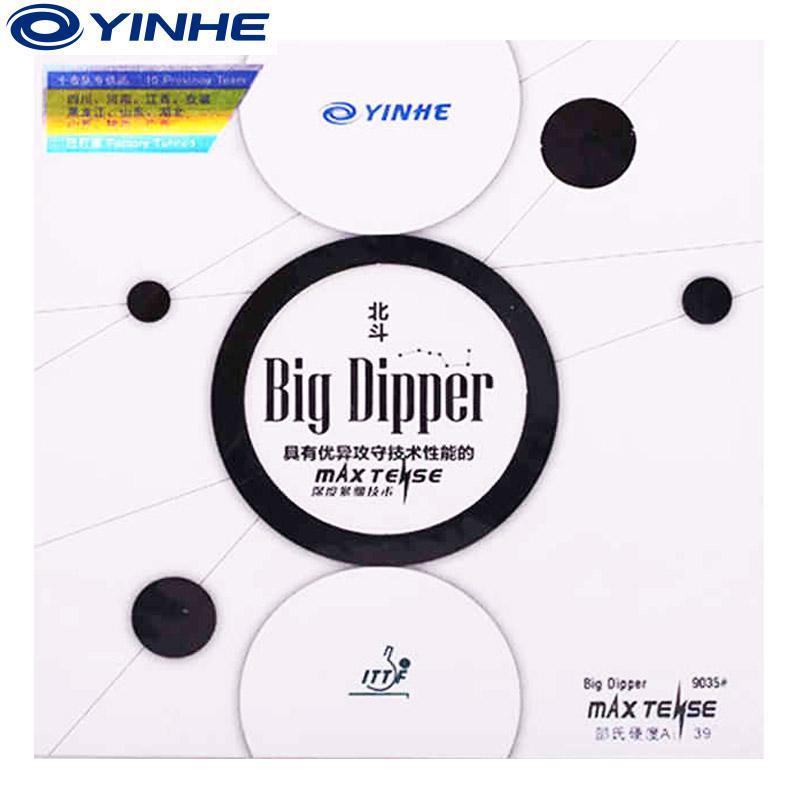
Pros
- Exceptional spin on serves, brushed loops and pushes
- Modern porous blue sponge with high control for a Chinese rubber
- Outstanding stability and almost no ball slippage
- Genuine value alternative to Hurricane 3 Neo and European tensors
- National version approaches a boosted blue sponge Hurricane 3
- Available in 38, 39 and 40 degree hardness options
Cons
- Slow and demanding at lower power, rewards hard active hitting
- Stiff sponge needs break in time and may benefit from boosting
- Not beginner friendly and weak for flat hitting on softer versions
- Some quality control variance reported between sheets
Ask for a cheap Chinese forehand rubber that still loops with serious spin and the Yinhe Big Dipper, sold under both the Yinhe and Galaxy names, is the answer that comes back. It is a hybrid tacky rubber, a Chinese style tacky topsheet over a more modern porous blue sponge, aiming for the spin of a provincial Hurricane with a little of the speed and bounce you associate with European tensors. It comes in 38, 39 and 40 degree hardness variants, with distinct Pro and National editions and a non tacky Big Dipper 2 alongside. Yinhe pitches it as a value answer to the DHS Hurricane 3, so almost every Big Dipper conversation turns into a comparison with that rubber, and that is the frame running through the real reviews and forum threads below.
Performance
Spin is the headline. Racket Insight, which rates the Big Dipper 4.4 out of 5, names spin potential and control its strongest attributes and says it excels at brushed loops, serves and chops, with massive dwell time and essentially no ball slippage. The same reviewer found serves came out noticeably spinnier than serves played with a Fastarc G-1, a respected European tensor. The Tabletennis11 blog says the same: very tacky, able to lift the ball for several seconds, and superb on long forehand pushes against backspin serves. Reddit owners consistently like its feel and spin, even the ones who later look to upgrade. Speed and throw are where you have to recalibrate. Racket Insight rates speed only medium, notes that regular 70 percent speed loops felt quite slow, and concludes the Big Dipper sits a lot closer to Chinese rubbers than European ones. The throw runs medium to low on the standard sheets and punishes passive shots, so the rubber rewards committed, accelerating strokes over soft pushes and blocks. Hardness is the other practical wrinkle. The rubber is sold as 38, 39 and 40 degrees, yet the 39 degree sample Racket Insight measured came in around 51 degrees on the ESN scale, which is very firm, and a Reddit owner of the 38 degree version reports the sponge still feels relatively hard straight after gluing.
The Tabletennis11 blog adds a useful split into two versions. The 37 degree Big Dipper Pro is the spin and short game specialist, very tacky, excellent on pushes and flicks with a safe high throw, but too slow for advanced players unless mounted on a very fast blade and weak for flat hitting. The factory boosted 40 degree Big Dipper National is the dynamic one, a higher throwing take on a boosted, blue sponged 39 degree Hurricane 3, with a prominent clicking sensation, more speed on low to medium impact shots, exceptional pushing and better smashing, while giving up slightly less raw power than a Hurricane 3 on the very highest impact shots. Put it all together and the picture holds: a tacky spin engine with surprisingly good control, a stiff slow base gear, and a top gear that opens up only when you drive through the ball or boost the sponge.
What Reviewers Agree (and Disagree) On
Strong consensus on the core: a spin first rubber with high control and exceptional serves, loops and pushes, and outstanding value against both Hurricane 3 Neo and European tensors. Every source agrees it is demanding and rewards active full strokes. The arguments are about how far it closes the gap to a real Hurricane 3 and to euro rubbers. Racket Insight keeps it firmly in the Chinese camp and harps on how slow medium power loops feel, while the Tabletennis11 blog argues the boosted National version really does approach a blue sponged Hurricane 3 and is more forgiving on top. Reddit debates whether to boost it at all, some reaching for Falco Tempo or Haifu to unlock the top gear and others running it unboosted on a faster blade. Hardness variance and which exact degree to buy is the other open question, since the printed hardness runs noticeably stiffer than the number suggests.
Who Should Buy It
Reach for the Big Dipper if you are an intermediate or advanced player with a spin based forehand who wants Chinese tacky spin without paying for a Hurricane 3 Neo or a premium European tensor. It fits players who live on heavy serves, brush loops and aggressive pushes and who are happy to swing full, committed strokes. Lighter sheets like the 37 degree Pro suit spin and short game specialists, while the boosted 40 degree National or a 40 degree sheet on a fast blade suits more powerful attackers chasing a Hurricane 3 feel. Stay away if you are a beginner, if your game leans on flat hitting and soft blocking, or if you want an easy, fast rubber that performs without much input, since the slow base gear and firm sponge will feel unforgiving.
FAQ
Is the Yinhe Big Dipper a good Hurricane 3 alternative?
Yes, for most players. The Tabletennis11 blog reads the boosted 40 degree National version as a higher throwing take on a blue sponged 39 degree Hurricane 3 that forgives more, while the lighter Pro version is more a spin and short game specialist than a full Hurricane 3 replacement.
Which hardness of Big Dipper should I get?
It depends on your power. Racket Insight steers most players to the 38 degree version because the 39 degree sample measured very firm, around 51 ESN. Go 37 or 38 degrees for spin and control, and 40 degrees or the boosted National if you have a fast stroke or a fast blade.
Is the Big Dipper fast enough for offensive play?
It is offensive but spin first. Reviewers put speed at only medium and note that medium power loops feel slow, so the top gear opens up mainly on hard, full strokes. Many players either bolt it to a fast blade or boost the sponge to add speed.
Does the Big Dipper need boosting or a break in period?
It works unboosted, though several players report the sponge feels hard right after gluing and softens with use, and some boost it with products like Falco Tempo or Haifu to unlock more speed. Boosting is optional and comes down to your rules and preferences.
Is the Big Dipper good for beginners?
Not really. Reviewers call it demanding and best for players with a few years behind them, since the firm sponge, low base speed and medium to low throw punish passive shots and reward active, accelerating strokes.