Butterfly Glayzer vs Yinhe Big Dipper: Which Should You Buy?
| Butterfly Glayzer | Yinhe Big Dipper | |
|---|---|---|
| Our rating | 8.2/10 | 8.4/10 |
| best_side | Forehand or Backhand (all-round offensive) | forehand |
| control | High | high |
| speed | 81 (manufacturer) | medium (offensive) |
| spin | 73 (manufacturer) | extreme |
| sponge_hardness | 38 degrees (JPN) | 38/39/40 degrees (provincial-style blue sponge; 39 measures roughly 51 ESN) |
| type | Inverted / High Tension (Spring Sponge X) | hybrid tacky (blue sponge) |
| weight_uncut_g | around 48g uncut | 68 |

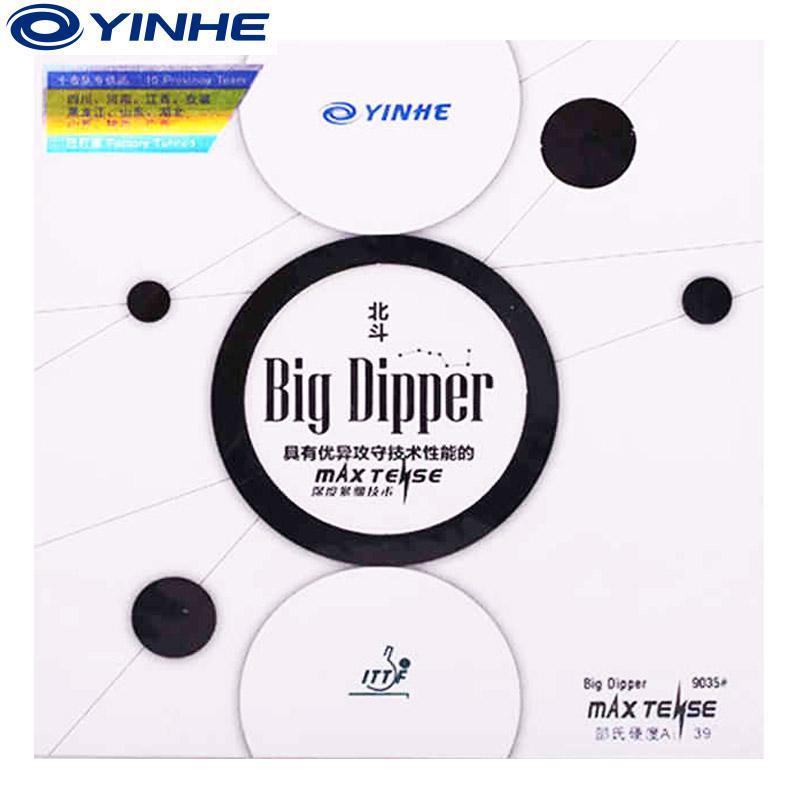
We may earn a commission from links on this page. Learn more.
Same rating tier, different rubber philosophy
Butterfly Glayzer (8.2 overall) and Yinhe Big Dipper (8.4 overall) land within two-tenths of a point of each other, and two of the six tracked axes - speed and durability - are exact ties, a delta of precisely 0 on both. That evenness makes it tempting to call this a coin flip. It is not: the tackiness axis splits by 3.1 points, and that single number explains most of the difference between these two rubbers.
Tackiness: the real fork in the road
Glayzer rates 2.0 on tackiness; Big Dipper rates 5.1. A 3.1-point spread on a 0-10 scale is large enough to put these rubbers in different families rather than different tiers of the same family. Big Dipper is explicitly framed in its own source material as a budget alternative to Hurricane 3 Neo - Tabletennis11’s blog coverage even asks directly whether it is a genuine Hurricane 3 alternative - meaning it is built around grabbing the ball with a tacky topsheet on a stiffer, Chinese-style sponge. Glayzer is the opposite build: a springy 38-degree Japanese sponge with a low-tack, Dignics-05-derived topsheet that returns energy to the ball rather than gripping it. If you have ever switched from a European tensor to a Chinese tacky rubber, or back, you know this one axis dictates serve feel, backspin handling, and how much arm speed you need to generate spin.
Throw and control: smaller but real
Throw angle favors Glayzer by 0.7 (6.5 vs 5.8) and control favors it by 0.5 (9.1 vs 8.6). Both gaps are modest but consistent with the tackiness split: Big Dipper’s stiffer, tackier build is, per its own cons list, “not beginner friendly” and demands “hard active hitting,” which naturally trades away some margin for error and arc height compared to Glayzer’s more forgiving Spring Sponge X setup.
What’s genuinely tied
Speed (8.6 vs 8.6) and durability (7.5 vs 7.5) are exact ties in this dataset, not merely close - identical. If either of those axes was your deciding factor between these two rubbers, drop it from consideration; the data says there is nothing there. Spin is close enough to call a tie too, 8.8 vs 8.9, a 0.1-point gap well within noise.
Should you switch?
If you are already on Glayzer and considering Big Dipper for “more spin,” the axis data does not support that as the reason - spin is essentially flat between them. The actual reason to switch is tackiness preference and cost: Big Dipper is positioned as a budget Hurricane 3 alternative for players who specifically want that heavier, grabbier Chinese forehand feel and are willing, per its own cons, to accept a stiff sponge that “needs break in time” and possibly boosting, plus reported quality-control variance between individual sheets. If none of that trade-off appeals to you, stay on Glayzer.
Going the other direction, from Big Dipper to Glayzer, makes sense if Big Dipper’s own listed weakness matches your complaint: weak at anything less than full commitment, and not friendly to flat hitting. Glayzer’s wider gear range, per its own pros list “works for gentle touch play and full-swing loops,” directly answers that gap.
Who each rubber actually suits
Big Dipper’s own bestFor description names “intermediate to advanced spin oriented attackers who want Chinese style tacky spin on the forehand at a budget price and are willing to play with full, active strokes or pair the rubber with a fast blade” - a specific, forehand-focused player. Glayzer’s own bestFor description is broader: intermediate offensive players, 1200-1800 USATT, wanting Butterfly quality at a manageable price, without a wing restriction. Reddit’s r/tabletennis threads on Big Dipper, cited alongside Racket Insight’s review, generally frame it within this same Chinese-alternative conversation rather than as a direct rival to Japanese-style rubbers like Glayzer.
Bottom line
Two rubbers, same rating bracket, genuinely different rubbers underneath. Speed and durability will not decide this for you - they are tied. Tackiness, throw, and control will: Glayzer for an all-round, forgiving, Japanese-style feel that works on both wings; Big Dipper for a forehand-focused, tacky, Chinese-style alternative to Hurricane 3 at a lower price, provided you are ready to swing fully and accept some break-in stiffness along the way.
Frequently asked questions
Is Yinhe Big Dipper really a Hurricane 3 alternative?
That is how its own source material frames it - Tabletennis11's blog coverage directly asks whether it is a Hurricane 3 alternative, and its pros list calls it a genuine value alternative to Hurricane 3 Neo. The 3.1-point tackiness gap versus Glayzer supports that positioning; Big Dipper is a tacky Chinese-style rubber, not a Japanese-style one.
Which rubber is more beginner-friendly, Glayzer or Big Dipper?
Glayzer. Big Dipper's own cons list states directly that it is not beginner friendly and is weak for flat hitting on its softer versions, while Glayzer's pros list highlights a wide gear range covering both gentle touch play and full-swing loops.
Do Glayzer and Big Dipper differ in speed?
No - they are an exact tie at 8.6 on the speed axis. Durability is also an exact tie at 7.5. Whatever difference you notice between them comes from tackiness, throw angle and control, not raw speed or longevity.
Does Yinhe Big Dipper need to be boosted?
Not necessarily, but its own cons list notes the stiff sponge needs break-in time and may benefit from boosting - it is described as demanding hard, active hitting rather than being ready to perform at low effort out of the packet.