Tibhar Samsonov Force Pro Black Edition Review: Controlled Offensive Power for Intermediate Players
Pros
- Outstanding price-to-performance ratio for a quality 7-ply all-wood blade
- Linear, predictable rebound makes timing forgiving and consistent
- Excellent blocking control with good forgiveness on off-center contact
- Uniform feel across the entire blade surface confirmed by lab testing
- Handles looping, hitting, and blocking across a single session
- Works well with a wide range of rubber types, including tensor and sticky rubbers
Cons
- Slightly head-heavy balance requires arm conditioning and physical stamina
- Not suitable for beginners without solid stroke fundamentals
- Speed ceiling is lower than carbon alternatives for players wanting maximum pace
- Spin generation on loops is marginally reduced compared to softer, more flexible blades
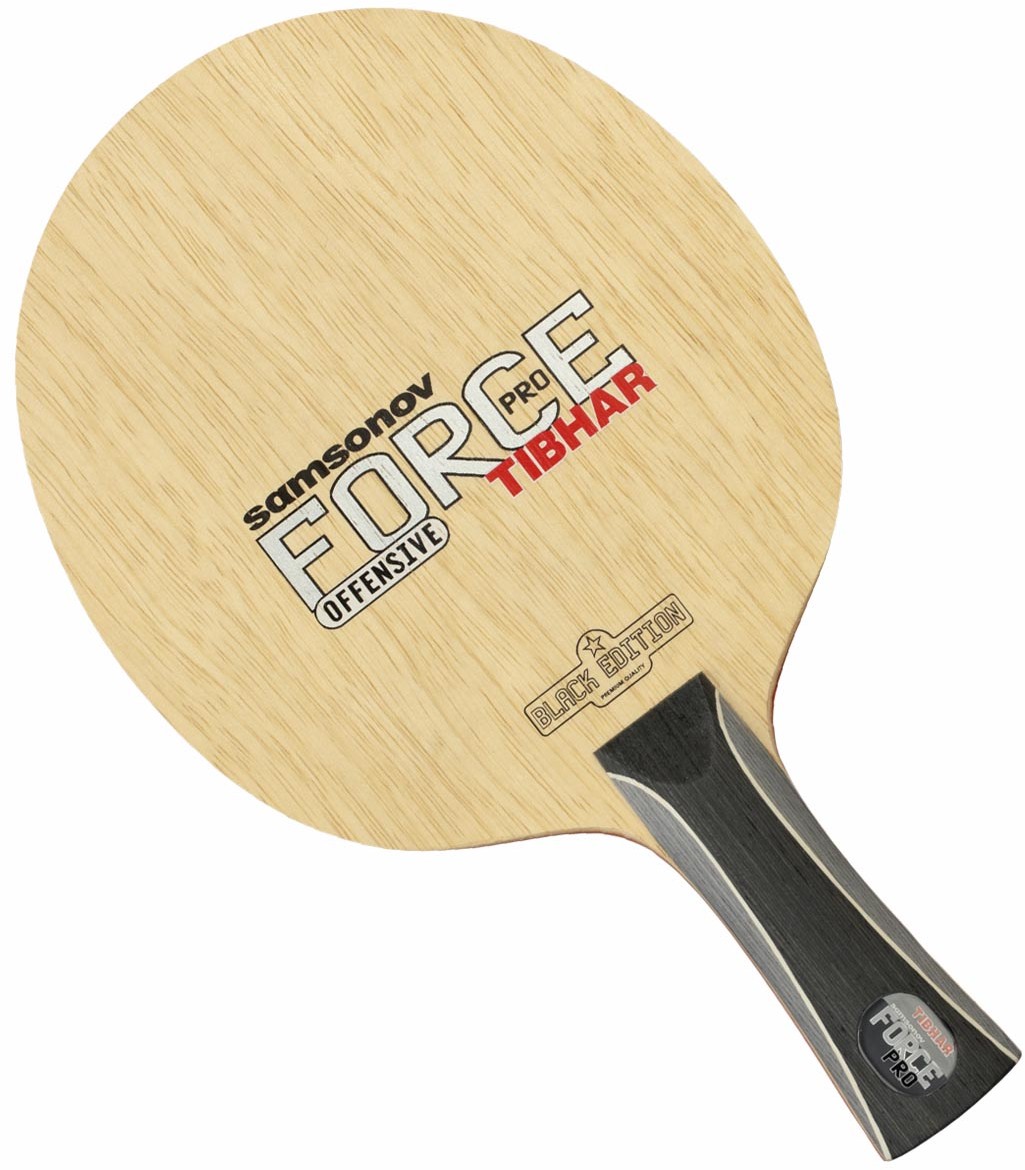
Few all-wood offensive blades are as widely known as the Tibhar Samsonov Force Pro Black Edition, which carries the name of Vladimir Samsonov, former world number one and three-time European champion. It was Tibhar’s best-selling blade in 2016. The 7-ply all-wood construction runs limba-ayous-ayous-ayous-ayous-ayous-limba, measuring roughly 158 by 151mm at a thickness of about 6.6 to 6.7mm. The Black Edition label is cosmetic and nothing more: two of the inner plies are dyed red and show through the surface, but the wood and the playing characteristics match the standard Samsonov Force Pro exactly. This review pulls from lab test data, a hands-on assessment by TableTennis11, customer feedback aggregated on Megaspin and BladeRubber, and discussion on Reddit’s r/tabletennis, well over 150 independent user impressions in total.
Performance
TTGearLab’s lab testing found a mild hold characteristic, with an elasticity central-to-primary ratio of 0.9, meaning the blade keeps the ball on the face a fraction longer at impact and sends it out on a linear, predictable path. For an OFF blade, that makes it unusually forgiving. You can read the result of your input easily and precisely, which shows up as consistent placement and fewer errors under pressure. A vibration lateral-to-primary ratio of roughly 1.02 backs up the near-uniform feel across the whole face, whether you catch the sweet spot or drift toward the edge.
In play it handles the full offensive range. Moderate forehand drives come off fast and controlled; wind up the swing and you get a crack of sound and solid power transfer. The backhand stands out, and several reviewers call it perhaps the best balance of speed, control, and crisp feel in this class. Blocking is a highlight too. The stiff build gives much better control on passive blocks and more room for error when your timing is off, which keeps you safe in fast exchanges.
On loop drives it reaches about 95 percent of the spin and speed a more flexible blade would give, a small price for the extra consistency and feel. Weight runs between 83 and 90 grams, averaging around 87g, and the balance leans head-heavy, which a few reviewers find tiring across a long session. TTGearLab’s comparison grouped it with the Butterfly Korbel SK7 and Stiga Clipper CC in the benchmark tier for 7-ply wood blades built for modern topspin: a step slower than the Stiga Clipper CR, but a close match on construction quality.
Rubber pairing matters here. The community pushes hard for medium-hardness tensors like Vega Europe or Evolution MX-P. Very hard Chinese rubbers turn the already-firm blade overly stiff, while softer European rubbers play to its natural hold and feel.
What Reviewers Agree (and Disagree) On
Every source lands on the same headline: the Samsonov Force Pro Black Edition is exceptional value, parked at the slower end of OFF, with balanced and forgiving performance. Control, feel, and blocking come up again and again as its best attributes. Where opinions part is weight tolerance. Some intermediate players love the head-heavy balance for the power it adds; others, usually those with less physical conditioning, tire over a long session. The community also agrees the Black Edition is a cosmetic change and nothing more, neither better nor worse than the standard Samsonov Force Pro. Worth knowing if you are weighing the price premium for the finish.
Who Should Buy It
This blade fits intermediate players with solid fundamentals who are ready to move past a standard 5-ply all-wood blade. It hits harder and faster than a typical all-round blade while keeping the wooden feel and control players want before jumping to carbon. It suits a mixed game of looping, blocking, and hitting more than one-dimensional power play. Advanced players who prefer the tactile feedback of pure wood over composite will find it dependable. Complete beginners and pure speed chasers should look elsewhere: the first group needs a more forgiving setup, the second a faster composite construction.
FAQ
What is the difference between the Black Edition and the standard Samsonov Force Pro?
The Black Edition is cosmetic only. Two inner plies are dyed deep red or black for a distinctive look, but the wood species, construction, and every playing characteristic match the standard Samsonov Force Pro.
What speed class does this blade fall into?
It sits at the slower end of OFF, sometimes pegged between OFF- and OFF. Faster than a typical 5-ply all-wood blade, slower than most carbon or composite blades rated pure OFF or OFF+.
What rubber works best with this blade?
The community leans toward medium-hardness tensors such as Tibhar Evolution MX-P, the Yasaka Rakza series, or Donic Acuda S2. Very hard Chinese rubbers leave the blade feeling overly stiff, and very soft ones dampen its natural responsiveness.
Is this blade suitable for beginners?
Mostly no. It rewards players who already have reliable stroke technique and the conditioning to match. Until your fundamentals are set, a lighter and more forgiving all-round blade serves you better.
How heavy is the Tibhar Samsonov Force Pro Black Edition?
Most weigh between 83 and 90 grams, averaging around 86 to 87 grams. The balance leans slightly head-heavy, which takes some adjustment but feeds power into attacking strokes.
How does it compare to the Stiga Clipper?
Both are 7-ply all-wood blades around 6.7mm thick. The Samsonov Force Pro Black Edition is a touch slower than the Stiga Clipper CR but on par with the Clipper CC, and lab tests place them as peers in the standard 7-ply benchmark category. The Samsonov reads as slightly more forgiving thanks to its mild hold.
Sourced From
This review synthesizes opinions from 5 independent community sources:
- TableTennis11 Blog (ecommerce)
- TTGearLab (forum)
- Megaspin (ecommerce)
- BladeRubber (forum)
- Reddit r/tabletennis (forum)