Donic Persson Powerplay Review: The All-Wood OFF Blade With Outstanding Control
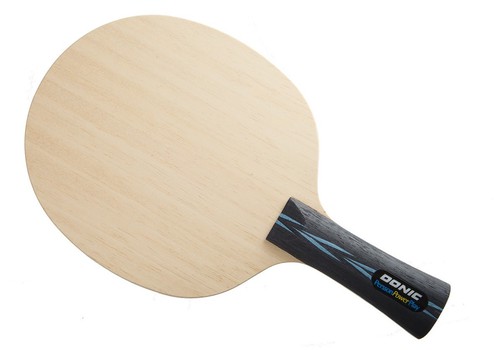
Pros
- Exceptional control even when under pressure from hard-hitting opponents
- Crisp, feedback-rich feel from hard koto outer plies
- Internal foil damping layers tame vibration without killing touch
- Flexible enough for high-throw loops yet stable for low-throw blocks
- Outstanding value for the price, especially in the used market
- Works well for both shakehand and penholder grip
Cons
- Weight around 90g can feel heavy compared to lighter all-wood competitors
- Requires committed swing on loops; tentative strokes suffer
- Officially discontinued, so stock depends on used market availability
- Smaller head size requires a brief adjustment period
The Donic Persson Powerplay is a 7-ply all-wood offensive blade endorsed by World Champion Jorgen Persson. A hard koto outer ply, a three-ply ayous core, and thin DONIC foil damping layers tucked just under the surface put it in an unusual spot: fast for an all-wood board, yet easy to control. Donic discontinued it years ago, but it still gets recommended on forums and keeps changing hands on the used market, which tells you how much its owners trust it.
Performance
On the forehand, the Persson Powerplay pays back committed strokes. The hard outer plies build speed fast, and the natural flex adds arc to loops without throwing the ball long even on full-power shots. One veteran reviewer who has tested around 60 blades called it the best blade they ever used, praising how the stiffness gives low-throw control on blocks while the flex adds high-throw carry on loops. Set against pure five-ply blades of similar flex, the Persson Powerplay does not fold under maximum power, which kills the usual problem of powerloops sailing off the end.
On the backhand, blocking is the highlight. The hardness keeps the ball low and the blade barely deflects on passive returns, so it stays predictable and consistent under pressure. The DONIC foil layers soak up unwanted vibration, and the feedback comes back clean rather than buzzy. Several reviewers called out the short game in particular: pushes, flicks, and drops all read clearly through the handle. The sweet spot is large but not huge. Players who lined it up directly against other top 7-ply all-wood blades, including the Stiga Clipper, DHS Power G7, and Xiom Extrem S, rated the Persson Powerplay best of the group for overall balance. Control is the headline trait, with several independent sources calling it some of the best they have had from any blade they owned. Part of that traces to the uniform thickness of the ayous core plies and part to the foil damping, which together give a blade that responds the same way across the full hitting surface.
What Reviewers Agree (and Disagree) On
Reviewers line up on the strengths: strong control, clean tactile feedback, solid looping with good arc, and dependable blocking. The main variation is weight. Some shrug off the 90g figure as a minor annoyance; others flag it as the blade’s one real weakness. There is also a split on who it suits. Some treat it as a stepping-stone for intermediate players headed for carbon, while others keep it long-term precisely because they prefer the directness of all-wood over composite speed.
Who Should Buy It
The Persson Powerplay suits intermediate and advanced offensive players who put control and feedback ahead of raw speed. If carbon blades feel too stiff or too indirect to you, its all-wood character will land. It is also a strong pick for penholders who want a reliable platform for blocking, smashing, and counter-driving. Budget-minded players chasing a true OFF-class all-wood blade without flagship prices will struggle to match the value, especially on the used market where it is still around.
FAQ
Is the Donic Persson Powerplay suitable for beginners?
It can work for beginners who already have some technique, but the hard outer plies mean tentative strokes give unreliable results. Most coaches would point you to a softer or slower blade while you build fundamentals.
What rubbers pair well with this blade?
Mid-speed tensors like Nittaku Fastarc G-1, Andro Rasanter R47, and Donic Bluefire JP01 Turbo come up often. Softer rubbers such as Yasaka Mark V also work for players who want extra control. On the backhand, a slightly softer rubber helps offset the blade’s natural hardness.
What is the difference between the Persson Powerplay and the Persson Powerplay Senso V1?
The Senso V1 version adds Donic’s vibration-sensitive handle technology, built to push more feedback through the handle on ball contact. The blade construction and speed class are the same, but the Senso handle draws players who are especially tuned to touch and feel.
Is the Persson Powerplay a carbon blade?
No. The Persson Powerplay is a pure 7-ply all-wood blade. The thin internal DONIC foil layers are not carbon fiber; they are wood-based damping plies that cut harsh vibration while keeping ball feel intact.
How fast is the Persson Powerplay compared to other blades?
It sits in the OFF to just below OFF-plus range for an all-wood blade, quick without crossing into the territory of composite blades. Players moving from slower all-wood boards should adjust their stroke timing to control the additional pace.
Can I still buy the Persson Powerplay new?
Donic has officially discontinued the standard Persson Powerplay. New old-stock units may appear on specialty retailers or auction sites, and the used market remains active. The Persson Powerplay Senso V1 is a currently available close relative.
Sourced From
This review synthesizes opinions from 4 independent community sources:
- Revspin (forum)
- Reddit r/tabletennis (forum)
- Tabletennis Reference (forum)
- Bladerubber.net (forum)