Donic Waldner Senso Carbon V1 Review: Controlled Carbon for Allround Attackers
Pros
- Woody, natural feel despite the carbon construction
- Outstanding topspin and looping capability close to the table
- High throw angle helps generate spin on low balls
- Senso V1 hollow handle dampens harsh vibrations and aids feedback
- Light weight (around 85g) makes it nimble and easy to maneuver
- Works well with a wide range of European inverted rubbers
Cons
- Speed drops noticeably at mid to far distance from the table
- Not stiff enough for flat smashes or aggressive flicks over the net
- Mismatched rubber hardness across sides can create resonance issues
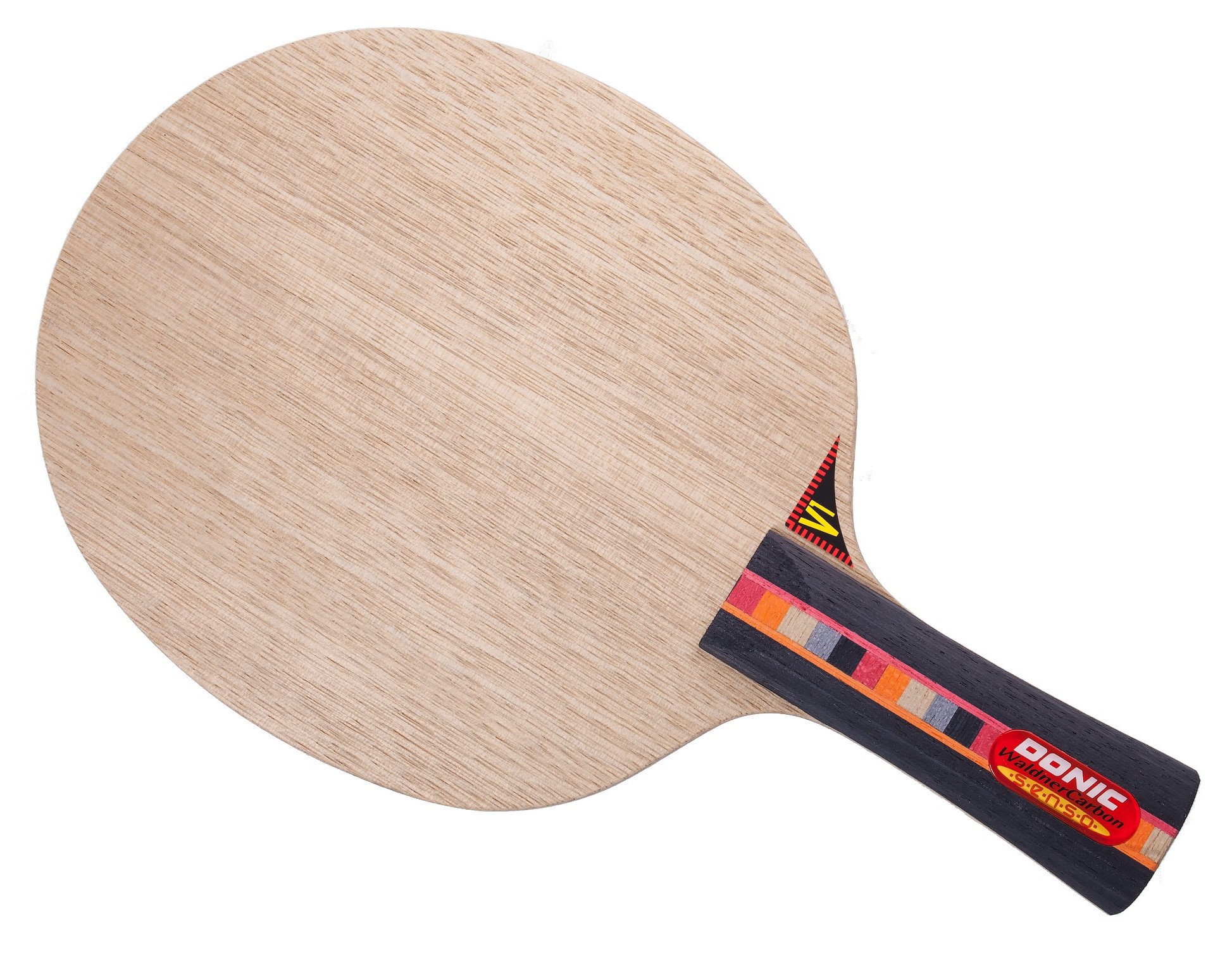
The Donic Waldner Senso Carbon V1 sits in the Waldner signature line, built to match the Swedish champion’s technical, touch-based game. It skips the aggressive carbon-for-baseliners route and lands at an OFF- speed rating, aimed at players who put precision and spin ahead of flat power. The 7-ply build buries thin carbon plies in the inner layers, holding onto a woody feel while adding just enough stiffness to lift it past a pure wood racket. The Senso V1 hollow handle is the headline feature: the chamber inside soaks up unwanted vibration and hands back clean, informative feedback on every contact. At around 85g bare, it is one of the lighter carbon options out there.
Performance
The Waldner Senso Carbon V1 pays off for players who work the ball with technique instead of leaning on blade speed. Close to the table it shines. Topspin loops, counter-loops, and blocks come off crisp and controllable; Revspin reviewers say you can adjust on the fly by feel, and TableTennisDaily calls it a looping monster close to the net. The elastic inner carbon throws the ball high, which lets you load spin onto low and chopped balls without swinging out of your shoes.
Dropshots and short play are strong suits, helped by the blade’s flex and the Senso handle feedback. Reviewers report you can feel exactly where the ball lands on the face, which matters a lot for touch shots. Blocking earns the same praise: it flattens the ball without fuss and gives pace back without redirecting wildly.
The carbon layers are thin, around 0.025mm each, set at the third ply from each face. They add spring and speed but never fully erase the soft Limba and Ayous outer-wood feel. Megaspin reviewers describe a soft wood feel that snaps into a carbon kick once you hit harder.
Step back from the table or reach for flat power, though, and the blade falls off. All three sources report that mid-distance counterspins turn unreliable, and there simply is not enough stiffness to drive aggressive smashes. Flicks over the table cost extra effort too. The OFF- rating is honest: anyone expecting OFF or OFF+ output walks away disappointed. One more thing — running very different rubber hardnesses on each side is a mistake here. The mismatch sets up an audible, tactile resonance that pulls your attention off the ball. Match weight and hardness on both wings and it behaves.
What Reviewers Agree (and Disagree) On
Revspin, Megaspin, and TableTennisDaily agree on the core strengths: strong close-to-table control, real spin potential, and a woody feel that defies the carbon. They also agree on the main flaw — the blade loses bite at medium to far distance. Sweet-spot size draws a mild split. Some Megaspin reviewers find the head a bit smaller than usual, which shrinks the usable area, while Revspin users praise the larger sweet spot from the soft inner carbon. That gap probably comes down to differing technique and expectations rather than uneven manufacturing. The same pattern shows up on short-game control: one Megaspin reviewer struggled with it using hard rubbers, Revspin users found it excellent, and again the difference traces back to rubber matching.
Who Should Buy It
This blade fits improving intermediates who want out of all-wood gear but are not ready for a fast, stiff carbon plate. It rewards close-to-table attackers who win with topspin, looping, and smart placement rather than flat power. Coaches reach for it as a first carbon blade because the OFF- speed leaves room to build technique. It also suits club players with consistent topspin who want a light, controllable tool for European loop-dominant play. Players who attack mainly from mid or far distance, or who lean on hard flat smashes, should look at faster blades. Whatever rubbers you mount, keep the hardness matched on both sides for the best vibration behavior.
FAQ
What is the exact ply construction of the Waldner Senso Carbon V1?
It runs 7 plies: Limba (outer), Ayous, Carbon, Ayous (center), Carbon, Ayous, Limba (outer). Each carbon ply is roughly 0.025mm and sits at the third position from each face, deep enough to keep a woody feel while still adding speed and spring. Total thickness is about 5.6 to 5.8mm.
What does the Senso V1 hollow handle do?
The Senso V1 grip hides a hollow chamber that absorbs unwanted vibration from off-center hits. You get cleaner, more informative feedback on well-struck balls and less of the harsh buzz that harder carbon blades send up the arm. Reviewers keep crediting it for better touch and feel.
What rubbers pair best with the Waldner Senso Carbon V1?
Most reviewers point to medium-soft to medium European inverted rubbers on both sides. Common pairings include Donic Bluefire M3, Joola Bluefire JP1, Tibhar Bluefire JP3, Yasaka Rakza 7, and Tenergy 05. The rule that matters: match hardness and weight on forehand and backhand, because a mismatch sets up that distracting resonance. Avoid running something very hard like JP01 Max on one side and a soft rubber on the other.
Is this blade suitable for beginners?
It can work for motivated beginners who want a blade to grow into. The OFF- speed keeps it from running away, and the high control helps groove proper technique. True beginners are still better off on an all-wood allround blade first. The players who get the most out of it have one to two years of club experience and a developing topspin game.
How does it compare to the Waldner Ultra Senso Carbon?
The Waldner Senso Carbon V1 is the slower, more controlled sibling. The Ultra Senso Carbon is faster and stiffer, with a slightly thicker center ply and uniform ply construction that pushes more power at distance. The V1 wins on short-game touch, close-to-table looping feel, and forgiveness. Want more mid-distance punch, pick the Ultra; prize control and touch, pick the V1.
What is the weight and is head-heaviness an issue?
The bare blade weighs around 85 to 87g, on the lighter side for carbon. The Senso V1 hollow handle trims handle mass, though, so an assembled paddle can sit a bit head-heavy depending on your rubbers. Some reviewers like that balance for backhand loops. If it bothers you, lighter forehand rubber pulls the balance back.
Sourced From
This review synthesizes opinions from 3 independent community sources:
- Revspin (forum)
- Megaspin (ecommerce)
- TableTennisDaily (forum)