Nittaku Septear Review: The All-Wood Hinoki Blade Built for Control
Pros
- Exceptional control and ball placement precision across all strokes
- High dwell time and soft, responsive feel characteristic of Kiso Hinoki
- Handles loops, blocks, pushes, flicks and smashes without a weak stroke
- Forgiving sweet spot supports players still developing consistent technique
- Premium Japanese craftsmanship with durable, long-lasting construction
- Effective at short range and mid-distance from the table
Cons
- Lacks explosive finishing power compared to carbon or composite blades
- Performs poorly with soft rubbers — requires medium-hard to hard sponges
- Soft hinoki surface is susceptible to dents over time
- Thin handle may be uncomfortable for players with larger hands
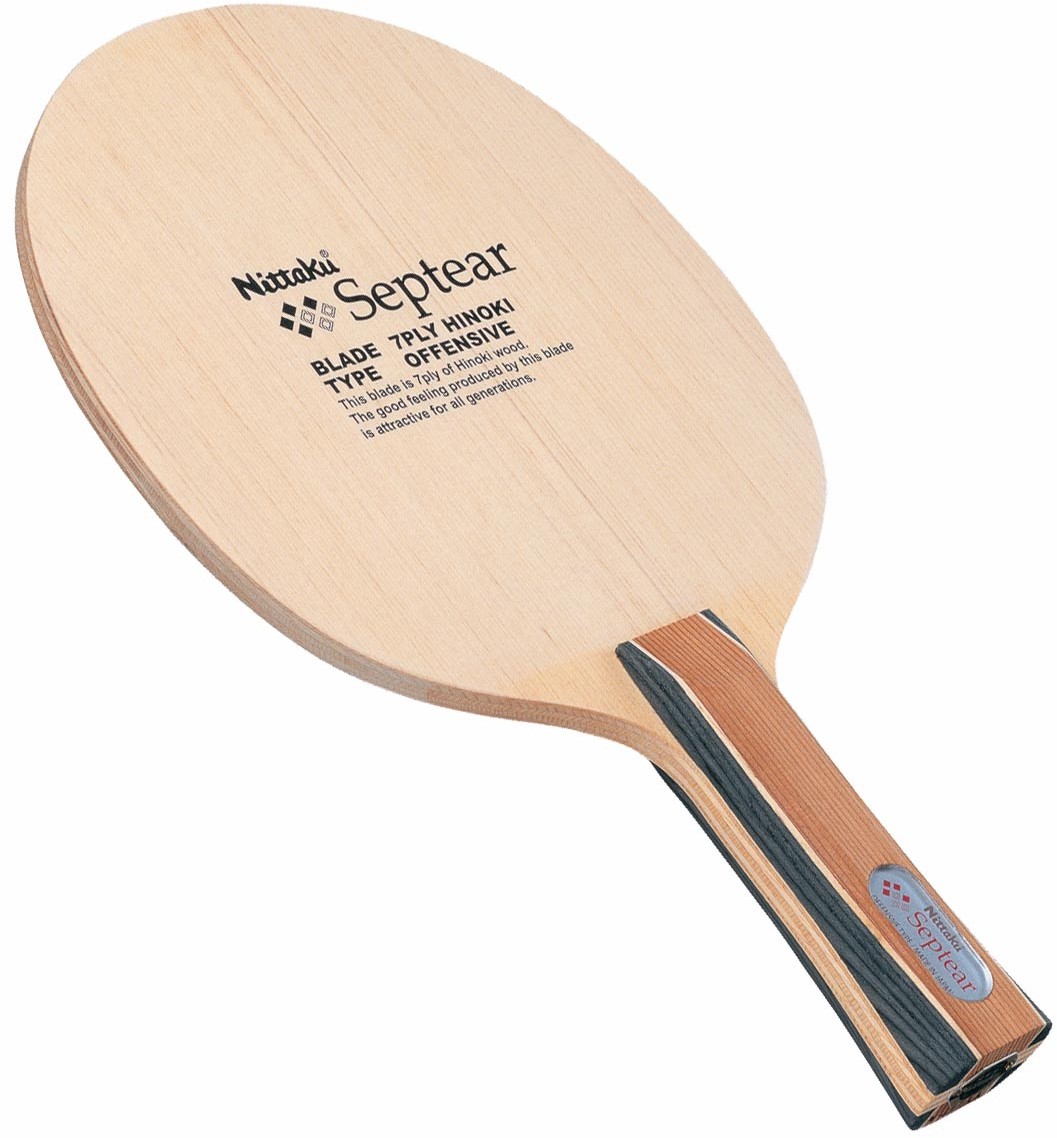
The Nittaku Septear is a 7-ply all-Kiso-Hinoki blade from Nittaku, built on the idea that control and feel come before raw power. Rated ALL+/OFF-, it straddles the top of the all-round category and the soft edge of the offensive one, a natural fit for players who pair controlled topspin attacks with reliable touch. At 6.7mm thick and about 85g, it is balanced and manageable, a blade that rewards technique and footwork over muscling the ball with speed. The Kiso Hinoki, cut from high-quality Japanese cypress, gives it the soft feel, generous dwell and mild catapult that hinoki blades are known for.
Performance
On the table the Septear is a controllable, touch-sensitive blade that suits technical players. Reviewers across platforms keep using the same word for the control, ‘unbelievable,’ and placement is one of its biggest assets. Players report hitting edges and corners with a consistency that faster, stiffer blades make hard. Topspin looping is where it really comes together. The dwell stretches contact through the forward swing, so spin comes reliably without needing perfect timing on every ball. Experienced users have tagged it a ‘loop monster,’ with mid-distance looping a particular strength. Drops, pushes, flicks and blocks all benefit from the soft, responsive feel, which feeds back precise information on every contact. Smashing and power driving are serviceable, not dominant. Several reviewers say the blade ‘lacks the final gear’ for explosive finishers next to faster carbon, which is the ALL+/OFF- classification doing what it says rather than a flaw.
Rubber choice makes or breaks it. Multiple sources warn off soft rubbers, which turn the pairing mushy and unpredictable. The consistent call is medium-hard to hard sponges in the 45-degree-plus range on the European scale. Tenergy 05, Acuda S1 Turbo and Tibhar Sinus come up as pairings that keep the blade’s control while adding the spin and speed you need to threaten at competitive level. It plays best from close to mid-distance, and a deep mid-distance game will find it short on pace.
What Reviewers Agree (and Disagree) On
Across Revspin, Megaspin, BladeRubber.net and Reddit the core read is the same: excellent control, high dwell, a soft feel that rewards touch players. Reviewers consistently file it as ALL+/OFF- in speed, and the soft-rubber warning shows up everywhere. Handle comfort splits a little. Most players are fine with it, but larger hands report the thin grip as a drawback. A few reviewers find it slightly underpowered even for the all-round offensive category, while others take that same trait as exactly what makes it safe and usable across a long development arc. Nobody disputes the quality or the construction.
Who Should Buy It
The Septear is a strong pick for intermediates stepping up from a beginner blade to a better setup, and for all-round players who want to grow their topspin game without giving up control. It fits players who stay close to the table and win points with technique, placement and spin rather than raw speed. It is the wrong blade for a power smasher or anyone set on soft rubbers, since a medium-hard or hard sponge pairing is non-negotiable. Coaches sometimes hand it to developing players because the forgiveness helps groove proper technique. Advanced players chasing maximum firepower should go to faster, composite alternatives.
FAQ
What is the speed rating of the Nittaku Septear?
It is rated ALL+/OFF-, which puts it at the top of the all-round category. There is enough speed for controlled offensive play, but not the explosive pace of carbon or composite blades.
Is the Nittaku Septear all wood or does it contain carbon?
It is pure all-wood, a 7-ply Kiso Hinoki construction with no carbon, arylate or other composite layers. That is where the soft feel and high dwell of traditional hinoki blades come from.
What rubbers pair best with the Nittaku Septear?
Medium-hard to hard sponge rubbers work best. Reviewers point to Tenergy 05, Acuda S1 Turbo, Fastarc G-1 and Tibhar Sinus. Steer clear of soft rubbers, which leave the combination mushy and unpredictable.
Is the Nittaku Septear suitable for beginners?
It can work for advanced beginners or early intermediates who already have basic technique, since the forgiving sweet spot helps build consistency. But the price and the rubber-pairing demands make it better as a step-up blade for intermediates than an entry-level buy.
How does the Nittaku Septear compare to carbon blades?
Against carbon, the Septear gives you more control, better feel and feedback, and more dwell, but less raw speed and explosive power. If touch and placement matter more to you than top-end attack speed, the Septear wins; if you want pace and pop, go carbon.
Does the Nittaku Septear dent easily?
Being a soft hinoki wood blade, it dents more easily than harder wood or composite blades. That comes with hinoki construction and should be expected. Store it carefully and keep it away from hard impacts to protect the surface.
Sourced From
This review synthesizes opinions from 4 independent community sources:
- Revspin (forum)
- Megaspin (ecommerce)
- BladeRubber (forum)
- Reddit r/tabletennis (forum)