Stiga Rosewood NCT V Blade Review: Xu Xin's All-Wood Weapon
Pros
- Exceptional short game — passive touch, soft returns, surprise your opponents
- Flat drives can match or exceed carbon blade speed
- Fast flicks and counterattacks with excellent pop
- Communicative organic feel — blade tells you when technique is off
- Outstanding consistency rating; reliable from shot to shot
- Endorsed by Xu Xin, highly respected pedigree
Cons
- Looping requires precise loose-wrist technique; errors fly off the table
- Hard feel is unforgiving for beginners
- Discontinued — limited new stock availability
- Optimal for penhold grip; shakehand players may feel less feedback
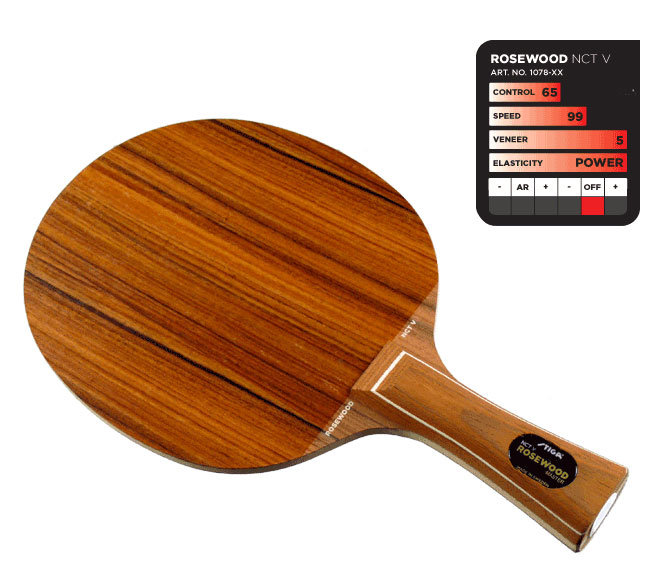
The Stiga Rosewood NCT V is one of the most celebrated all-wood offensive blades in modern table tennis. Built around hand-picked rosewood outer plies and finished with Stiga’s NCT (Nano Composite Technology) surface process, it reaches a speed and hardness you rarely see from a 5-ply pure wood. Xu Xin, one of the world’s top penhold attackers, competed with this blade paired with Boost TX rubber, and that sealed its name as a high-performance all-wood weapon. It is discontinued now, but it stays the benchmark that newer all-wood OFF blades get measured against.
Performance
Two things carry this blade: an elite short game and flat-hit speed that catches people off guard. In the short game it lets you take the ball with a passive, relaxed wrist and drop it back soft and close to the net, even off a powerful incoming loop. Reviewers keep noting how easily they surprised opponents with delicate touch on what is, on paper, an offensive setup. That passive touch is unusual at OFF speeds and makes the Rosewood NCT V a weapon for receive-of-serve and short push exchanges.
Flat drives and smashes flip a switch. Tighten the wrist and arm and the rosewood outer plies crack out a sharp pop that reviewers stack right next to carbon blades. Drive speed really is carbon-class. Flicks stand out the most, faster than a lot of composite blades, and that pairing of short-game control with flick explosiveness becomes a tactical edge.
Looping takes discipline. A loose wrist and tangential brushing contact gives you heavy spin and a clean flight arc. Add even a little wrist tension and the stroke turns into a flat smash that sails long. Players coming off carbon or forgiving mid-range all-wood blades need time to adjust, and the higher throw at hard impact means closing the racket angle on purpose.
Counterattack and counterspin are well covered. Press down onto topspin and you get a hard, controlled counterattack pop. Revspin community ratings put numbers on it: 8.9 for speed, 8.9 for control, 5.8 for stiffness, 6.7 for hardness, and a rare 10.0 for consistency, a score that captures how reliably the blade repeats itself across different shots.
What Reviewers Agree (and Disagree) On
Reviewers agree on the strengths: a standout short game and flat-hit speed that is high for an all-wood blade. The passive-touch receive game and the explosive flat drives draw praise everywhere, and there is consensus that looping demands precise technique, with mistakes flying long. Where opinions split is how approachable the blade feels. Some intermediate players clicked with it after a short adjustment; others fought the hard, stiff feel to keep it under control. Grip style is the other divide. One detailed review pegged the blade as ideal for penhold players, whose fingers sit centrally on the paddle and pull the most feel out of it, while shakehand users reported less feedback coming through the handle.
Who Should Buy It
The Rosewood NCT V suits intermediate and advanced offensive players who want pure-wood feel at near-carbon speeds. If your game leans on a top short game, aggressive flat hitting, and explosive flicks, this blade pays off. It is a natural fit for penhold players, especially Chinese penhold with heavy close-to-table attack, and worth a look for shakehand players built around counter-hitting and short exchanges. Beginners should skip it. The hard, communicative feel punishes weak technique, unless a coach is steering the development. Rubber pairing matters a lot here: reviewers keep recommending medium-tension spinny rubbers like Rakza 7, Omega IV Euro, Sigma II Euro, and DHS Hurricane 3 to balance the blade’s speed and hardness.
FAQ
Is the Stiga Rosewood NCT V a carbon blade?
No. The Rosewood NCT V is a pure 5-ply all-wood blade. The NCT (Nano Composite Technology) name refers to a surface treatment on the outer plies that adds some stiffness, but there are no carbon or composite layers inside. The construction is fully all-wood.
What rubbers pair best with the Rosewood NCT V?
Medium-tension spinny rubbers balance the blade’s natural speed best. Common pairings include Rakza 7 on both sides, Omega IV Euro, Sigma II Euro, DHS Hurricane 3, and Calibra LT Spin. Stay away from very fast tensors, where the combination runs away from you.
Did Xu Xin actually use this blade?
Yes. Xu Xin is documented using the Stiga Rosewood NCT V with Boost TX rubber at the professional level. Backing from one of the world’s top penhold players is a big part of why the blade carries the reputation it does.
Is the Rosewood NCT V still available to buy?
Stiga discontinued the blade, and major retailers like Megaspin no longer carry it. You can still turn it up on secondary markets, used-equipment boards, and the odd smaller specialty shop with leftover stock.
How does the Rosewood NCT V compare to the Stiga Intensity NCT?
The Rosewood NCT V has more dwell time and a softer, more forgiving feel than the Intensity NCT, which plays stiffer and more demanding. The Rosewood is faster in flat hitting and gives back clearer feedback, so it rewards technique more openly.
Is this blade suitable for beginners?
Not really. The hard, stiff feel punishes weak technique and needs a developed stroke to control. Intermediate players stepping up to offensive equipment get more out of it, though expect a short adjustment period.
Sourced From
This review synthesizes opinions from 3 independent community sources:
- Revspin (forum)
- TableTennisDaily (forum)
- Reddit (forum)