Butterfly Innerforce ZLC Review: Woody Feel Meets ZLC Carbon Speed
Pros
- Inner ZLC construction gives a distinctive woody feel rare in carbon blades
- Outstanding balance of speed, spin, and control for an OFF-class blade
- Works well at all ranges from short-game touch to mid-distance looping
- Large sweet spot improves consistency across stroke types
- Pairs well with a wide range of rubbers including Tenergy and Rakza
- Low vibration and high dwell time reward spin-focused technique
Cons
- Discontinued; buying new is difficult and prices can be elevated
- Moderate speed for a ZLC blade — players in fast baseline exchanges may be outpowered
- Premium price when it was in production; resale prices remain high
- Requires solid technique to unlock its full potential
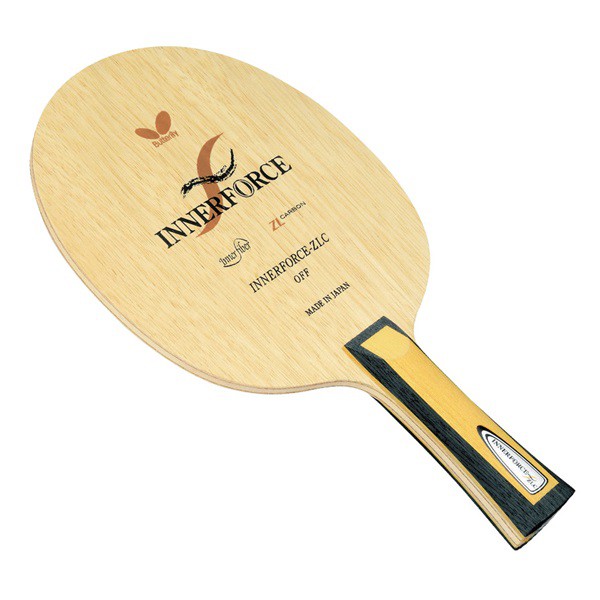
This is the original Innerforce ZLC, the blade that started the family before the Layer ZLC and the Harimoto and Franziska signature versions arrived. The whole design hinges on one decision: Butterfly buried the ZLC (ZL Carbon) plies near the center of the five-wood-ply build instead of mounting them under the outer surface, an approach it later branded Innerfiber in the successor models. Play it blind and you would swear it was a premium all-wood racket, yet the pace and spin ceiling that ZLC unlocks are still there when you swing through. Butterfly retired it once the Layer series landed, and the players who own one now treat it as one of the best blades the company ever built.
Performance
You feel the inner carbon on the first ball. Short pushes, flicks, and blocks come back soft and tactile, the way a seven-ply all-wood blade reports to your hand rather than a stiff outer-carbon setup. The ball sits on the surface a fraction longer than most carbon blades allow, and that extra beat is enough to load rotation before it leaves the rubber. Every major review source lands on this dwell as the blade’s best trait.
Topspin from close to mid-table is where it does its best work. Open up against backspin and the ball climbs in a high arc loaded with spin; counter-topspins stay controlled and repeat well. Bolt on Tenergy 05 or Rakza 7 and the spin gets heavy enough that opponents misread it. Speed sits firmly in the OFF class. That is fast enough to punish a weak return outright, but not so explosive that the ball flies long before you have finished brushing it.
The baseline is where its one real weakness shows. In fast, flat exchanges against players on stiffer ALC or outer-carbon blades, the Innerforce ZLC runs a touch short on power. The same inner carbon placement that gives you all that dwell costs you some direct speed against an equivalent outer-carbon build. Flat hitters more than loopers will notice it, getting outpaced now and then in long baseline rallies.
Blocking is a clear strength. The moderate stiffness and the touch let you redirect incoming pace to a spot rather than just back over the net. Serving leans on the same control-first feel, and reviewers find short serves and heavy backspin serves land where intended time after time. The sweet spot runs large enough that an off-center hit still comes back usable, which keeps the unforced errors down when a rally turns ugly.
What Reviewers Agree (and Disagree) On
Revspin, TableTennis-Reference, TableTennisSpot, and Reddit all land in the same place: the Innerforce ZLC is one of the most balanced, feel-rich ZLC blades ever made. Almost everyone praises the woody dwell, the spin, and how it handles whatever situation you throw at it. The argument is about speed. Some reviewers call it fast enough for offensive play; others, mostly the ones who have since switched to the Viscaria, Innerforce ALC, or newer Layer ZLC, think it leaves you exposed in high-speed baseline exchanges. The split tracks playing style. Loopers and spin players keep rating it near 9 or 10 out of 10, while flat, high-speed attackers score it lower. Price comes up everywhere as a barrier, and being discontinued adds a scarcity premium that pushes resale prices up.
Who Should Buy It
This is a blade for advanced attackers who put feel, spin, and all-around control ahead of top speed. Aggressive loopers who play close to mid-distance, lean on dwell to load heavy topspin, and want one blade that handles both the short game and a long rally will get the most from it. It also suits players moving up from a good all-wood blade who want carbon-level power without the harsh, bouncy slap of a traditional outer-carbon build. Beginners and lower-intermediate players should pass: the refinement is lost without solid technique, and you cannot justify the price this early in your development.
FAQ
What is the difference between the Butterfly Innerforce ZLC and the Innerforce Layer ZLC?
The original Innerforce ZLC was Butterfly’s first blade to put ZLC carbon fiber near the core. The Layer ZLC came later and reworks the same inner-carbon idea with a different wood veneer mix and Butterfly’s formal Innerfiber branding. It also runs seven plies against the original’s five-wood-plus-two-ZLC structure. The feel is similar on both, but the Layer ZLC is the model you can still buy new; the original is discontinued.
Is the Innerforce ZLC suitable for beginners?
No. Reviewers across the platforms describe it as a blade for advanced players with solid stroke mechanics. A beginner cannot get at its feel or speed, and the price makes it poor value at entry level. Start on a slower all-wood blade instead.
What rubbers pair best with the Innerforce ZLC?
Tenergy 05 and Tenergy 80 FX come up most often, and both match the blade’s soft, control-first feel. Rakza 7 is the other regular pick for players who want medium-hard sponge. Medium-hard tensors in the 42 to 47 degree range work, letting the inner ZLC build show its natural dwell.
How fast is the Innerforce ZLC compared to other Butterfly carbon blades?
It sits in the OFF class, above ALL+ blades but below the fastest outer-carbon designs like the Timo Boll ALC or Viscaria. Community speed ratings average around 6.9 to 7 out of 10, on the moderate side for a ZLC blade. The inner carbon placement is built for feel and control, not maximum output.
Can the Innerforce ZLC be used at mid-distance as well as close to the table?
Yes. Several reviewers call out that it holds up in both positions. The OFF-class speed gives you enough to loop from mid-distance, and the dwell plus the big sweet spot make close-table touch and blocking comfortable. Handling both ranges is one of the things reviewers praise most.
Where can I buy the Innerforce ZLC since it is discontinued?
It is out of production, so you are buying from secondary markets: eBay, specialty table tennis shops still holding inventory, or secondhand equipment forums. Price moves with condition and handle type. If you want something current, the Innerforce Layer ZLC is the closest match and sells widely at the major retailers.
Sourced From
This review synthesizes opinions from 4 independent community sources:
- Revspin (forum)
- TableTennis-Reference (forum)
- TableTennisSpot (forum)
- Reddit r/tabletennis (forum)