Sanwei Nova Carbon Blade Review: Budget Hinoki-Carbon for Attacking Players
Pros
- Real Hinoki outer plies and carbon fiber at a budget price
- Direct, linear feel rewards decisive attacking strokes
- Good blocking control with authoritative returns
- Well-finished build quality for its price bracket
- Kiri core adds stability and reliable feedback
Cons
- Speed falls below premium carbon blades at closer price gaps
- High stiffness reduces dwell time and punishes brushy spin technique
- Noticeable weight variation between production units
- Not suitable for heavy loop-dominant or close-table touch styles
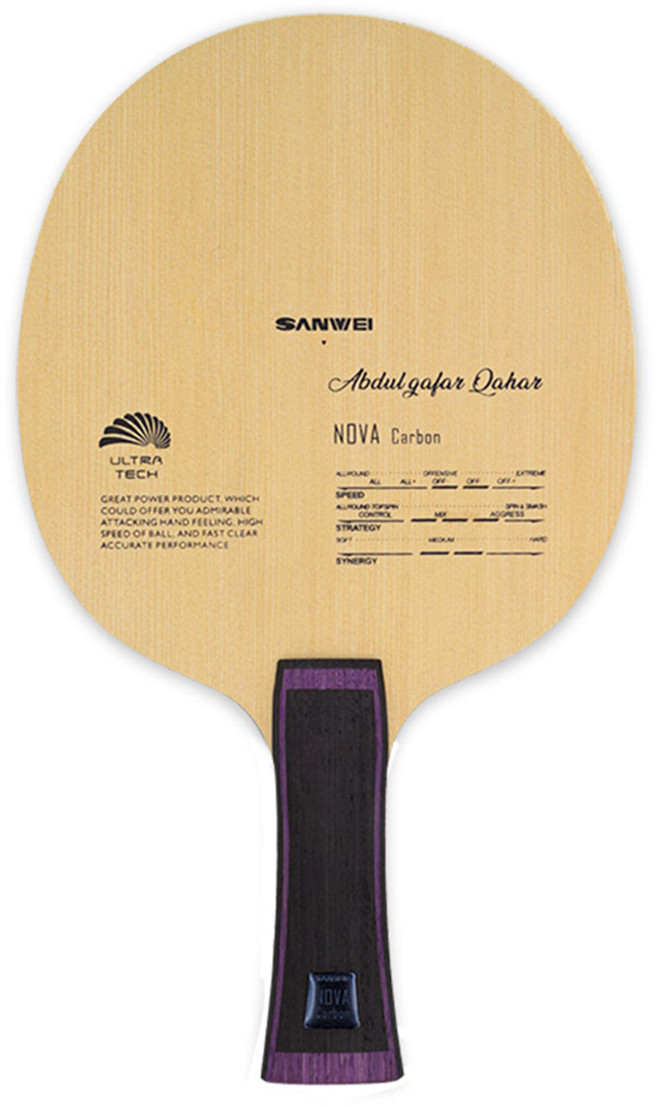
The Sanwei Nova Carbon is one of the cheapest real Hinoki-carbon blades you can buy, priced in the $50-60 range. It’s a 5-ply build, Hinoki outer plies, Nova Carbon fiber layers, and a Kiri wood core, 6.2mm thick and nominally around 90g. The target is attacking players who want carbon speed at a price usually reserved for all-wood blades.
Performance
On the table the Nova Carbon does what the build promises: direct, linear speed with a stiff, immediate feel. David Bruce of Racket Insight gave it 4.2 out of 5, noting the carbon layers add useful acceleration without overdoing it, and that the Hinoki outer plies soak up incoming power, so the blade stays grounded through blocking exchanges. Close-to-table control is a relative strength, and it returns hard-driven balls with authority on the block.
Spin is where it gives ground. The high stiffness and short dwell make it unforgiving for loop-dominant players who brush the ball to make topspin. TableTennisDaily reviewers warned outright that it’s wrong for a game built on heavy spin loops or delicate close-table touch. The straight 3-plus-2 ply power expression wants clean, decisive strikes, not glancing contact. Speed is rated OFF, and while it competes among budget carbon blades, it doesn’t reach the pace of premium Butterfly or DHS options. Vibration runs high in Revspin community scores; some players read that as useful feedback, others find it tiring. Weight inconsistency is the practical catch several reviewers flag: one test unit showed up at 84g against the advertised 90g plus or minus 5g, so two buyers can get blades that feel quite different in hand.
What Reviewers Agree (and Disagree) On
Reviewers agree the Nova Carbon is real value for the money and that the Hinoki-carbon build is the real thing, not a marketing label. Racket Insight, Revspin, and TableTennisDaily all describe the same directness and stiffness. They part ways on who it’s for. Some frame it as a stepping stone for intermediates coming up from all-wood; others see it as a niche tool for players who already have clean mechanics and want unfiltered power transfer.
Who Should Buy It
The Nova Carbon is best for intermediate offensive players with around 2-3 or more years in who attack from mid-distance. Heavy loopers and soft-touch close-table players should look elsewhere. It makes the most sense for budget-minded players who want to try Hinoki-carbon construction without paying flagship money for it.
FAQ
What is the Sanwei Nova Carbon’s ply construction?
A 5-ply blade: Hinoki outer plies on both faces, Nova Carbon fiber layers beneath them, and a Kiri wood core in the center.
What speed class is the Nova Carbon rated?
Rated OFF, for offensive players who attack from close to mid distance.
Is the Nova Carbon good for looping and spin play?
No. The stiff, linear build cuts dwell and works against heavy topspin technique. It rewards clean, decisive strikes, not brush-heavy loop strokes.
How much does the Nova Carbon weigh?
Advertised at around 90g, but production varies and some units come in lighter. Be ready for a blade in the mid-80g range.
What rubbers pair well with the Nova Carbon?
Forum users go with medium-hard or boosted rubbers to offset the blade’s directness and put spin back into the setup. Softer rubbers bring back some dwell.
How does the Nova Carbon compare to premium carbon blades?
It’s slower than premium options like the Butterfly Primorac Carbon, and cheaper. It fits players who want a Hinoki-carbon feel at a fraction of the cost and can live with the trade-offs in outright speed and consistency.
Sourced From
This review synthesizes opinions from 3 independent community sources:
- Racket Insight (forum)
- Revspin (forum)
- TableTennisDaily Forum (forum)