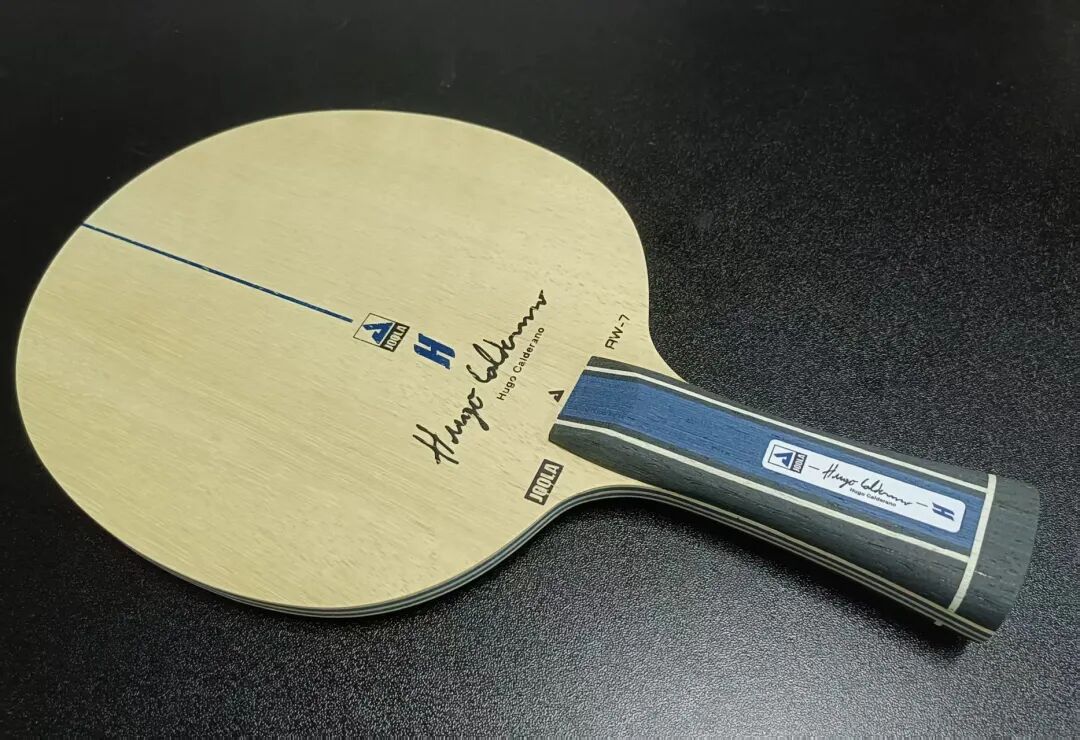
JOOLA Hugo Calderano AW-7 Review: A Controlled Seven-Ply Wood Blade
Pros
- Seven-ply wood construction gives a clear, controlled response
- Good touch on pushes and confident moderate-power looping in the field report
- Reported to work with both grippy and tacky rubber pairings
- A less demanding route into offensive seven-ply blades
Cons
- Less top-end power than a faster carbon blade or a more forceful seven-ply wood blade
- Sample weight and thickness are not universal specifications
- Players seeking the crispest, fastest response may find it too restrained
A wood blade with a clear job
JOOLA identifies the Hugo Calderano AW-7 as a seven-ply all-wood blade using limba and ayous layers. Its pitch is controlled offensive play built around touch and spin, rather than the abrupt response of an outer-carbon blade. The August field report from Heima Liao Pingpang and Table Tennis Berlin’s filmed playtest both point toward that use case. The 8.2/10 score is our editorial assessment of the blade’s fit and trade-offs, not a laboratory measurement.
Construction and feel
One AW-7 sample in the field report weighed 89.1 g, measured about 6.8 mm thick, and had a head near 157 × 152 mm. These are sample measurements, not factory promises. The tester described a comfortable handle, a sensible balance and a smooth outer veneer that resisted splintering during that short test. Durability over many rubber changes remains unproven.
Seven plies can suggest a hard, blunt blade, but that was not the impression here. The report found a clear ball contact and a fairly large usable striking area, with enough give to shape a topspin. JOOLA’s stated limba-and-ayous construction is consistent with the more measured, contact-oriented feel, although wood selection and individual blade weight can change the experience.
At the table
In the field report, short pushes and touch shots were manageable, while a moderate forehand swing produced useful speed without requiring an all-out effort. The tester paired it first with older Tenergy 05 and Tenergy 80 sheets, then tried a tacky forehand rubber; all three were reported as workable pairings. This shows some flexibility, but it does not prove every rubber combination will feel equally balanced.
The limitation appears when a player asks for maximum power. The same tester judged its top end below a more forceful Stiga Clipper Wood. That comparison came from one player’s setup, so it is best used as a direction, not a speed measurement. Table Tennis Berlin’s filmed test separately emphasizes secure passive play and spin-oriented strokes, which fits the blade’s broader profile.
Who should buy it
The AW-7 makes sense for an attacker who wants seven-ply stability but still wants to feel the ball and place a loop. It also suits a player learning a more complete offensive game, provided the rubber pairing does not make the whole racket too heavy. An established power player who depends on a sharp carbon rebound should compare faster blades before choosing it.
FAQ
Is the AW-7 a carbon blade?
No. JOOLA specifies seven wood plies and no carbon layer.
Is it suitable for a developing player?
It can be, particularly for someone already comfortable with custom equipment and ready for a controlled offensive blade. The field report found useful pace at moderate effort, but the total racket weight still depends on the chosen rubbers.
Will every AW-7 weigh 89.1 g?
No. That was one measured sample. Check an individual blade’s weight if a light setup is important to you.