How to Use Semi-Tacky Forehand Rubbers at the London Worlds (Part 1)
1 — Dignics 09c (Key Player: Matsushima Sora)
If you had to pick one semi-tacky rubber as the number-one choice, D09c is almost certainly it. But is it objectively the best-performing rubber on the market? That’s harder to say. What it is, is thoroughly well-rounded.
It suits both looping and flat-hitting. The topsheet has excellent grip, the sponge isn’t especially dense but delivers adequate power depth, and the balance between speed and spin is solid. Beyond pure performance, D09c’s claim to the top spot in most players’ minds comes largely from being one of the earlier semi-tacky options on the market (though not the earliest), and from carrying the Butterfly brand name.
That said, its absolute power depth isn’t exceptional. When players are looking for a no-boost alternative to Hurricane 3, many still gravitate toward Chinese rubbers rather than D09c — because they’re used to the dense, solid feel of Chinese high-density tacky rubbers, and the ability to “brush” backspin balls with a high-tack surface. That grip difference shows up when countering half-out backspin: Chinese tacky rubbers let you loop it freely, while D09c requires more of an upward “lifting” motion.
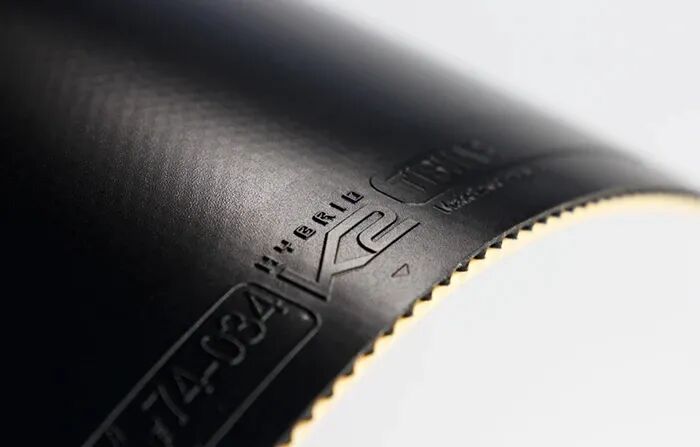
2 — K2 (Key Player: Darko Jorgic)
Unlike most semi-tacky rubbers, Tibhar K2 is actually closer to “high-tack.” Being high-tack makes it well-suited to the penhold style that older amateur players use — short game control plus push-attack — and its low price and ease of use have made it popular among recreational players.
The general perception: it’s a straightforward rubber, gets the ball on the table easily, produces a consistent arc, isn’t particularly fast, and isn’t particularly powerful. But because it’s so consistent and predictable, even aggressive players like Jorgic can extract workable ball quality from it (adding boosting would raise that quality further).
That said, if you want a forehand rubber that generates quality on its own without requiring big swings, K2 is not the right choice. It’s too middle-of-the-road — even a touch bland. It doesn’t have guile, and it doesn’t bite.
3 — Blue Star A1 (Key Player: Qiu Dang)
Among Donic-sponsored players, Asian players historically tended toward Grubber C2 while Europeans leaned toward Blue Star A1. If you want a semi-tacky forehand rubber with a denser sponge than D09c but more control than K2 Pro or Huangchao ZRG, A1 is worth considering.
The sponge is very firm, and thin-friction strokes still generate decent output — which makes it a kind of energy-type substitute for Hurricane. The downside: compared to several other semi-tacky rubbers, it’s on the slower side. The general recommendation is to pair it with a faster outer carbon blade to compensate for speed and make it easier to punch through.
4 — Grubber C2 (Key Player: Lind)
Lind’s professional version differs from the retail version in feel. Still, the retail C2 is popular among amateur players — it has a very low barrier to entry, lower than Blue Star A1. With this semi-tacky forehand rubber, you can freely choose between looping for speed or looping for spin.
Many players describe it as a softer, friendlier version of D09c. In plain terms: it’s cheaper and a bit softer. The rubber and sponge integrate well together.
The downside is still speed: where A1’s slowness comes from a dense sponge that’s hard to punch through, C2’s slowness comes from the rubber being somewhat mushy. So C2 is still best paired with a stiffer or springier blade when used on the forehand.