Equipment Breakdowns for a Few Under-the-Radar Pro Players
Images sourced from external sites; credit information is shown within each image.
1. Chen Haohua — Gold-Label Viscaria, Blue NEO Hurricane, D09c
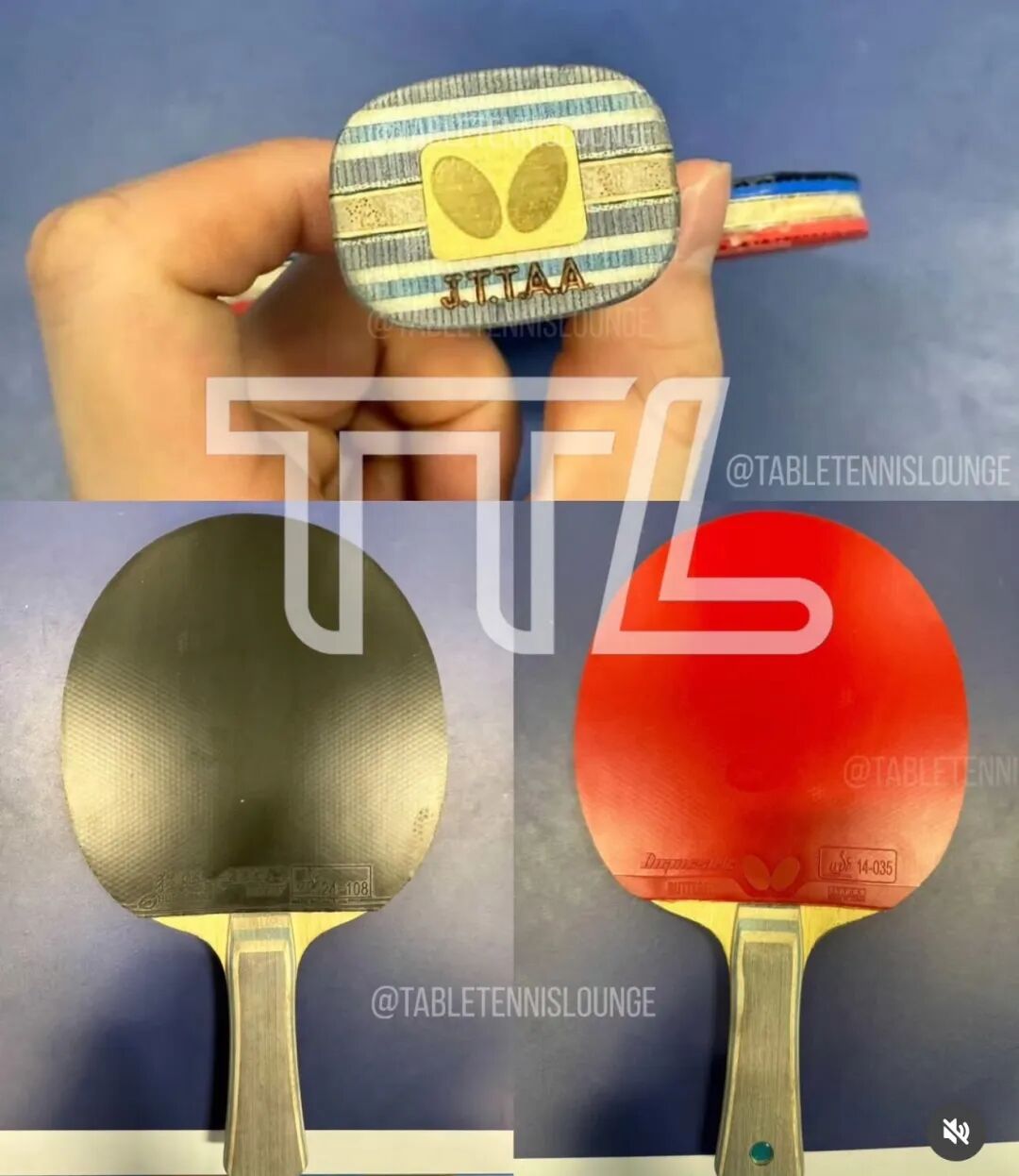
He plays for the Hong Kong team. This setup is very mainstream and nothing out of the ordinary. The Gold-Label Viscaria is a special edition that the China subsidiary requested from headquarters, sold exclusively on the mainland. Its reputation is decent.
Our perception of equipment tends to shift over time — partly because products change between production runs, and partly because we find better ways to use them. The Gold-Label Viscaria is a good example. When the first batch hit the market, the general consensus was that it felt soft and plush, with noticeably more dwell than the retail Viscaria. A lot of people complained it was too soft — almost no drive at all. But that view gradually softened. For one thing, once players realized they had a soft blade, many moved to harder rubbers to compensate. For another, later production runs of the Gold-Label Viscaria actually gained a bit more firmness and support.
D09c follows a similar arc. When it first came out on the forehand, players felt the raw power clearly lagged behind Hurricane 3 — not by a small margin. Over time, people figured out how to play with it: stay closer to the table, score with a combination of spin and speed rather than raw drive. Plus, if you’re putting it on the forehand, go with a stiffer, more springy blade.
This whole process is also one of players being gradually shaped by their equipment. How do I mean that? I was used to inner carbon blades, always relying on dwell to loop heavy, high-arc balls with lots of spin. When I switched to Viscaria, I couldn’t loop as heavy at first. But after adapting for a while, my stroke naturally adjusted on its own, and I was generating high spin again.
2. Wang Yang — Outer ALC Special Order, Z03, SPINPIPS D1 pimples
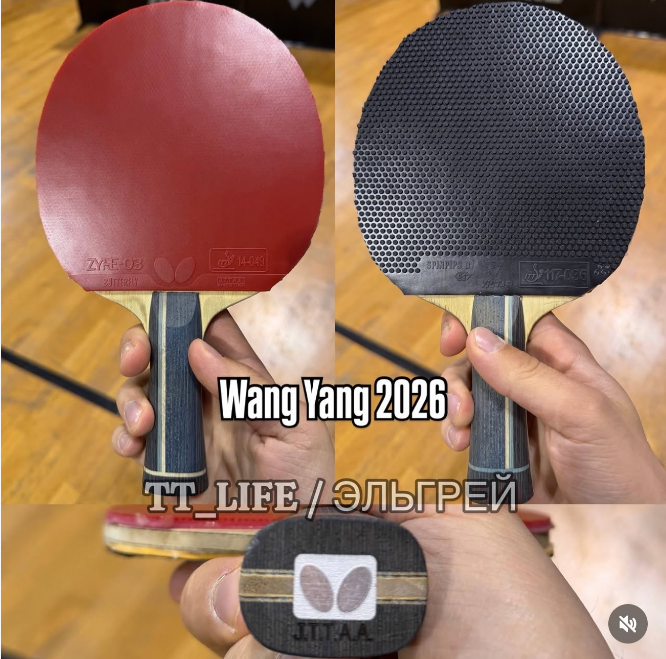
I’ve mentioned this before. Although the handle features Zhang Ben ALC’s decorative grain, beneath that grain is actually an outer ALC special order blade (similar in construction to the Viscaria). The blade’s origin I’ll leave aside.
What I want to focus on today is this: as a stylish chop-attack player, Wang Yang previously used T05 Hard on the forehand — a very powerful rubber. Now he’s followed the trend and switched to Z03. Next time there’s a match with him, I’ll pay close attention to see if there’s any observable change in shot quality.
Compared to T05 Hard’s weighty, forceful feel, Z03 should play more easily, though with less raw power. But just as I mentioned above, players get shaped by their equipment. Maybe over time his game evolves into scoring more through speed and penetration than through sheer power.
As for the pimple rubber on the backhand side for chopping, Victas pimples have always been reliable and consistent for chopping, and are relatively easy to produce spin variation with.
Nagasaki Miyu has also recently followed the trend, switching from D05 to Z03 on the backhand. The only reason I’m tossing her in here is that her side profile is really nice.
3. Lilian Bardet — Inspira Hybrid Carbon, both sides DNA Hybrid
Christina Kallberg — Inspira Hybrid Carbon, DNA Dragon, DNA Platinum
Looking back now, Stiga’s DNA rubber series has been a genuine success story. Performance is one part of it; the other is that by working through ESN as the manufacturer, they solved their own long-standing pain point.
Bardet beat Liang Jingkun 3-2 at last year’s US Open Grand Smashes. He was using two-sided DNA then as well, but on a Fan Zhendong ALC blade. Honestly, these outer carbon blades — once you’re at a certain level and you’ve adapted to them — won’t hold back your game. Whether it’s Fan A, Inspira Hybrid Carbon, or the Hema Yazhi ALC, the more I play with them the more I feel: grip comfort in the hand matters, and for outer carbon, as long as the dwell and clarity meet your needs, the power comes from you. You can generate it yourself.
I personally liked the Inspira Hybrid Carbon quite a bit at the time — the surface has a slightly grabby quality, but the dwell is solid and shot quality is respectable. My reason for moving on was that the handle was just a bit too thin for me, which made my forehand-backhand transitions feel insecure. If your hands are smaller, it would actually suit you well.
The new Luma Hybrid Carbon uses a handle similar to the Viscaria (same as the Hema Yazhi series), which feels very comfortable in my grip. Even at 93.5g, it doesn’t feel heavy at all.