Xiom Stradivarius Blade Review: The Budget Viscaria That Delivers
Pros
- Excellent topspin and looping performance thanks to Aramid Carbon construction
- Very low residual vibration gives clean, direct ball contact feel
- Competes with Butterfly ALC blades at a fraction of the price
- Generous sweet spot and good consistency for offensive play
- Performs at OFF+ close to the table and solid OFF at mid distance
- Pairs well with a wide range of rubber types and stiffnesses
Cons
- Stiff carbon feel may not suit players who prefer softer, more flexible feedback
- Speed drops off noticeably at longer distances
- Can produce flatter trajectories at very high swing speeds
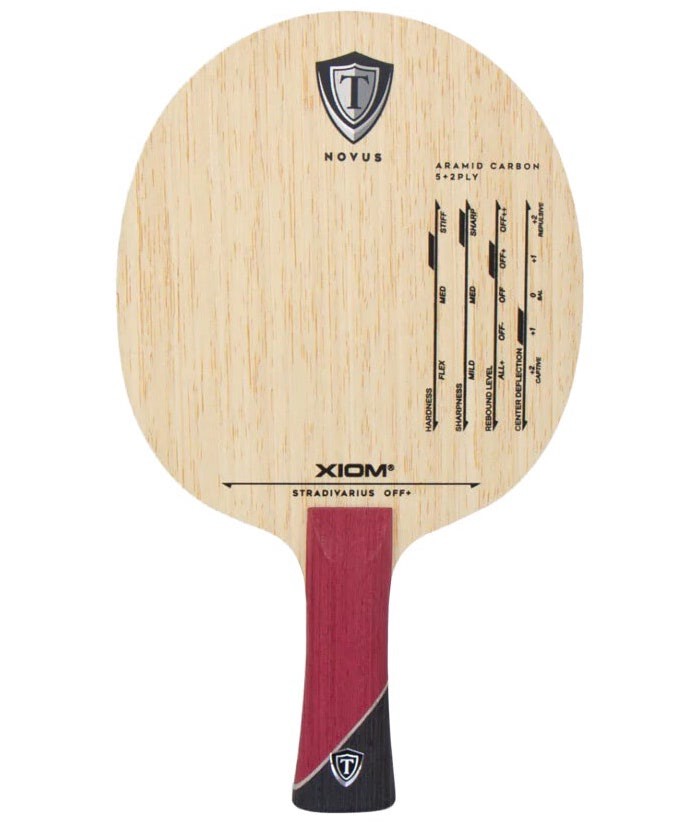
The Stradivarius has been one of Xiom’s bestselling blades for over a decade, and the reason is straightforward. Its Aramid Carbon (arylate carbon) composite construction targets the big slice of offensive players who want a carbon blade’s crisp speed and spin without losing the ball feel that keeps loops consistent. Community reviewers slot it into the same bracket as Butterfly ALC blades like the Timo Boll Spirit, at roughly half the price. The 2019 Novus refresh updated the looks and tuned the construction while keeping the character that made the original a name.
Performance
Close-to-table and mid-distance topspin exchanges are where the Stradivarius does its best work. The Aramid Carbon layers damp residual vibration well, so impact reads direct without the harsh buzz of stiffer carbon blades. You feel the ball clearly. That shows up in looping you can trust: receiving high-spin serves, transition loops from mid-table, and steady third-ball attacks.
On speed, independent community sources land on solidly OFF, with individual pieces touching OFF+ depending on production variance and weight (heavier examples around 90-92g play a step faster). At 5.7mm thick and around 85-87g, it sits in the heart of the premium offensive segment. The 157mm x 150mm head gives a large sweet spot that forgives off-center hits.
Spin comes up again and again in reviews. The arylate carbon composite catches the ball deeply with enough dwell, then releases it with high rotation, which sharpens loop-to-loop exchanges and heavy-spin serves. Blocking earns praise too: the stiff-but-damped build makes redirecting fast incoming balls straightforward.
Medium-to-hard inverted rubbers get the most out of it. Community members keep pointing to Xiom Vega Pro, Vega Asia, the Yasaka Rakza series, and similar grippy tensors. Very soft sponge makes the setup feel sluggish; very hard rubbers push the stiff feel further than most players want.
Distance is the one real limit. Pull back to mid or long range and the blade goes underpowered, so you swing harder to make pace and consistency suffers. Close-to-table loopers and modern short-to-mid-distance attackers get the most out of it.
What Reviewers Agree (and Disagree) On
Across Revspin, Reddit, TableTennisDaily, and retailer reviews, the consensus is firm: an excellent looping blade with standout value. The Viscaria and ALC comparison shows up across independent sources, with most estimates putting it at 80-85% of Viscaria performance for under half the price. Feel draws some dissent. A minority find it too stiff with not enough tactile feedback, while the majority count the low-vibration direct contact as a plus. Speed gets a mild debate too: most settle on OFF at mid distance, with close-table play nudging it toward OFF+. No major voice argues against the value, and long-term owners keep coming back to it after trying other blades.
Who Should Buy It
Buy the Stradivarius if you’re an intermediate to advanced attacker who loops mostly from close to mid distance and want to move up from an all-wood blade or a slower composite. It gives carbon’s speed and spin without trading away the feel and control that keep play consistent. On a budget, a player eyeing a Butterfly Viscaria or Timo Boll Spirit should give this one a hard look as a real alternative. Skip it if you’re a beginner who hasn’t built consistent looping mechanics yet, or if you prefer a very soft or highly flexible blade.
FAQ
Is the Xiom Stradivarius similar to the Butterfly Viscaria?
Yes. Reviewers describe it as a near-Viscaria alternative at a much lower price, estimating 80-85% of Viscaria performance. Both use arylate carbon construction and target close-to-mid-distance attackers. The Stradivarius runs slightly slower and a touch softer, which many players prefer for consistency.
What is the official speed class and how does it play?
Xiom rates it OFF+/OFF with a speed score of 90 and control of 82. In practice, reviewers call it solidly OFF at mid-distance and closer to OFF+ right at the table. It isn’t the fastest carbon blade out there, but the speed-and-control balance gets wide praise.
What rubbers pair best with the Stradivarius?
Medium to medium-hard inverted tensors pair best. Community picks include Xiom Vega Pro, Vega Asia, Omega VII Asia, Yasaka Rakza Z, and Nittaku Fastarc G1. Very soft rubbers leave the setup feeling slow; very hard ones lean into the stiff carbon character too much.
How much does the Stradivarius weigh and what handle options are available?
The standard weight is around 85-87g, with individual pieces running between roughly 83g and 92g. Heavier ones play faster. The current Novus version comes in Flared (FL) and Straight (ST) handle shapes.
Is the Xiom Stradivarius good for players transitioning from an all-wood blade?
Yes. It’s one of the most recommended first arylate-carbon blades for that move. Reddit users who came off all-wood blades reported steadier loops and better power efficiency without the jarring speed jump of faster carbon. The balanced OFF speed class keeps it accessible while still adding clear spin potential.
Sourced From
This review synthesizes opinions from 4 independent community sources:
- Revspin (forum)
- Reddit (forum)
- SmashTableTennis (ecommerce)
- TableTennisDaily (forum)