Stiga DNA Pro M Review: The Most Versatile of the DNA Pro Series
Pros
- Workable balance of speed and spin for a 47.5-degree sponge
- Forgiving medium-high arc reduces net errors
- Very grippy topsheet generates strong spin with modest effort
- Strong close-to-table control despite high speed
- Holds up on both forehand and backhand
- Less shrinkage than many comparable ESN rubbers
Cons
- Easy to over-brush and send the ball long if technique is off
- Tackiness fades faster than competitors
- Durability averages only four to five months under regular training
- Now discontinued - stock is limited
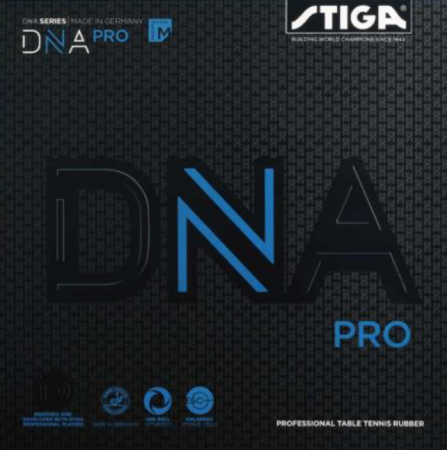
The Stiga DNA Pro M arrived in late 2019 as part of Stiga’s first ESN-produced lineup, the product of roughly two years of work with the factory. It marked a break from Stiga’s earlier Japanese-made rubbers and aimed at the tier held by Tenergy and premium European tensors. The M sits at 47.5 degrees ESN, between the softer S at 42.5 and the harder H at 50, and most users land on it as the sweet spot of the series. Enlarged sponge cells boost the catapult, the topsheet is translucent and grippy, and the orange sponge is tuned for the ABS plastic ball. The pitch was clear: German reliability with Stiga’s own feel, for competitive players.
Performance
The DNA Pro M pays off when you sink the ball into the sponge rather than skim the surface. Drive through it and the enlarged cells spring back with a lively catapult, sending out fast, arced shots without much physical effort. The throw is medium-high, putting the ball about 4 inches above the net on forehand drives — lower than the H but still forgiving enough to clear the net on aggressive strokes. Underspin is where it gets demanding. Brush it without engaging the sponge and the ball sails over the table. Blocking is a real strength: the soft grippy topsheet eats incoming pace and sends it back where you point it. The short game and close-table exchanges lean on the high control rating, and Chiquita flicks and counter-topspin come off the elastic topsheet without a fight.
On speed, the community puts it just below the Joola Rhyzer 48 and a step above the Rasanter V47 — fast by any measure, still manageable. Plenty of players say it feels softer than its 47.5-degree ESN rating, some pegging the real feel closer to 39 degrees on the Chinese scale. That keeps it comfortable across long practice sessions and easy on technique without capping top-end output. Loop drives at mid-distance kick out with a sharp, uniform second bounce instead of the extra forward jump the harder H gives, which some players prefer for keeping rallies consistent.
What Reviewers Agree (and Disagree) On
Most reviewers land the M on the backhand or as a both-sides rubber for all-round attackers, and send aggressive forehand loopers who can fully load a harder sponge toward the H. Near-table control draws praise across the board, and people note it covers a wide range of skill levels. Forehand power is the fault line: some advanced players found it short on punch up front and switched to the H, while intermediates called it more than enough. Durability splits too. A few report the tacky-ish topsheet fading within weeks; others got four to five months of playable life out of it. The recurring gripe is sheet-to-sheet weight, said to vary by as much as 10 grams uncut, which matters if you’re particular about setup balance.
Who Should Buy It
This is a club-and-competitive rubber for intermediate to advanced players who want a rounded ESN tensor without the demands of the harder stuff. Coming off Chinese rubbers, you’ll like the livelier catapult and still keep it under control. It does its best work as a backhand rubber on a medium-fast all-round blade, or as a both-sides setup for players who put consistency and spin ahead of raw pace. If you need maximum forehand power, step up to the DNA Pro H or its successors in the DNA Platinum and DNA Hybrid lines. One caveat for buyers: it has been discontinued.
FAQ
How does the Stiga DNA Pro M compare to Tenergy 05?
Most users put its arc and spin in the same territory as Tenergy 05, with a bit more control and a touch less speed and spin on top. It’s easier to handle for sub-professional players and costs less, which is why people reach for it as an alternative.
Is the DNA Pro M better on forehand or backhand?
Most reviewers settle the M on the backhand and hand the forehand to the H, whose harder sponge pays off more at full swing. Plenty of players still run the M on both sides and do well with it.
What is the sponge hardness in Chinese scale equivalent?
The 47.5-degree ESN rating works out to roughly 39 degrees on the Chinese scale. Users keep reporting that it plays softer than the ESN number on the package implies.
Is the Stiga DNA Pro M discontinued?
Yes, Stiga has discontinued it. The DNA Platinum M and DNA Hybrid M are its successors, with updated performance and a similar overall balance.
How long does the DNA Pro M last?
Under regular training, most users get four to five months of quality play before the topsheet grip drops off. Some find the tackiness fades faster than rivals in the same category.
Sourced From
This review synthesizes opinions from 3 independent community sources:
- Revspin (forum)
- TableTennisDaily (forum)
- Reddit (forum)