JOOLA Dynaryz ACC Review: Balanced Speed and Control for Competitive Players
Pros
- Spin production nearly matches Tenergy 64 at a lower price
- OFF+ speed with surprisingly forgiving control feel
- Excellent for both FH and BH use
- Strong catapult effect helps topspin loops dip consistently
- Performs well on delicate short game shots despite high speed
- Purple HyperBounce sponge at 47.5 degrees suits a wide range of playing styles
Cons
- Blocking is more difficult — ball pops up more than softer rubbers
- Throw angle can decrease after 3+ months, requiring reboosting
- Passive play style underperforms — needs active strokes
- Short game pushing harder to control than softer alternatives
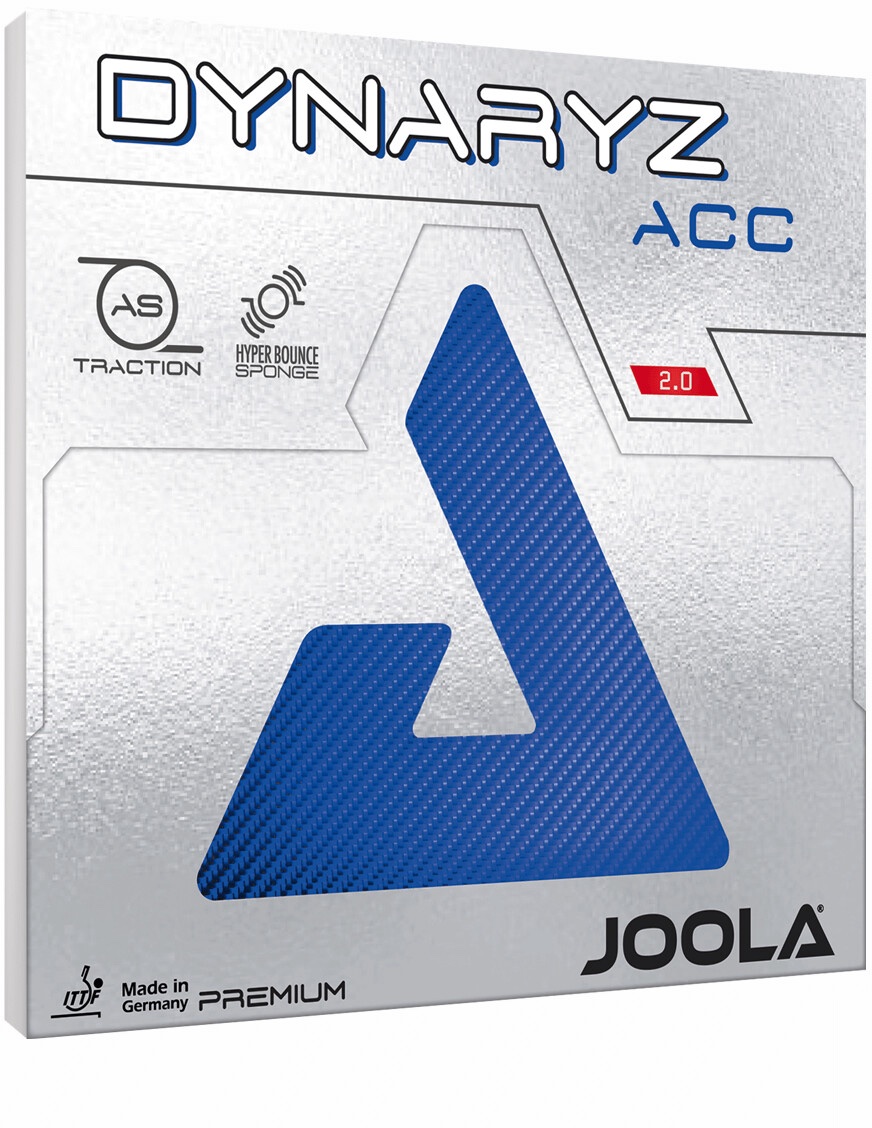
The JOOLA Dynaryz ACC is the calmer of the two Dynaryz rubbers, sitting between the ultra-fast AGR and mid-range options like the Rhyzer 48. A 47.5-degree HyperBounce sponge under Advanced Traction Surface Technology gives it pace and heavy spin while staying easier to handle than the AGR. The price undercuts European and Japanese rivals, aimed at players who want pro-level output without paying Tenergy money. It comes in 2.0mm and max thickness, which covers most setups.
Performance
Topspin is where the ACC earns its keep. It puts out heavy spin, on the level of Tenergy 64, with a medium-to-low arc that pulls loops down sharply onto the far side of the table. The catapult bites even at moderate swing speed, sending the ball off fast and loaded. Tom Lodziak clocked it about 25% faster and spinnier than his Rhyzer 48/43 setup, a jump intermediate players feel on the first ball. Opening against backspin is a strength: the grippy matte surface holds the ball even on low serves and deep pushes. Speed lands at OFF+, with a Megaspin speed index of 126 and spin index of 129, which puts it among the best European-style tensors. The 47.5-degree sponge is medium-hard, sidestepping the stiffness of harder Chinese rubbers while keeping enough dwell to generate spin.
Defense is the trade. Blocks come off higher than they do on softer rubbers, so you have to close the bat to keep them down. Short pushes work but lack the precision of the AGR or softer sheets, and anyone leaning on passive blocks and touch play will feel the rubber asking for active strokes. Even so, the very short game surprised reviewers: drop shots and short pushes came off cleaner than an OFF+ rubber has any right to. Durability is the one soft spot. Some users see the throw angle flatten after three months, and a reboost may be needed to bring back the original feel.
What Reviewers Agree (and Disagree) On
Across every source the agreement holds: the ACC puts out heavy spin and solid speed with more control than its rating implies. Megaspin, JOOLA’s blog, and TableTennisCoach.me.uk each land on the same point independently, that it matches Tenergy 64 for spin while playing more forgiving. The split is over who it fits. Some reviewers (ppongsuper.com) call it reachable for developing players; others (Tom Lodziak) stress that taming its speed on defense takes advanced technique. Reddit mostly slots it on the backhand, while long-form reviewers tend to test it on forehand. The throw-angle degradation comes up with only some users, which points to playing style and upkeep deciding the outcome.
Who Should Buy It
The JOOLA Dynaryz ACC fits intermediate and advanced players who attack with a topspin-first game. If you loop heavily, counter-loop from mid-distance, and want Tenergy-tier spin without the Tenergy bill, the value is hard to argue with. It plays on both wings but draws the most fans on the backhand, where it delivers controlled, fast attacks. If you lean on passive blocking, a touch-based short game, or heavy defense, reach for something softer or slower.
FAQ
How does the JOOLA Dynaryz ACC compare to Tenergy 05?
The ACC matches or slightly trails Tenergy 05 on spin, but it forgives more and stays easier to control at the same speed. Tenergy 05 throws a higher arc and a more explosive catapult; the ACC keeps a medium-to-low arc that some players find steadier. On price, the ACC costs a lot less.
Is the Dynaryz ACC better for forehand or backhand?
It works on both, but the community leans backhand. The forgiving, high-speed character suits players hitting fast backhand attacks who don’t want the brick-hard feel of stiffer Chinese-style sponges.
Does the JOOLA Dynaryz ACC need boosting?
No boosting needed out of the box; it plays well stock. Some users do see the throw angle drop after about three months of regular use, and a reboost brings back the original lively feel.
Sourced From
This review synthesizes opinions from 4 independent community sources:
- JOOLA Official Blog (Yogi_Bear Review) (ecommerce)
- Megaspin Customer Reviews (ecommerce)
- TableTennisCoach.me.uk (Tom Lodziak) (forum)
- Reddit r/tabletennis (forum)