Donic Bluefire M3 Review: The Loop-First Tensor for Backhand Specialists
Pros
- Exceptional topspin generation with a high, looping arc
- Long dwell time gives more time to brush and spin the ball
- Very forgiving — saves off-centre and slightly mishit shots
- Excellent for flicks, banana serves, and opening against backspin
- Consistent blocking with good placement control
- Softest and most control-oriented rubber in the Bluefire M range
- Strong value versus premium tensor alternatives
Cons
- Topsheet durability is below average — grip can fade within months under heavy use
- Not suited for flat hitters or smash-oriented players
- Significant doming after gluing can be a nuisance
- Can feel too slow when paired with soft or slow blades
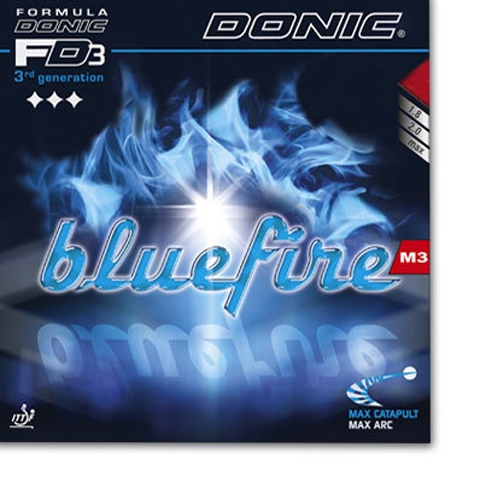
The M3 is the soft end of the Bluefire M family. Its 40-degree blue sponge comes out of Donic’s FD3 formula, and where the M1 and M2 chase speed, the M3 trades that for spin, forgiveness, and a longer ball-on-rubber moment. Backhand players have stuck with it for years because of the high looping arc and the way it holds up shot to shot rather than for any top-end pace. The picture below pulls from community feedback on Revspin, Megaspin, TableTennisDaily, and Reddit.
Performance
Looping is what the M3 does. Reviewers from one source to the next describe an arc that climbs higher than most tensors, which makes lifting heavy backspin and loading topspin from mid-distance feel automatic. The M-series sponge uses an uneven pore structure, unlike the uniform pores in the JP series, and several players compare the result to old speed glue: the sponge grabs the ball fast and throws it back with a burst of spin and pace. Dwell time runs longer than older tensor designs, so you get a fraction of a second more to brush and shape the ball.
The backhand is where it earns its keep. Banana flicks, opening loops against heavy backspin, counter-topspin at the table, passive blocks — they all land at a high rate. Blocking comes up again and again: the grip lets you steer the ball instead of just bouncing it back. One Megaspin reviewer switched from Andro Rasant Grip to M3 Max and called the change immediate. Dwell time went up and his backhand loops, in his words, turned devastating.
Serves load up easily on the grippy topsheet, with heavy spin for little effort. The short game is workable but bouncy. The high throw that makes looping so productive fights you when you want to keep the ball short, and players report a calibration period before touch shots and pushes settle down.
Flat hitting and smashing are the weak spots. The M3 is not a punching rubber. It wants spin on the ball to behave, and reviewers don’t waver on this: flat drivers and smash-first players will find it frustrating. For backhand use the common pick is MAX or 2.0mm. Drop to 1.8mm if you want more control or you’re on a fast blade.
Durability is where the complaints land. The sponge and edges last under heavy play, and one TableTennisDaily reviewer logged over 300 hours before he saw real degradation, but the topsheet grip fades ahead of the sponge. Several reviewers reported cracking or lost grip within a few months of regular play, and one Megaspin customer hit the same wall even with careful maintenance. If you burn through rubbers, build that into the cost.
What Reviewers Agree (and Disagree) On
All four sources land in the same place: the M3 is a fine backhand rubber for spin players, and the looping arc, dwell time, and forgiveness are real. None of them recommend it to flat hitters. The disagreement is over hardness. Donic lists 40 degrees, but several experienced players say it plays closer to 44 or 45 in practice, especially next to softer rubbers like Rakza 7 Soft. Durability splits the room too. Some logged hundreds of hours of competition and training with little drop-off; others cracked within a few months. Playing intensity, glue, and storage probably explain the gap. Megaspin’s crowd rates it a touch faster on speed than Revspin’s, likely down to different blade pairings.
Who Should Buy It
Buy the M3 if you already loop and want a forgiving backhand rubber that costs less than Tenergy or Dignics. It pairs best with ALL+ or OFF- blades when spin and consistency matter more to you than top speed. Beginners still building a looping stroke will fight the high throw on pushes that won’t stay short. For a budget player chasing premium-feeling topspin without the premium price, the M3 makes sense, as long as you accept replacing the topsheet more often than rival rubbers.
FAQ
Is the Donic Bluefire M3 better on the forehand or backhand?
Most reviewers across the platforms put it on the backhand. The high throw and the forgiveness suit the shorter backhand swing, and the spin-first character fits modern backhand looping. It works on the forehand for high-arc players, but the missing top-end speed holds back forehand attacking at higher levels.
How does the Bluefire M3 compare to the M1 and M2?
All three share a topsheet, but the M3 runs the softest sponge at around 40 degrees, against roughly 45 on the M2 and 47.5 on the M1. So the M3 is the most controllable and spin-friendly of the family, with the M2 and M1 adding speed and firmness as you go up.
What sponge thickness should I choose for the Bluefire M3?
On a medium-to-fast blade for the backhand, most reviewers reach for MAX or 2.0mm, which gives the best spin-and-speed mix. Slower blades or control-first players should look at 1.8mm. On the forehand, 2.0mm or 2.2mm is the usual choice for power looping.
Is the Bluefire M3 a good alternative to Butterfly Tenergy 05-FX?
Plenty of players name the M3 as a cheaper stand-in for Tenergy 05-FX, citing the similar high arc, the spin, and the soft-sponge feel. The M3 costs less and is easy to find. But Tenergy 05-FX is faster and more consistent at the elite level, and most experienced players rate its topsheet durability higher.
How long does the Bluefire M3 last before the grip fades?
Durability is the M3’s most-named weakness. Some players lose grip and see topsheet cracking within two to four months of regular play, even with protective sheets and careful storage. Others, mostly backhand users at moderate intensity, get six months or more out of it. How long it lasts swings widely with playing frequency, the glue on the blade, and climate.
Does the Bluefire M3 dome significantly after gluing?
Yes. Doming is a known M3 quirk and multiple reviewers bring it up. The sheet bows once glued to the blade, which makes cutting it to size fiddlier. A thin even coat of quality non-toxic glue plus enough curing time cuts down the bow, but expect some curvature regardless.
Sourced From
This review synthesizes opinions from 4 independent community sources:
- Revspin (forum)
- Megaspin (ecommerce)
- TableTennisDaily (forum)
- Reddit r/tabletennis (forum)