Donic Bluefire M2 Review: A Backhand-Friendly Tensor That Punches Above Its Price
Pros
- Excellent backhand performance for flicks, loops, blocks and sidespin
- Very grippy topsheet with high arc that opens up backspin easily
- Strong catapult and speed that respond well to boosting
- Surprisingly good control for a lively tensor, especially in 2.0 mm
- Strong value as a lower-cost alternative to premium Japanese rubbers
- Balanced middle option between the harder M1 and softer M3
Cons
- Bouncy on slow touches, so short pushes and passive blocks can go long
- Sponge is fragile, porous and shrinks noticeably when reglued
- Springiness makes short or dead serves harder to produce
- Red topsheet durability drops when boosted or used by sweaty players
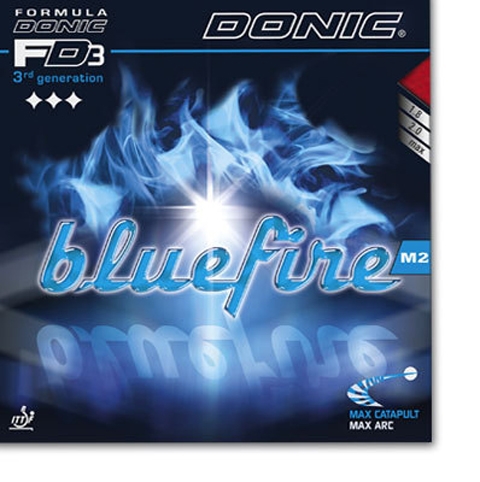
The Donic Bluefire M2 sits in the middle of Donic’s Bluefire M family, between the harder, faster M1 and the softer M3. It is an inverted tensor built on Donic’s Formula FD3 technology, with a large-pored blue sponge of roughly 42.5 to 45 degrees under a grippy, slightly long pimpled-in topsheet. Donic pitches it as a balance of speed, catapult and feel for players who like medium-hard rubbers and want both spin and pace. Over the years it has become one of the brand’s most popular sheets, recommended again and again as a backhand rubber and as a cheaper stand-in for premium Japanese tensors. This review pulls from aggregated Revspin feedback, scored member reviews on TableTennisDaily, and 46 customer reviews on Megaspin to show how it actually plays.
Performance
For raw output, the Bluefire M2 is a fast, spinny tensor, no two ways about it. Megaspin’s store ratings read Speed 97 and Spin 107 against a Control rating of 70, and TableTennisDaily member scores cluster around Speed 8.6 and Spin 8.6 out of ten. The trait that keeps surfacing is topsheet grip paired with a high throw. Opening against backspin is almost effortless: one Megaspin user notes the very high throw makes lifting a backspin ball easy, and a Revspin reviewer says opening with a banana flick is easy and slow brushes produce a very good arc. That puts the M2 firmly on the backhand, where reviewers across all three sources single it out. One Revspin user called it a backhand rubber all the way and said banana flicks, backspins, high arc loops, blocks and sidespins are a bliss, while a TableTennisDaily reviewer scored its control a perfect ten and called it very well suited for backhand and easy to execute every stroke.
The catapult cuts both ways. The same lively sponge that drives loops and counter-hits leaves the rubber bouncy on slow, passive contact. Reviewers warn that short pushes sail long over the net and that passive blocking demands a careful bat angle, and one Megaspin reviewer who loved it on backhand eventually moved off it because the high arc made passive shots hard to control. Dead or short serves are harder to produce because of the springiness too, a point raised on TableTennisDaily and in the user notes. Against Tenergy 05 the comparison is mixed: reviewers find similar speed and looping spin, several say smashes and hits feel better and more controlled on the M2 thanks to longer dwell time, but others flag the weight (one trimmed sheet hit around 50 grams against about 42 for T05) and call it a tensor with its own character rather than a true Tenergy clone. The M2 is at its best for loopers playing close-to-mid distance and for flat, direct hitting. One TableTennisDaily reviewer said it suits players who hit with flatter contact, excels at counter-hitting and blocking heavy topspin, and struggles a little for anyone after maximum brush spin.
What Reviewers Agree (and Disagree) On
Reviewers broadly agree the Bluefire M2 is a high-value, spinny, backhand-friendly tensor with a grippy topsheet and strong catapult, and that it stacks up well against premium Japanese rubbers on price. They also agree on the durability caveats: the sponge is porous and fragile, shrinks noticeably when reglued, and can show small bubbles. The fight is over control. Some TableTennisDaily reviewers rate it nine or ten and call it easy to use, while several Megaspin and Revspin reviewers insist control is not its strong suit and that the catapult is hard to tame, especially on passive strokes and short pushes. The split tracks blade pairing and skill level: the rubber comes up best on controlled, not-too-stiff blades and asks for sound technique, and at least one reviewer warns off beginners who have never used fast rubbers.
Who Should Buy It
The Bluefire M2 is a strong pick for intermediate to advanced players who want a fast, spinny, backhand-friendly tensor without paying premium Japanese prices. It fits loopers who play close-to-mid distance and lean on a high arc and easy backspin opening, along with players who like flat, direct hitting and easy blocking of heavy topspin. Sitting between the harder M1 and softer M3, it is also a sensible default if you are unsure which Bluefire hardness to take. It works less well for a game built on short pushes, passive blocking, or dead serves, since the springiness and high arc cost you control on those shots, and it is no rubber for an outright beginner. A controlled, not-too-stiff blade plus the 2.0 mm thickness will tame the bounce if you want more margin.
FAQ
Is the Donic Bluefire M2 better for forehand or backhand?
Reviewers come down heavily on the backhand, where the grip, high arc, and easy backspin opening make flicks, loops, blocks, and sidespins feel natural. It runs on the forehand too, especially on stiffer carbon blades, but several players find the medium sponge a touch soft for heavy forehand hitting.
How does the Bluefire M2 compare to Tenergy 05?
Players report similar speed and looping spin, and some say smashes feel better and more controlled on the M2 thanks to longer dwell time. It is heavier than Tenergy 05, though, and it is its own tensor rather than a clone. The pitch against T05 is comparable performance at a noticeably lower price.
Is the Bluefire M2 hard to control?
Opinions split. Some reviewers rate control very highly, others find the strong catapult and high arc tricky on slow, passive strokes, with short pushes and blocks running long. Control improves on a controlled, not-too-stiff blade and with the 2.0 mm thickness, and the rubber pays back solid stroke technique.
How is the durability of the Bluefire M2?
The sponge is porous and a bit fragile, shrinks noticeably when reglued, and the topsheet can show small bubbles. Black sheets last longer than red ones, and reviewers note durability drops faster when the rubber is boosted or used by players with sweaty hands.
Where does the M2 sit in the Bluefire M range?
It is the balanced middle option. The M1 is harder and faster, the M3 softer and easier to control. The M2 runs a medium sponge of roughly 42.5 to 45 degrees and splits the difference on speed, spin, and control, which makes it an easy all-round choice.