Butterfly Ovtcharov Innerforce ALC: Signature ALC Blade for European Power Attackers
Pros
- Inner-ALC construction achieves outer-ALC speed with Ep elasticity score of 2.02
- Outstanding blocking stability and flat-hit explosiveness praised by multiple long-term users
- Heavy topspin loops with excellent dwell time and spin generation rated 9.09/10
- Low vibration profile at Vp 1.21 — noticeably softer than Viscaria
- Overall user rating of 9.55/10 across TableTennis Reference community
- Reaction rating of 117 with vibration dampened to 105
Cons
- Premium price reflects flagship positioning
- Heavier build at 91-96g demands physical conditioning
- Requires advanced technique — beginners will struggle to control
- Larger head and thicker construction need an adjustment period
- High loop execution less effective than fast-topspin style
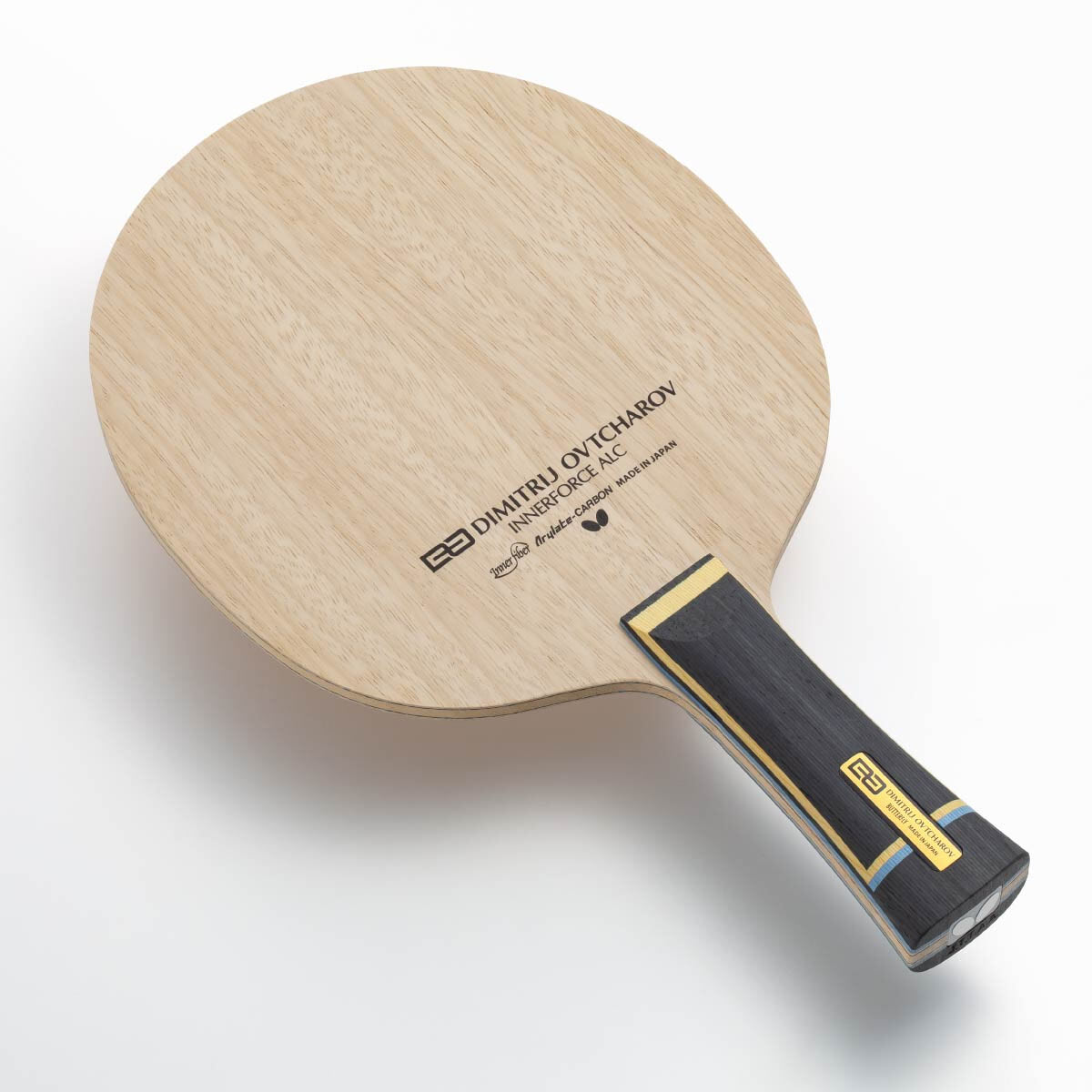
Butterfly built this one with Dimitrij Ovtcharov, one of Europe’s most decorated professionals and a regular in the World Top 10, and it sits at the top of the Innerforce family. The design tackles a problem elite attackers keep hitting: conventional inner-ALC blades lack the raw speed modern power rallies demand, while outer-ALC blades give up the dwell and feedback that precise placement needs. The Ovtcharov Innerforce ALC goes after both at once. It runs 5 wood plies and 2 inner ALC (Arylate Carbon) layers in a 7-ply build, measures 6.2mm thick — up from the 5.9mm of the standard InnerForce Layer ALC — and carries a slightly larger head at 158 x 152mm. Lab testing puts its primary elasticity at 2.02, over the line that marks outer-ALC blades, while the vibration stays softer than rival outer-fiber designs including the Viscaria. TableTennis Reference reviewers land it at 9.55/10 overall, a score that reflects broad cross-community endorsement of that hybrid character.
Performance
What sets this blade apart is how it closes the gap between inner and outer-ALC categories. TTGearLab’s independent lab numbers confirm a primary elasticity (Ep 2.02) that matches or beats outer-ALC designs, while the central elasticity ratio (Ec/Ep 0.84) and low lateral vibration (Vl/Vp 1.07) stay true to inner-fiber construction. On the table that means explosive flat hits and fast topspin drives — Megaspin reviewers call it very explosive and violent when you power the ball — with enough dwell left over for precise placement on touch shots and blocks.
Blocking is a strength, and users keep pointing to its stability during defensive exchanges. The contact is firm without jarring, so redirecting pace is efficient. Looping is strong at fast-topspin pace and mid-distance driving, but slow, heavily brushed high loops get less back from the thick construction.
Spin benefits from the inner-ALC placement, which keeps the carbon layers closer to the structural core. TableTennis Reference reviewers rated spin at 9.09/10, and several note that tensor rubbers like Tenergy 19 or Dignics 09C produce heavy rotation on topspin. The Megaspin community’s 4.8/5 aggregate from 30 reviews shows how well it carries a range of pairings, the DHS Hurricane and Tibhar Evolution series included.
Control at the table draws steady praise, rated 8.73/10 on TableTennis Reference. The compromise shows up in two spots: on very hard hits the thick construction can release the ball early, and on heavy backspin returns your contact timing has to be precise or the ball finds the net. Those trade-offs come with the OFF+ classification and fit a professional-grade attacking tool.
What Reviewers Agree (and Disagree) On
Across Megaspin, TTGearLab, and TableTennis Reference, reviewers agree on the core identity: a blade that merges outer-ALC pace with inner-fiber feel in a way no earlier Innerforce model managed. TTGearLab’s line — as powerful as outer ALC blades, and controllable as inner ALC blades — sums up the prevailing view. Long-term Megaspin users back it, one of them with more than two and a half years of daily use, saying it stands up against Butterfly’s most expensive flagships.
Two things divide opinion. The first is weight: 91g standard, up to 96g for the flared handle. Power hitters like the solid, planted feel; players with smaller hands or a lighter touch find the mass tiring over long sessions. The second is the short game, and the split runs along skill lines. Advanced players report fine touch and net-play control, while less experienced users blame the thick construction and slightly forward-weighted head for early frustration. The takeaway is the same either way — this blade is built for, and best appreciated by, technically developed attackers who commit to full swings.
Who Should Buy It
This blade is for advanced and professional players running a European-style power game — heavy topspin loops, explosive flat drives, aggressive counter-hitting from mid-distance. Outgrown the standard InnerForce Layer ALC and want more pace without losing the soft, controlled inner-fiber feedback? This is the natural step up. It also makes sense for attackers on the Viscaria or similar outer-ALC designs who want back the dwell time, spin sensitivity, and gentler vibration without giving up speed.
Intermediate players, or anyone leaning on slow, high-arc loops or passive blocking, are better off with the Harimoto Innerforce ALC or InnerForce Layer ALC, both of which ease you into ALC technology at a lower speed point. The Ovtcharov Innerforce ALC pays off physical conditioning, strong footwork, and commitment to full attacking swings. It is a purpose-built blade for players who compete at, or are chasing, professional standards.
FAQ
How does the Ovtcharov Innerforce ALC differ from the standard InnerForce Layer ALC?
The Ovtcharov Innerforce ALC is thicker at 6.2mm against 5.9mm, has a larger head at 158x152mm against 157x150mm, and hits a primary elasticity of 2.02 that crosses into outer-ALC speed. The InnerForce Layer ALC is slower and softer, which suits players who put control ahead of raw speed.
What rubber pairings work best with this blade?
Butterfly’s own Dignics 09C and Tenergy 19 draw the most praise across reviewer communities. It also plays well with Tenergy 05, Tibhar Evolution MX-P, and DHS Hurricane 3 NEO. Stick to medium thickness at 2.0-2.1mm to keep the ball-contact feel; go to maximum thickness and the setup turns excessively stiff.
Is this blade suitable for beginner or intermediate players?
No. Reviewers across all three sources say plainly that it takes good technique and physical ability to control. Beginners and intermediate players will struggle to manage the speed and firm contact consistently. Advanced club and competitive players get the most out of it.
How does the Ovtcharov Innerforce ALC compare to the Viscaria?
It matches the Viscaria in raw speed but runs lower vibration at Vp 1.21, with more dwell and better spin from its inner-ALC construction. Reviewers find it more lively than the Viscaria, with a higher arc and more rotation on topspin, while the Viscaria stays a touch more direct and predictable at full-power contact.
What makes this blade specifically suited to European-style play?
European attacking play leans on power drives, explosive flat hits, and aggressive counter-looping from mid-distance, and this blade is strong in all three. Its development with Dimitrij Ovtcharov, who plays a high-tempo, forehand-dominant game, shaped the thicker construction and higher speed ceiling to back that style.
What handle types are available for this blade?
It comes in three handles: Flared (FL), Straight (ST), and Anatomic (AN). The flared handle adds a bit of mass, and some users report total weight reaching 94-96g. Players with smaller hands often prefer the straight handle for a more neutral grip.
Sourced From
This review synthesizes opinions from 3 independent community sources:
- Megaspin (ecommerce)
- TTGearLab (ecommerce)
- TableTennis Reference (ecommerce)