Zhang Jike's Complete Butterfly Blade History
1
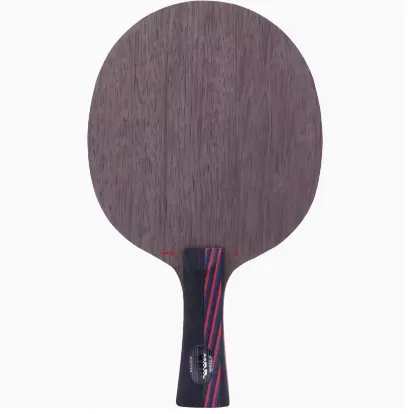
Before Zhang Jike joined the Butterfly roster, his most famous blade was the Stiga Red-and-Black Carbon King 7.6. Built on a structure similar to the Stiga CL, carbon powder was mixed into the adhesive between layers, boosting the speed sensation and explosive power. When you drive or loop the ball, it has that distinctive Stiga bite and ball-holding feel — and it’s violent in a good way. The price was only half that of a Viscaria.
The one drawback: the non-CR version tends to spray thread-like fibers in this non-boosting era. The 7.6 CR version has a harder surface, which makes short-ball control feel a bit lively.
2
Viscaria. The most important blade of Zhang Jike’s career, and one destined for the history books. Faithful, linear, stable — at high power the large kiri core shows its solidity and force. The craftsmanship behind the kiri large-core construction is fully on display here.
The influence of this blade is enormous. Many collectors seek out the Viscaria. Every edition shift — from iron badge to aluminum label, from one batch code to the next — becomes a talking point in the market. Even after Zhang Jike left Butterfly, the Viscaria’s luster didn’t dim; professional players still embrace it in large numbers.
3
Special-order Viscaria. The retail version is more linear; the special-order version has a ferocious ball-gripping feel and superior power storage, which is why the price of the special-order Vis has risen sharply. There’s been debate, but it’s undeniable that Zhang Jike used the special-order version for the majority of his career.
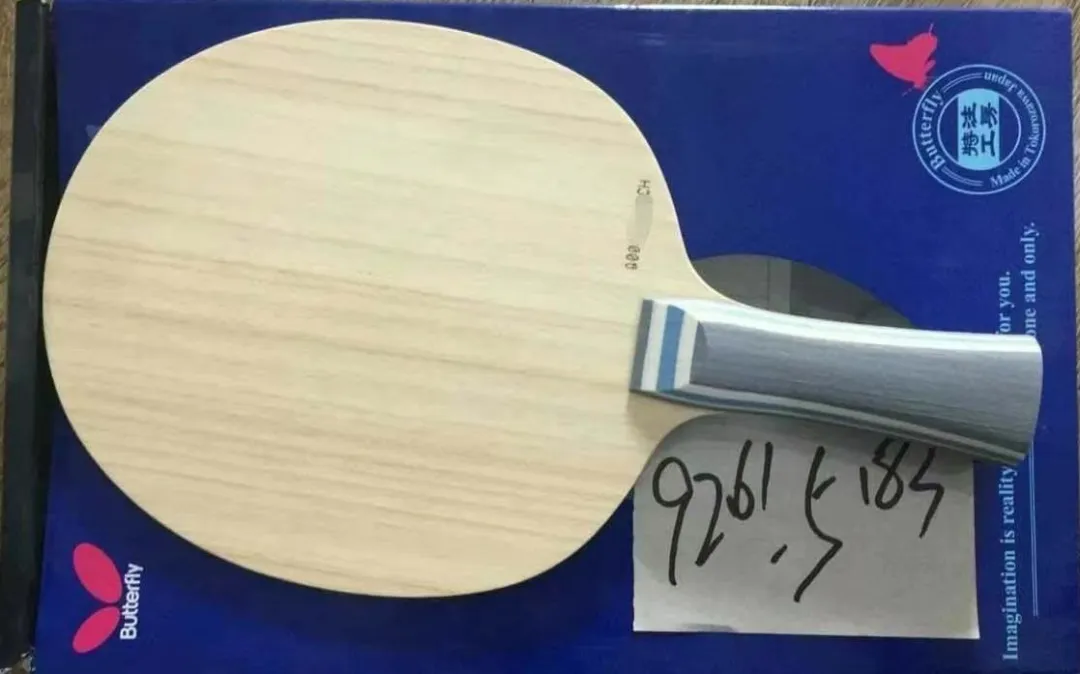
From a backhand control standpoint, the retail Vis is actually easier to use. The special order grabs the ball more, but backhand release feels less crisp — a bit sluggish. Yet it’s hard to ignore the special order’s superior ball-holding and depth on the forehand.
4
In 2011, the dragon and phoenix took flight. That year Zhang Jike won the men’s singles at the Rotterdam World Championships, launching the fastest Grand Slam run in history. The same year, Butterfly released the Dragon edition for Zhang Jike and the Phoenix edition for Liu Shiwen — an outer ALC and an inner ZLF, two sides of the same coin.
The Dragon-edition Zhang Jike blade has a fairly transparent feel and isn’t as dead as typical arylate-carbon blades; first-contact speed is solid and the overall feel leans soft. The bottom power is nothing special. Players who have used the Dragon Zhang include Feng Tianwei.
5
In 2013, the Zhang Jike series blades were released. Before that, Zhang Jike briefly tried the Super ZJ and complained it was too stiff, going straight back to the Vis. Butterfly even thoughtfully made a hybrid: the Super ZJ handle with a Viscaria structure — but he wouldn’t touch it. He said he preferred the woody feel, grain, and grip of his original blade.
Regardless, the Zhang Jike series went on to attract a huge following, from professional to amateur level.
The Zhang Jike T5000 plays like a thin steel sheet — outer carbon structure, genuinely blazing fast. The Zhang Jike ZLC was the main blade for Dan Xiaona (penhold regular-pips) for a long time. At 5.5 mm thin, the ZLC provides enough support and there’s a perceptible flex at medium-low power; under impact it feels firm. It roughly fits the requirement for a regular-pips blade to be “soft yet firm.”
6
The Zhang Jike ALC is the most important blade in the Zhang Jike series and is regarded as a variant of the Viscaria. Performance-wise, it best fits the description of “a softer Viscaria.” Players who have used it include Wang Manyu, Zheng Peifeng, Zhao Zihao, Wong Chun Ting, Shinozuka Hiroto, and Togami Shunsuke.
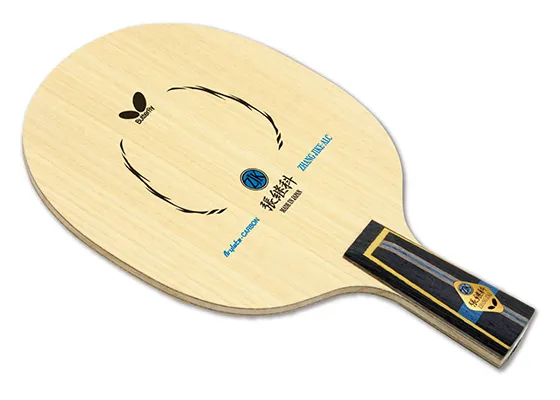
Notably, several penhold players chose this blade. The Viscaria penhold head is on the small side, whereas the Zhang Jike ALC penhold head is more standard at 161 x 150 mm. Penhold players tend to prefer better ball-holding feel.
7
The Super Zhang Jike — that is, the Zhang Jike Super ZLC — is the world’s first blade with Super ZLC fiber. Thanks to the “super” name, it’s enormously popular in amateur circles. Stiff, blindingly fast, with a generous sweet spot. National-level players who have used it include Yan Sheng and Wong Chun Ting (both penhold), and shakehand users like Chuang Chih-yuan and Lin Yun-ju are well known to fans.
Compared to the later Lin Yun-ju and Fan Zhendong SZLC versions, the original Super ZJ is still stiffer and punchier. With Donic having signed Zhang Jike, plenty of collectors — and players who already use this blade — are eyeing the Super ZJ with even more interest.
8
Now we arrive at the limited editions. The 2013 first-generation Zhang Jike Limited, structured like a Viscaria, genuinely reached special-order level. I only got brief sessions with it and never gave it a proper long-term test, but it was clearly something special — the clarity of ball contact, the transparency of feel, and the power storage were all excellent.
9
The 2017 second-generation Zhang Jike Limited attracted its share of admirers, but given the price wasn’t cheap, some physical shops are still sitting on unsold stock collecting dust. The hinoki face material in a 5+2 structure — Butterfly apparently thought “hinoki equals premium” — but the domestic market just wasn’t buying it. In essence it’s the same as the second-generation Chuang Chih-yuan limited.
10
In 2018, the Gold Label Vis arrived — grippier and easier to add spin — letting many people taste the sweetness of rapid value appreciation.
Then came 2021’s Super Zhang Jike 70th Anniversary Special Edition. For more details you can refer to the earlier full review: Super Zhang Jike 70th Anniversary Special Edition — How Does It Hold Up?
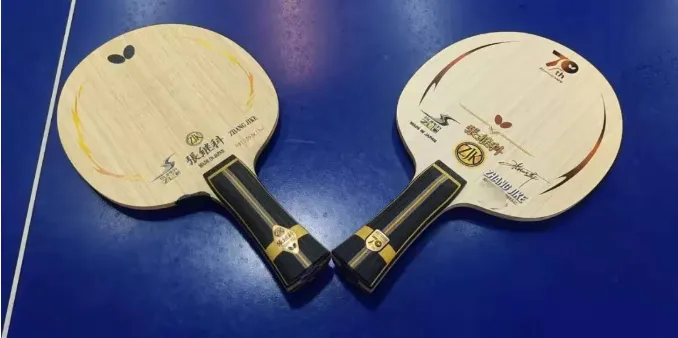
It feels noticeably softer than the retail version, with significantly improved elasticity and much stronger depth. Loop performance is more outstanding. It genuinely achieves special-order standard.