Key Basics to Know When Buying a Table Tennis Blade
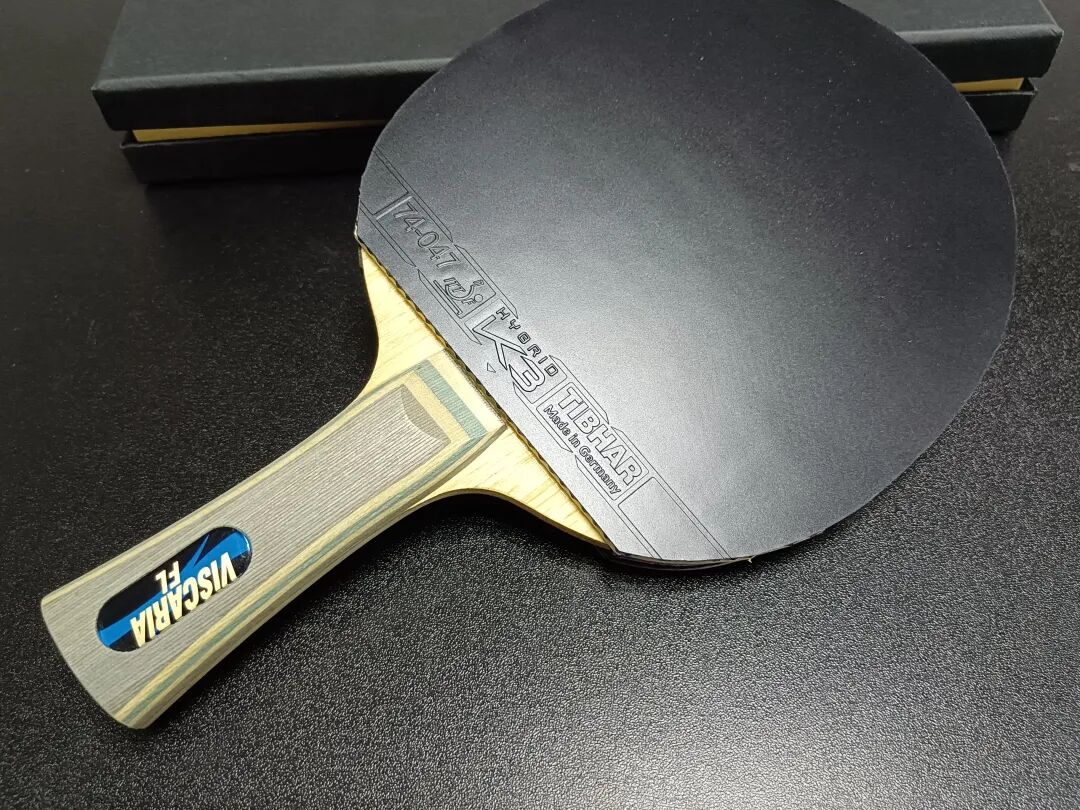
1. Weight
Racket weight includes both the blade and the rubber. Today we’re focusing mainly on the blade. Even from top-tier brands, weight variation within the same model can be significant. A Viscaria can range from 80g to 99g — I’ve seen both. Clearly, for a player using inverted rubber on both sides, 99g or more is borderline unreasonable.
Around 85g for penhold and around 90g for shakehand has become the sweet spot for most players. For beginners playing two-sided inverted, getting the weight right is important.
It’s worth adding: the “best weight” is always relative to the individual. There’s no universally ideal weight for any blade. The “official weight” listed by Butterfly is not a design target — it’s the average weight of actual produced blades (and Butterfly revises this number often).
2. Balance Point
Without picking it up, you can’t always feel where the balance point falls. Generally, blades with a thinner handle tend to be more head-heavy. A thicker handle is more likely to have a centered balance.
I also adjusted the handle on my Yinhe Heima Custom recently to reduce the heavy head feeling a bit.
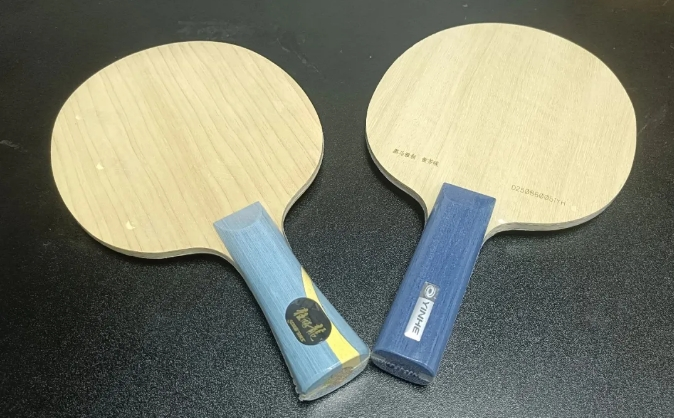
As for whether the handle is hollow on the inside — it’s complicated. Well over 90% of commercially available blades have hollow handles. And even within the same model, like Boll ALC, some serial numbers have a hollowed handle and some don’t. This probably has to do with the overall weight of the wood used. If the blade comes out too heavy, hollowing the handle is the only option.
As for balance point by brand: generally speaking, Butterfly and Yinhe tend to be less head-heavy, while DHS and Stiga tend to be more head-heavy. More forward balance means more offensive power, but you’ll tire faster.
This isn’t universal, but it holds for many models.
3. Head Size
Head size is closely tied to weight and balance. Blades with a larger head like Zhang Ben and Ovtcharov styles (158x152mm) will generally feel slightly heavier than Viscaria- or Zhang Jike ALC-style heads (157x150mm).
Not to mention heads like the XIOM Zhao Dacheng Pro or W968. Larger heads are a current design trend. A bigger head increases the ball contact feel and bottom-end power, but it also takes more effort to use.
4. Thickness
For a two-sided inverted topspin style, generally speaking: the more you emphasize your own active attack and spin generation, the thinner the blade should be. As a rule of thumb, don’t go above 6.4mm.
Thicker blades have better defensive capability and increased overall stiffness, which helps when borrowing the opponent’s power — like ordinary carbon. A 6.9mm thickness increases the rebound energy and accelerates borrowed-power shots. But if it’s too thick, tactile feedback suffers and it’s harder to “play through” the blade. When you can’t play through it, errors pile up.
At the same time, if a blade is too thin — especially below 5.5mm — it tends to sting the hand badly. Borrowed-power defensive play also suffers.
5. Face Material
Because the face is what contacts the rubber, it’s the most sensitive part in terms of feel, even at moderate power. Koto faces are crisper, with a faster first-gear ball speed. Limba faces are more accommodating — softer contact, better control.
Beyond push-and-hit styles, beginners generally aren’t recommended to choose hard wood faces like ebony, walnut, or wenge. And hinoki faces can sometimes feel “muddy” to some players when paired with Chinese sticky rubber.
6. Construction
Many different constructions can produce excellent play. A pure 5-ply wood is good for beginners or fundamentals training — strong spin, great control. A pure 7-ply wood is more middle-of-the-road: stable, faithful, linear.
Today’s two most popular types — outer ALC and inner KLC — are approachable for most players. The former offers better speed and an easier-to-control backhand. The latter holds the ball longer, and the forehand is better for stepping back and looping arcs.
For newer players, going with a popular construction means there’s more community knowledge to draw on.