Wang Chuqin's Achilles Heel; Did Lebrun Switch to Butterfly Tenergy 09c?
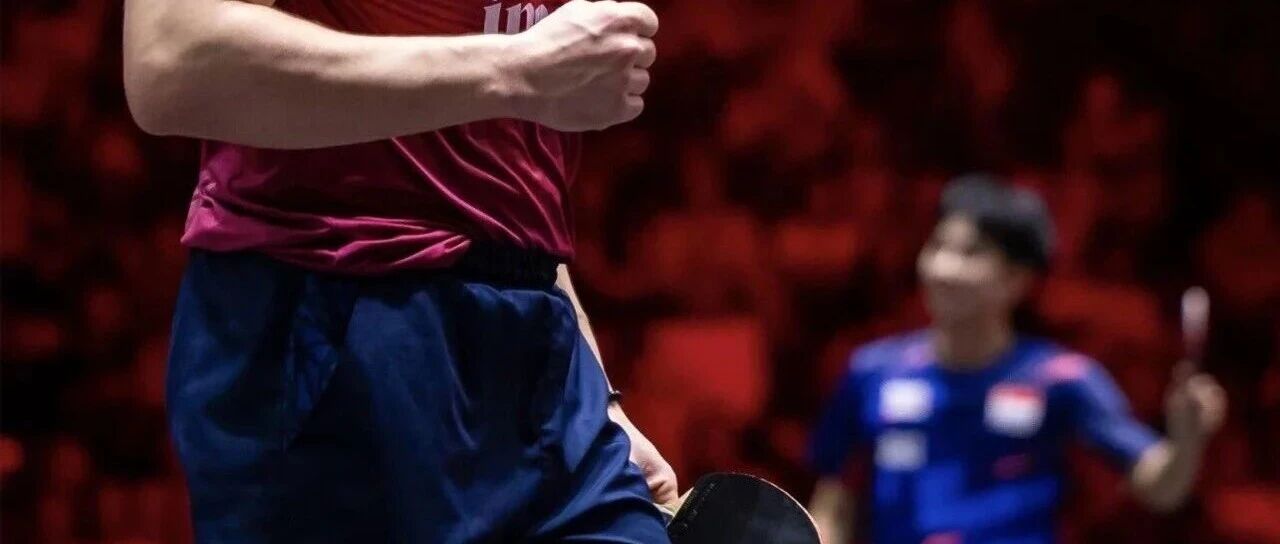
At the Singapore Smash men’s singles round of 16, Wang Chuqin defeated Lind 3-1 in a match that was closer than the scoreline suggests.
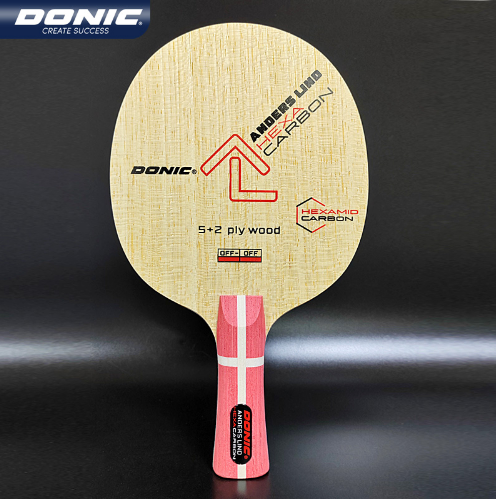
In the third game, Lind led 7-1 before Wang Chuqin clawed back a point to make it 7-2. Lind then called a timeout. In hindsight, it gave Wang Chuqin exactly the breathing room he needed. Wang Chuqin went on to win that game 13-11, turning the match around entirely.
Lind had already beaten Wang Chuqin at the 2024 China Grand Smash. Why was this matchup so difficult again? Because Wang Chuqin’s weakness has been found.
Wang Chuqin has made real improvements in sustained rallying, but his scoring and threat level come primarily from the first three strokes. When the rally rhythm and the opponent’s returns stay within his expectations, it feels as easy as a practice session. But when the opponent handles his serve well and disrupts his expected rhythm, his ability to adjust still falls a notch below Ma Long and Fan Zhendong.
I’ve written before that when receiving Wang Chuqin’s serve, the best approach is not to rush — pause first, then act. Most players just add a brief hesitation before flicking or pushing long (like Harimoto). Lind’s method was different. He would pause, then suddenly slow-chop or side-slice, occasionally mixing in an aggressive flick. This disrupted Wang Chuqin’s expected rhythm and made it hard for him to loop directly. And because the chopped ball’s landing point and second bounce were a bit tricky, Wang Chuqin could rarely threaten with his first backhand shot.
There were other tactical details too. Lind served longer balls to invite Wang Chuqin to attack, but those balls were only marginally beyond half-long. His defense was solid, and he could suddenly add power while absorbing force. Back when I made the university team, the coach had us analyze our own point distribution. I always assumed I won mainly through attacking, but the analysis revealed that a lot of my points actually came from opponent errors. Forcing errors is itself a talent and can be a key tactical component.
Of course, once Wang Chuqin settles down and grinds it out rally by rally against Lind, he has the advantage in sustained exchanges — that’s just not his natural comfort zone. Also, since Lind’s backhand is strong, targeting his middle and short forehand more often would limit his variety.
Lebrun Possibly Using Tenergy 09c
The most interesting equipment story from the past couple of days involves Alexis Lebrun.

First, it was clear that Lebrun’s forehand is the red Dignics 05.
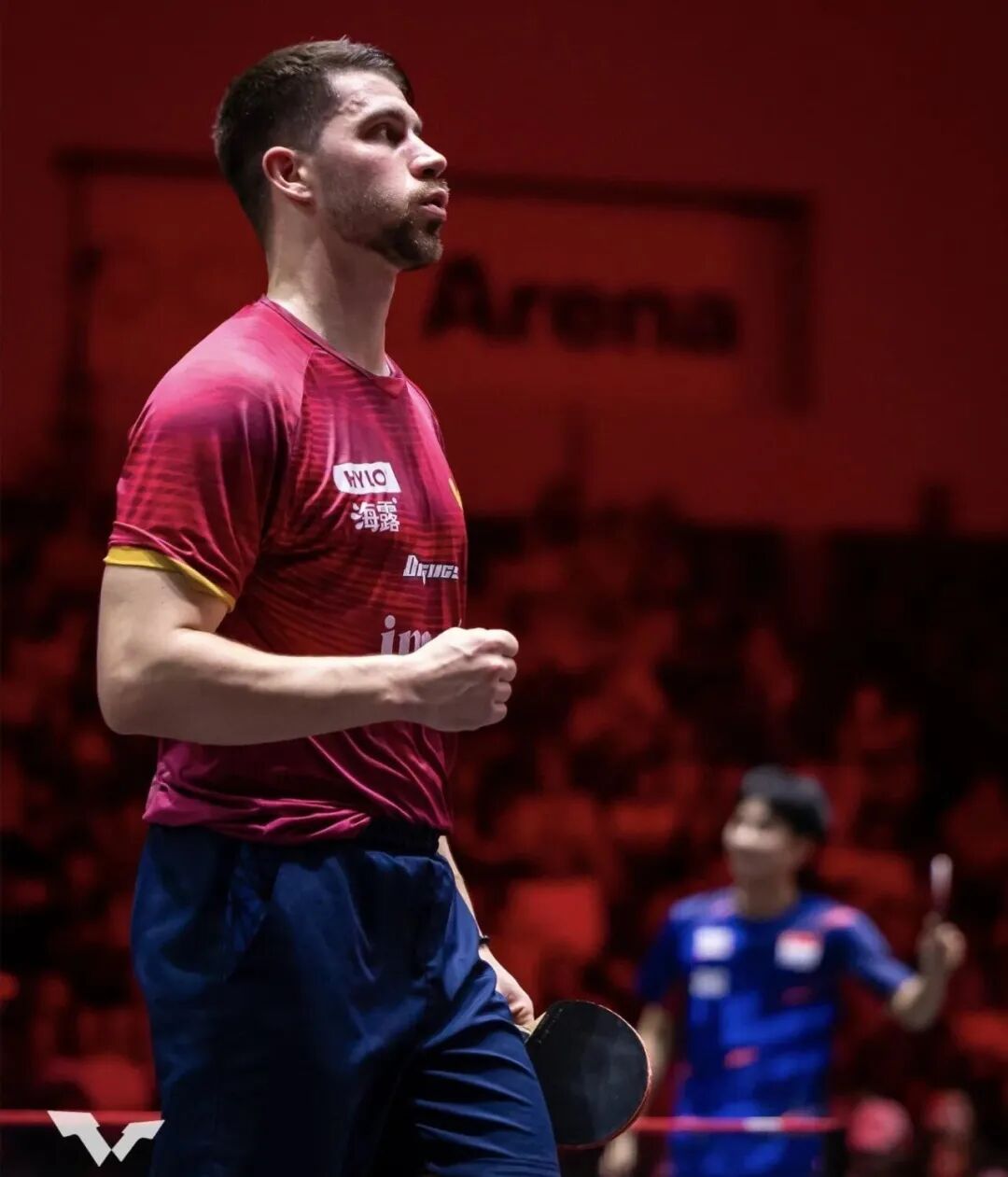
(The above two images are from WTT.)
I went through a lot of photos trying to confirm his backhand setup. Over the past year, he has been rotating through D05, D09c, and ZYRE-03 on both sides. This time, the sponge color on his backhand clearly matched the Tenergy series. That made me initially suspect T05 Hard.
But looking closely at the rubber surface — specifically the arrangement of the letters and numbers — it ruled out virtually every Tenergy model I know. On T05 and T64, the number doesn’t sit on the same line as the rest of the text. T19 is a remote possibility, but the characters after “Tenergy” look more like three characters. That points toward a rubber not yet on the market: Tenergy 09c.
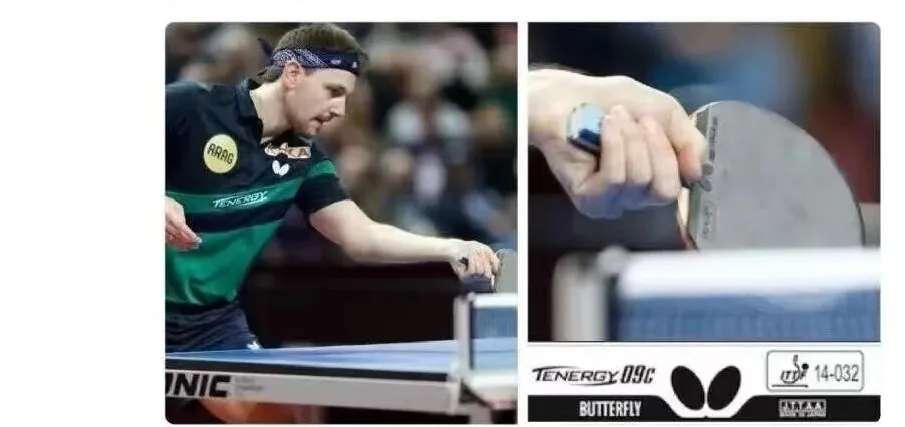
At the end of last year, when I was speculating about new products for the coming year, I mentioned the Tenergy 09c that Timo Boll used back in 2019. Boll is of course Lebrun’s teammate on the German national team.
What happens when the D09c topsheet is married to a Tenergy sponge? Many players have said that D09c’s sponge feels a bit stiff on the backhand — they’d prefer something slightly softer. But if top pros end up using T09c, it’s probably not because of the lower sponge hardness. It’s more likely because Tenergy sponges have a higher catapult effect than Dignics in mid-to-back-court play. Anyone who has compared T05 and D05 knows this — Boll even mentioned in a review that T05 is less effort and easier to generate elasticity from mid-distance.
Speculating about Butterfly’s new products isn’t baseless. And Butterfly’s new factory is already up and running, which means the previous production bottlenecks should be resolved. More new products are almost certainly in the pipeline.
Speaking of the new factory, it reminds me that many players have been discussing whether Butterfly’s outer-layer ALC series blades are all just cookie-cutter copies of each other. Some have even claimed that the special edition (tokuchu) and retail versions are the same quality. I find that pretty funny. The tokuchu workshop has limited capacity and operates entirely separately from the retail production line — different facilities, different material selection, different fiber treatment, and different adhesives.
It’s similar to how Yinhe’s Blue-Gold Workshop differs from its retail line, or how DHS’s Research Institute differs from its standard market production. The DHS 968 digit version is well known to be made by the Research Institute itself, not on the retail production line. The suggestion that tokuchu special orders perform the same as retail versions is simply sensationalism.