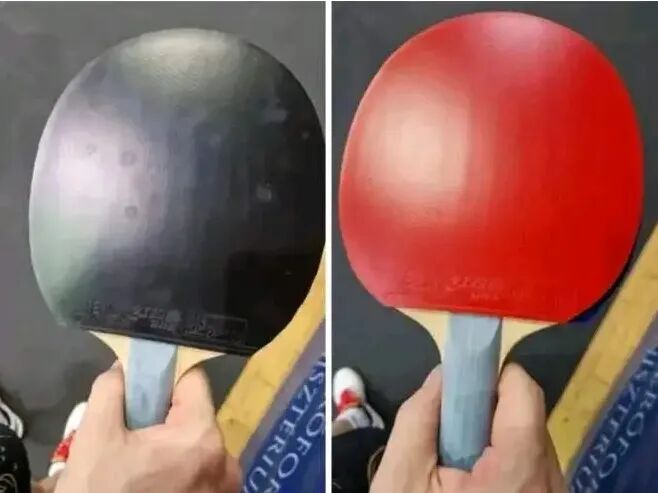
How to Use Classic Inner Carbon and Classic Outer Carbon Blades Differently
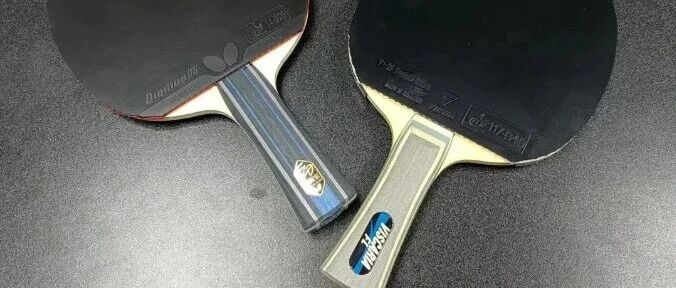
The most popular construction is 5+2 — five wood plies plus two fiber layers. The “classic” types discussed here also exclude special structures. “Inner” here means classic fiber inner carbon with an Ayous core; “outer” means classic fiber outer carbon with a Kiri (Paulownia) core.
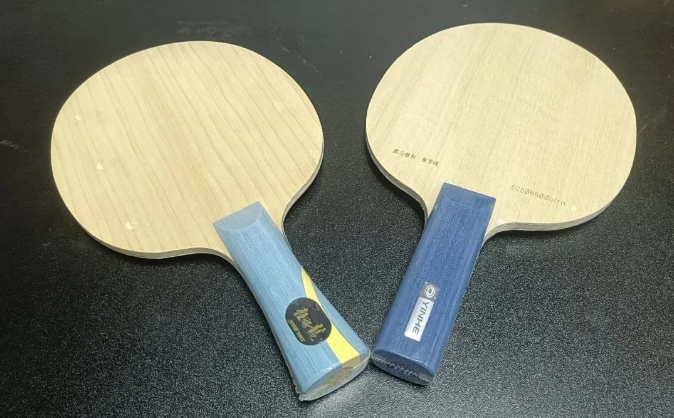
In structural terms, the 968 fits the classic inner category we are describing, while the Zhang Ben SALC does not. The Viscaria is the classic outer, while the Xu Xin blue-label is not.
So as you read on, keep in mind we are only talking about those classic outer and classic inner blades.
1. The Winning Formula: Spin-and-Power vs. Speed-at-Medium-Force
The inner carbon blade’s competitive core is spin and power. The outer carbon blade’s competitive core is speed at medium power levels.
Inner blades — like the W968 or S968 — can certainly generate fast exchanges, but their transition speed generally does not match a classic outer. Without sufficient topspin, an inner blade tends to feel a beat slow and lacks punch.
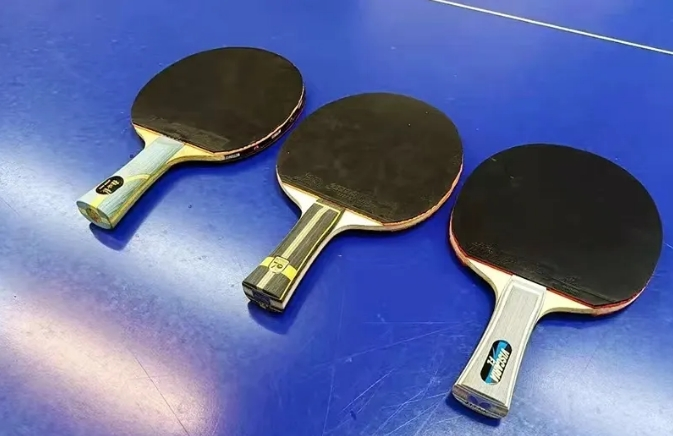
The inner blade has a higher absolute power ceiling. When your stroke reaches the fiber layer and the Ayous core, that large-cored construction delivers superior flex-and-spring energy and raw penetration. With spring blades like the W968, N301, 520X, or the Yinhe B-Horse custom Max ZFC, you can sometimes just wind up and smash a point outright. Swap to an outer carbon — a Viscaria or Fan Zhendong ALC — and you may find that one-shot kill suddenly feels tamed.
The outer carbon blade generates output more easily at moderate effort, and produces speed more readily. Transition speed is also better, and placement control feels a touch more precise. For amateurs of roughly equal skill, setting aside the ceiling, the outer carbon simply makes it easier to feel that satisfying burst of speed.
3. Inner Carbon Demands Power to Perform
Inner carbon blades are state-dependent. How well you play genuinely correlates with energy level and physical condition.
With inner fiber construction, if your stroke never reaches the fiber layer, you are essentially hitting with an all-wood blade — and not even a modern one at that. So naturally it feels sluggish. On a day when you are not well-rested, lacking in energy, or just not fired up, playing with it makes you think “I need a Red Bull” or “Why can’t I put this ball away?”
When you are fully rested and physically fresh, you open it up, and the ball speed is ferocious — lightning fast — perfect for players who want to finish the point in one shot.
So, generally speaking, younger players adapt to inner carbon more easily. Many players in their fifties or sixties complain they can no longer handle inner carbon — really what they mean is they no longer want to generate that much force themselves.
A lot of how we evaluate an inner carbon blade depends not only on our own habits, but on the physical energy and mental state we happen to be in at the time. Sometimes we are more fatigued than we realize.
3. Outer Carbon Is More Forgiving of Unorthodox Strokes
Outer carbon blades are more forgiving of odd contact and unorthodox technique to get the ball on the table. Partly because the outer fiber layer dissipates some of the incoming spin and pace relatively quickly. Partly because outer carbon is genuinely easier to play defensively at low-to-medium force.
When you lack the power to drive an inner carbon properly, or the technique to control it, you tend to get caught by spin — something outer carbon handles more easily. Outer carbon is more bouncy and less prone to being caught by heavy topspin. Of course, spin output will also be somewhat lower unless you compensate with rubber selection.
That is right — the quality of an outer carbon blade is more susceptible to rubber choice. The outer fiber construction already produces significant bounce at moderate force, so you need a rubber that can control that — one that also adds dwell and spin capability.