Koki Niwa's Blade Evolution: A Complete History
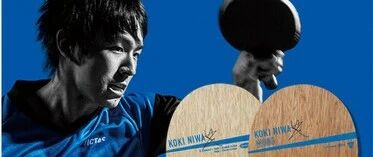
This one was genuinely difficult to write. This guy is unconventional not just in his game but in his blade choices too. He burst onto the scene as a teenage prodigy at the 2009 Yokohama World Championships at age 14 — back then I hadn’t even started working yet (hadn’t written a single article for Table Tennis World magazine). And with his habit of wanting to try every Butterfly blade that came out, the list of blades he’s burned through is enormous.
I’ve already written about so many of them in detail. Let me see if I can connect these blades — through their feel — to Niwa’s expressionless face and his freewheeling style of play.
1 — Butterfly Boll ALC
At the dawn of the inorganic era, the Boll ALC was a redesign built on the Boll Spirit’s foundation. According to Zhuoqiu Kingdom’s records from that time, Butterfly made the Boll Spirit at Boll’s request: starting from the Viscaria, they enhanced close-table spin and control. Crispy on the outside, satisfying on the inside — generating spin with it feels incredibly smooth and refined. Even at medium-low force you can rely on the koto surface and outer ALC for speed.
At that point Niwa was barely a teenager, and while his style was starting to show hints of improvisation, it was nowhere near mature. Whether it fit him well is almost beside the point.
2 — Butterfly Innerforce ALC (2010)
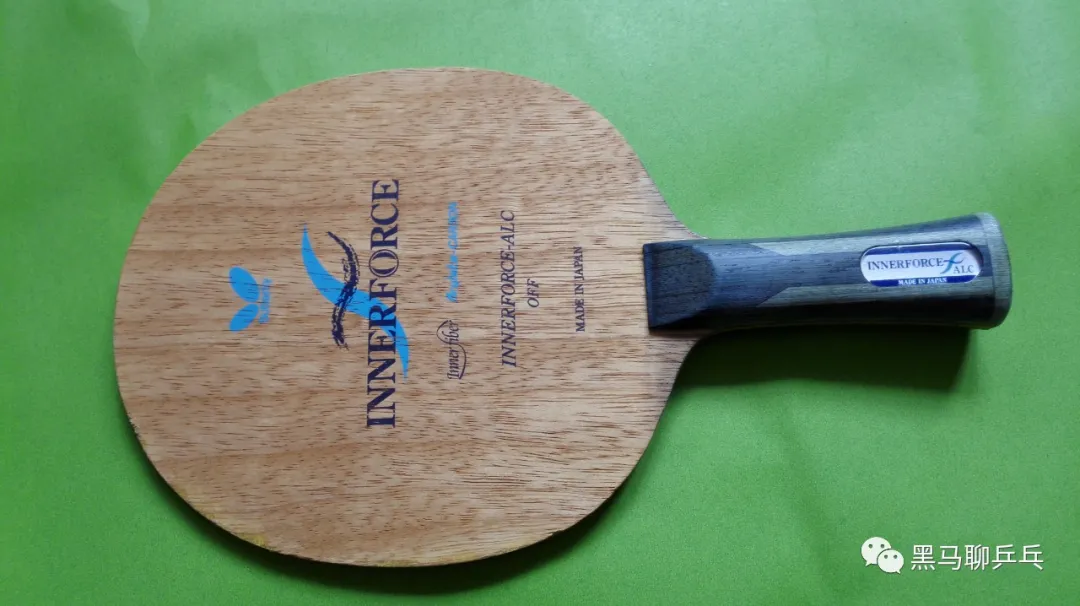
In 2010, Butterfly introduced the Innerforce ALC with the concept of “embedding the carbon fiber inside to enhance ball-gripping ability.” In some ways this design catered to the mid-distance looping and rally demands of the era. But when Niwa first picked it up, he probably wasn’t drawn to the deep power reserve.
When Kong Linghui became head coach of the Chinese women’s team in its early days — when he was still considered handsome — he recommended a blade to Zhu Yuling, Liu Shiwen, and other young players, a new blade of his own: Innerforce ALC. I thought of it as a loop-power upgrade of Kong’s aramid carbon blade. I played with one for a few years myself.
3 — Liu Shiwen ZLF
At the 2012 Asian Championships men’s team event against Zhang Jike — both players wielding famous Butterfly blades at the time (by “twin dragon and phoenix” I genuinely mean the blades, as Zhang Jike and Liu Shiwen’s Butterfly models were nicknamed) — Niwa boldly showed up with the Liu Shiwen ZLF. Fans joked: is this a love confession? At the time, Lee Sang-su was also using the Liu Shiwen ZLF, while Mattenet used the Innerforce ZLC.
Niwa later moved on to the small-yellow-man Innerforce ZLC. By then his style was crystallizing: compact swing, emphasis on transition speed and placement variation. He even had Butterfly make him a custom Innerforce ZLC with a paulownia core. At one point, a player put a 2000-yuan Niwa small-yellow-man (paulownia big core) right in front of me and I didn’t buy it. Because I couldn’t afford it then. I still can’t now.
Looking back, isn’t that paulownia core plus inner ZLC concept essentially the same idea as today’s Zhang Ben Zhihe SALC — both aimed at better speed and swing transition?
4 — Butterfly Mizutani Jun ZLC
Niwa also used the Mizutani Jun ZLC for a while. At that time the MJ was lower-powered than current versions, delivering: high margin for an easy arc, a light and snappy feel, very easy to play. That silky touch makes defense effortless and free-flowing — perfectly suited to Niwa’s taste. At some point — probably around a new edition — the MJ became capable of punching quite hard, with a more solid feel and a power bump. Assessments of it being “low-power” need revisiting now.
5 — Victas Quartet AFC
One second using a Viscaria, the next switching to the Quartet AFC. In 2016 — an Olympic year — Niwa started showing off. Players almost never change equipment in Olympic years, so he did exactly that.
Commercially it made sense: it was early in the year and he had just signed with Victas. The double outer aramid carbon layers are not stiff — they serve mainly as a power transition and a modest boost to borrowing-force ability. The double inner aramid carbon layers do provide some support. The Quartet AFC is one of the most unique-feeling fiber blades out there. The earliest versions were only 5.6mm thick.
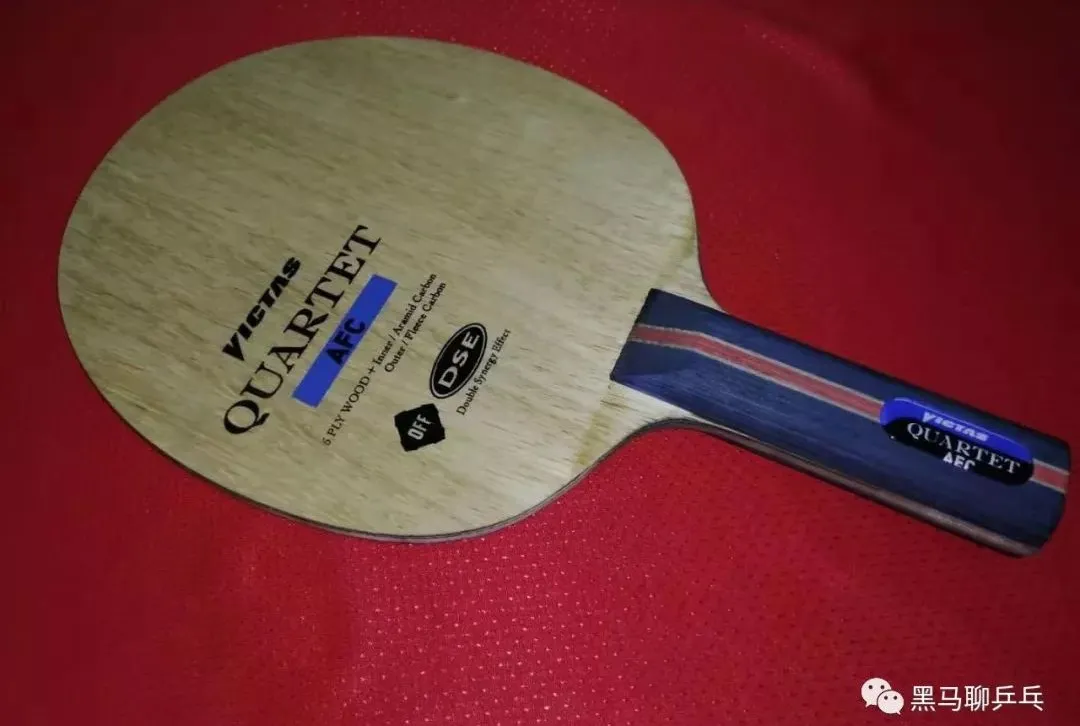
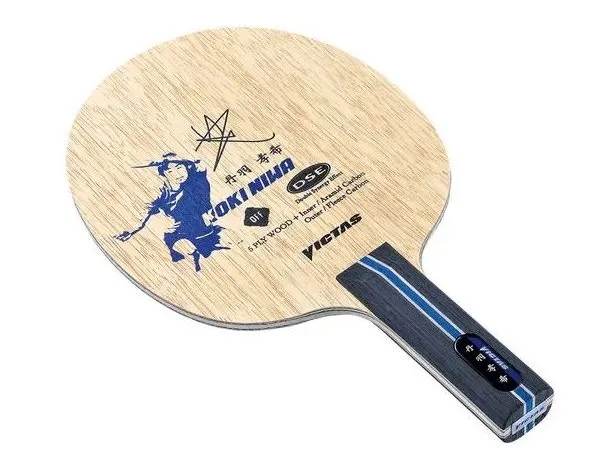
Victas later made a signature model for Niwa.
6 — TSP Swat Power
At the 2017 Dusseldorf World Championships, Niwa went wild. Skateboard shots, side cuts, sudden counter-loops, casual speed drives, backhand flicks, forehand smashes. He beat home-crowd Ovtcharov 4-3 and reached the men’s singles quarterfinals.
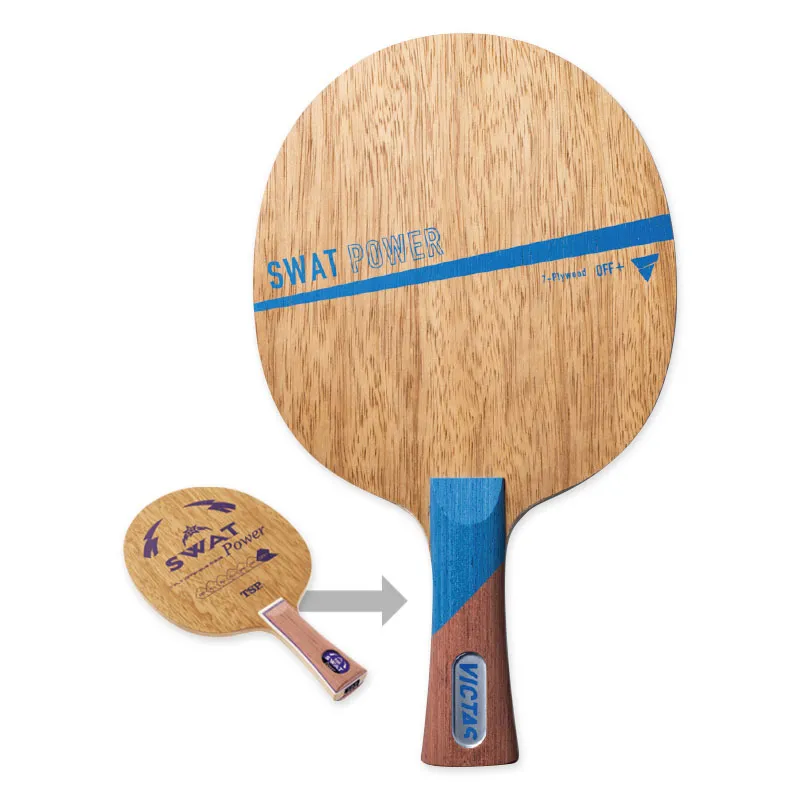
At that time he was using a custom TSP Swat Power — a powerful seven-ply all-wood blade. Thicker than the Swat used by Ni Xialian, with a power step up.
7 — Victas Koki Niwa AFC
Later Victas made him the Koki Niwa AFC, a thickened version of the original Quartet AFC with somewhat better power. Not dramatically better. But the feel remains silky smooth. Note: the core is still paulownia. From this you can basically map Niwa’s preferences:
Power isn’t the top priority — transparent, through-the-hand feel is. And better close-table speed, which is where paulownia cores excel.
8 — All-Wood Seven-Ply
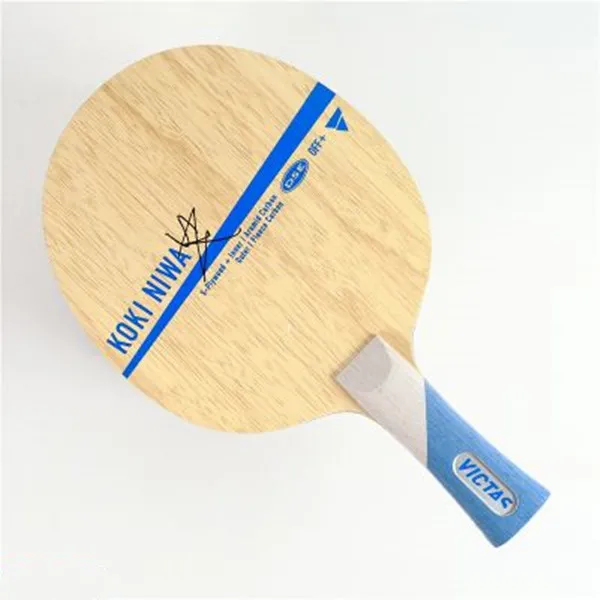
When Niwa’s all-wood version was ready, he naturally moved into it. Power feels a bit less than the Swat Power, but the feel is genuinely good — and despite being domestic production, the transparency is solid, and the elastic feedback at medium force is satisfying. The structure is fairly traditional, big core still ayous.
Afterward, I got hold of a thin-paulownia-core all-wood seven-ply, Japan-made, with even better speed enhancement. It’ll be available next month.
9 — Two Blades at Once (2022)
In 2022, in the later stages of his international career, Niwa was no longer content with the fiber-wood-fiber-wood cycle. He decided to go further: I’ll take both.
So he started carrying both the Koki Niwa all-wood and the ZX-Gear Out. Small courts, enough speed already — all-wood seven-ply for better control. Large courts, ZX-Gear Out for speed. Or on a rough day emotionally, swap to the outer Z-carbon ZX-Gear Out to let off some steam. The wandering became more and more unstoppable.
10 — ZC and ZC Inner
Victas later released the Koki Niwa ZC — a ZX-Gear Out variant with the surface ply switched to hinoki. More recently, a ZC INNER (inner carbon version) appeared. We’ve reviewed that one too.