Choosing a Shakehand Blade by Handle Style, Part 2
Zhang Jike played a crucial role in making FL the dominant grip. As the fastest player to achieve a Grand Slam, his explosive backhand banana flip and forehand loop became widely admired. FL is generally thought to make short-ball banana flips and forehand loop drives easier to power through — particularly on the backhand flip. As that technique went mainstream, FL grew increasingly popular.
FL players now make up the clear majority, while ST users have become rare. Even Mizutani Jun, a long-time ST devotee, switched from ST to FL in 2020. His take: ST made short-ball handling and wrist-powered shots easier, but switching to FL gave him a stronger backhand and a more natural forehand.
Matsudaira Kenta liked ST in his youth but had his handle shaved down very thin. By high school and university, seeking better control, he switched to FL. Because he prefers a slim handle, Butterfly made the Matsudaira Kenta ALC specifically for him. He feels a thinner handle makes forehand-backhand transitions smoother and gives more flexible ball control. Wang Chuqin shares this view — he finds the slimmer 968 handle more comfortable than the Viscaria because switching between forehand and backhand is easier.
Tanimoto Takumi believes ST lets you fine-tune your grip at the very moment of impact, while FL’s wider base feels like a barrier. On forehand shots he uses a standard grip; on backhand shots he uses a shallower grip, which makes it easier to bend the wrist and significantly increases spin and power.
In my view, even within the FL family, the fuller and rounder the handle, the more both short-ball control and forehand/backhand strokes tend toward “stability” — the Viscaria handle is the classic example. Conversely, the slimmer the handle, the more “flexible” and “instantly adjustable” it becomes. More flexibility also means less consistency. There is another FL variant — like the Boll ALC and Fan ALC handles — whose overall curve is slightly straighter and less tapered than the Viscaria. Backhand stability is actually a touch lower than with the Vis handle, but the forehand loop drive has more snap and whip to it.
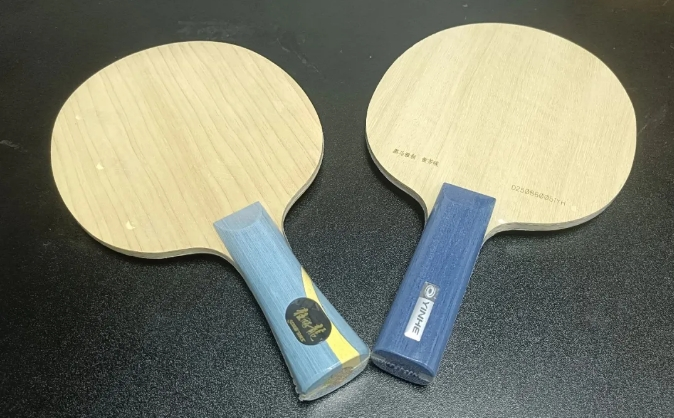
If you have played with both the Heima Yasei KLC and the DPRK special-issue 520X, you will know exactly what I mean. The Heima KLC uses a Viscaria handle; the 520X handle is noticeably slimmer.
Say all three Butterfly contract players — Lin Shidong, Zhang Jike, and Fan Zhendong — are using the same pro-stock ALC formula. Even then, their handles differ in meaningful ways. Lin Shidong and Zhang Jike use the fuller Viscaria handle, which provides greater backhand control stability. Fan Zhendong’s flatter-profiled ALC handle gives more snap on forehand loop drives.
A similar pattern shows up when comparing the Ovtcharov Innerforce ZLC against the Yoshimura Maharu limited-edition blade.
Beyond handle shape: a wider blade shoulder makes backhand shots easier to stabilize and produces better explosive power, while a narrower shoulder lets the forehand loop drive whip through more freely with more trailing bite. This is a key reason some players switch brands but stick to a handle of similar thickness — changing only the handle (not the blade body) also conveniently disguises the switch.
That said, grip feel is deeply personal. Most players can adapt to almost anything over time. If a handle truly cannot be adapted to, then switching blades becomes unavoidable.