Choosing a Shakehand Blade, Starting from the Handle (Part 2)
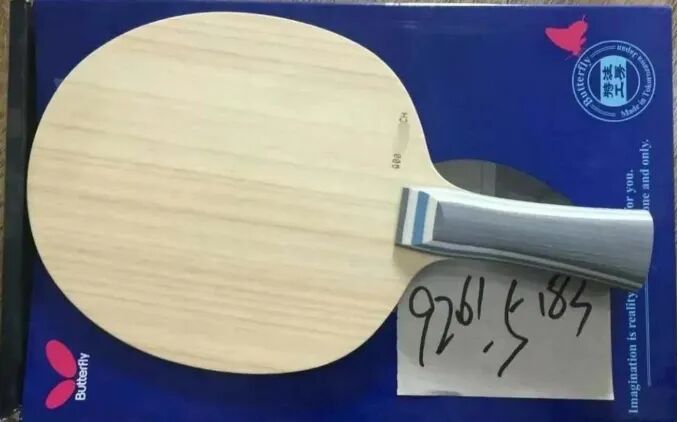
Zhang Jike played a key role in making FL the dominant grip style. As the fastest-ever Grand Slam winner, his backhand banana flip and forehand loop were widely admired. The general view is that FL makes it easier to generate power on short-game flicks and forehand loops, especially backhand flips. As that technique went mainstream, FL became ever more popular.
FL users now make up the majority; ST has become rare. Even Mizutani Jun, a long-time ST user, switched to FL in 2020. He felt ST gave better wrist action for short-game play. With FL, his backhand strokes got more power, and the forehand felt easy too.
Matsudaira Kenta liked ST when young, but shaved his handle very thin. By high school and university, wanting better control, he switched to FL. Since he prefers a narrow grip, Butterfly built the Kenta Matsudaira ALC around that. He finds narrow handles easier for forehand-backhand transitions and more nimble overall. Wang Chuqin shares the same feeling — he prefers the 968’s narrower handle over the Viscaria’s for smoother side-switching.
Tanimoto Takumi finds that ST lets him adjust his grip at the moment of contact. The wide butt on FL feels like a blocker to him. On forehand strokes he uses a standard grip; on backhand he uses a shallow grip, which lets him flex the wrist more and dramatically boosts spin and snap.
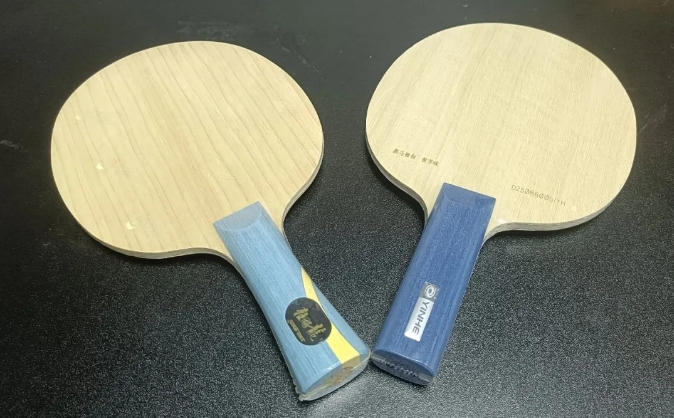
My take: even within FL, a fuller handle tends to make both short-ball control and side-switching feel more stable — like the Viscaria handle. Conversely, a narrower handle is more nimble and offers better instant adjustment. And of course, more nimble also means less stable. There’s another FL shape — the Boll ALC and Fan Zhendong ALC style — which runs a bit straighter than the Viscaria’s, with a different taper. I find that handle slightly less stable on the backhand than the Viscaria, but the forehand loop has more whip and grunt.
If you’ve used both the Yinhe Hei Ma Yazhi KLC and the North Korea special 520X, you probably get this. The KLC has a Viscaria handle; the 520X handle is relatively narrower.
Imagine Butterfly-contracted players Lin Shidong, Zhang Jike, and Fan Zhendong all using the same special ALC formula. Their handles still have individual character. The fuller Viscaria-style handle that Lin Shidong and Zhang Jike use gives better backhand control and stability. The straighter-contoured Fan Zhendong handle gives more forehand whip and snap.
I’ve had a similar feel comparing the player-spec inner ZLC and the Yoshimura Maharu Limited.
Beyond that: a wider blade shoulder makes backhand strokes more stable and easier to generate explosive power; a narrower shoulder makes the forehand loop easier to whip out with more “trailing snap.” That’s also a major reason some players switch brands while keeping a similarly sized handle — and another reason why switching just the handle (not the blade head) is convenient for those who want to fake a swap.
Of course, grip feel is intensely personal. That means you can usually adapt to most anything. Once you really can’t adapt, swapping blades becomes necessary.