Stiga Mantra H Review: Hard-Sponge Tensor Built for Forehand Power
Pros
- Speed matches or exceeds the Tibhar MX-P
- Very grippy topsheet enables heavy topspin and easy backspin lifting
- Low throw angle creates threatening attacking trajectories
- Exceptional blocking stability for close-to-table play
- Outstanding value for a Japanese-made tensor rubber
- Works well across a range of forehand techniques including serves and flicks
Cons
- Strong catapult reduces dwell time, requiring precise technique
- Too hard for most players on the backhand side
- Durability limited to roughly 3 months under regular training sessions
- Discontinued; now replaced by the Mantra Pro H line
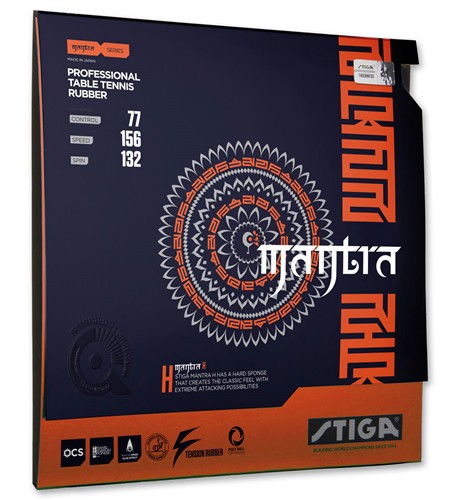
The Mantra H is the hardest sheet in the original Mantra series, sitting above the softer M and S, and it came out of Stiga’s first tensor line built with Japanese rubber technology. Stiga aimed it at players chasing the top of the speed and spin ceiling from an inverted rubber, and it brought a grippy topsheet that earlier Stiga Japanese lines like the Airoc series never had. Sponge hardness runs around 47 to 47.5 degrees, the same bracket as the Tibhar MX-P, Fastarc G1, and Rasanter R47, but reviewers keep calling its trajectory and feel its own thing. The original is discontinued now, replaced by the Mantra Pro H, yet the Mantra H still turns up in club play and equipment threads.
Performance
Speed is what defines the Mantra H, and it comes straight off the catapult. Reviewers put it at or above the Tibhar MX-P for pure pace, and the low, sharp throw angle hides the ball from opponents who expect a flatter or higher arc. The topsheet grips hard with no real tackiness, so a clean brush loads heavy topspin and backspin balls lift more easily than they would off a softer or duller sheet.
Blocking and countering is where it earns its keep. Returns skim just over the net and die fast on the far side, a habit that comes straight from the low-arc build. Revspin, MyTableTennis, and TableTennisReference all flagged the blocking on their own, which makes the rubber a real threat for anyone playing tight, aggressive close-to-table defense and counter-attack.
The cost is dwell time. Between the hard sponge and the strong catapult, the ball leaves quickly, and you get less window to fine-tune spin or direction. That puts everything on technique. Land a clean brushing stroke and you get heavy spin and pace; arrive with developing mechanics and the rubber punishes you. On the backhand the hardness is too much for most players, and reviewers say flatly not to bother there.
Blade choice swings the result hard. On a Carbonado 290 or another fast carbon blade, only the most experienced attackers keep it under control. Drop it onto an all-around or off-minus blade, an Allround Classic or a Timo Boll Spirit, and the best of the rubber shows up while the shots stay manageable. Durability is the known weak point: around 1.5 to 2 months in, the topsheet pimples start to surface-float, and by the 3-month mark drive performance has dropped far enough to swap it out.
What Reviewers Agree (and Disagree) On
Reviewers agree the Mantra H gives you forehand speed and spin for well under flagship money, and that the blocking stability is one of its best traits. The limitations are just as settled: too hard for the backhand, short dwell time, below-average durability. The one mild split is throw angle. Most sources call it low or medium-low, which the MyTableTennis reviewer treated as an advantage, while at least one Revspin reviewer logged it as medium-high, probably down to blade and stroke differences. Overall scores cluster from 8.5 to 9.2 on community sites, with TableTennisReference lower at 8.33, a number pulled down by that site’s wider pool of less experienced reviewers who wrestle with the hardness.
Who Should Buy It
The Mantra H fits intermediate to advanced players who have a forehand loop dialed in and want a hard tensor with power and spin minus the Butterfly Tenergy or Dignics price. It rewards close-to-table attacking paired with tight blocking, for players who don’t mind driving hard through a stiffer sponge. Still grooving your stroke mechanics, or shopping for a backhand rubber? Go softer with the Mantra M or Mantra S. And if you already run the Mantra H, note the Mantra Pro H now carries the line forward off the same formula.
FAQ
How does the Stiga Mantra H compare to the Mantra M?
The Mantra H is faster and harder than the Mantra M, with a lower, sharper throw. Reviewers call the M the tamed H: it keeps most of the spin but is easier to control and a better pick if you want more dwell time or plan to run it on the backhand too.
What blade pairs best with the Mantra H?
Reviewers steer you toward a medium-speed blade in the all-around to off-minus range, an allround classic wood blade or a carbon blade at the slow end of off. Put it on a very fast off-plus carbon blade and the catapult goes up while control drops to where only elite players stay comfortable.
Is the Stiga Mantra H suitable for the backhand?
No, for most players. At around 47 degrees the sponge is too stiff for the backhand. Reviewers keep it forehand-only and point you to the Mantra S or M if you want a Mantra rubber on the backhand.
How long does the Stiga Mantra H last?
Train two to three hours a day, five days a week, and reviewers report the peak holding roughly 1.5 to 2 months before the topsheet pimples start to float. By about 3 months drive consistency falls off noticeably. Play lighter and it lasts longer, but against German tensor rubbers the durability is below average.
Is the Stiga Mantra H still available?
The original Mantra H is discontinued and out of production. Stiga released the Mantra Pro H as the successor, built on the same lineage with updated construction. Some retailers may still have original stock on the shelf.
How does the Mantra H compare to the Tibhar MX-P?
Reviewers rate them close in speed, with the Mantra H sometimes nudging ahead. The real gap is trajectory: the Mantra H throws sharper and lower, which makes shots harder for an opponent to read. The MX-P covers more playing positions, while the Mantra H wants the front court.
Sourced From
This review synthesizes opinions from 4 independent community sources:
- Revspin (forum)
- MyTableTennis (forum)
- TableTennisReference (forum)
- Reddit (forum)