Donic Defplay Senso V3 Review: The Defender's Control Weapon
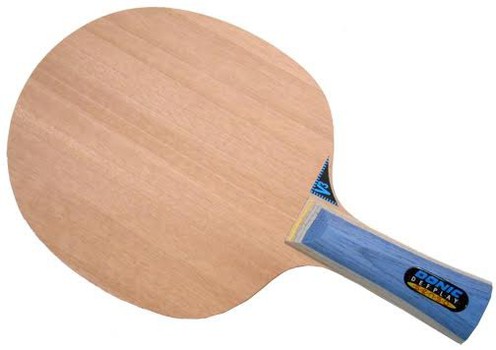
Pros
- Exceptional control rating — one of the highest among defensive blades
- Produces more backspin on chops than most comparable all-round or defensive blades
- Enlarged head size increases the effective sweet spot for off-center defensive strokes
- Senso V3 handle dampening technology reduces shock and vibration
- The same dwell that loads chops also loads heavier topspin on loops than a DEF board suggests
- Used by professional players including Wu Yang at elite level
- Outstanding value for money at under 60 USD
Cons
- Too soft for adequate spin reversal with very low-friction long pimples (e.g. Grass DTecs)
- Wide flared handle design makes twiddling difficult
- Passive blocking can feel slow and requires rubber selection to compensate
- Head-heavy balance with dual thick rubbers mounted
The Defplay Senso V3 is a purpose-built defensive blade from German maker Donic, made for the modern defender who chops from distance and still has to counter-attack with pace. It is 5-ply all-wood: Gabon outer plies, Anegre sub-outer plies, and an Abachi core. The Senso V3 handle adds a hollow void design that lifts feel and trims unwanted vibration, and the head runs 3mm larger than standard, which drops the resonance frequency and adds dampening. Donic rates it 63 for speed and 94 for control, square in the DEF category. The review pile is unusually deep for a budget defensive blade — 14 on Megaspin, 48 on Bladerubber.net, plus a steady run of Reddit defensive-play threads — and it skews strongly positive.
Performance
The one thing every source keeps returning to is the backspin this blade loads onto chops. Reviewer after reviewer got caught off guard by how much it puts out. One Megaspin reviewer called it ‘significantly spinnier than any other all-round blade I have tried,’ and a Bladerubber.net reviewer named it ‘the blade that produced the most spin I found in any blade while still having good speed and control.’ The source is the soft, dampening outer plies and the thin 5.5mm build, which let the ball sit on the surface longer through a chop.
On attack it does more than its DEF rating promises. The same dwell that helps the chop also loads topspin on loops, and several reviewers got heavier loop spin than they expected from a defensive board. The Megaspin crowd described looped balls coming off like ‘a Ronaldo free kick.’ Passive shots are where it goes slow. Push blocks and flat hits need a faster rubber on at least one side for pace, and a power smash wants good technique plus a faster forehand rubber to put the ball away.
In blocking the flex cuts both ways. At moderate speeds the dampening earns its keep, soaking up pace and buying the defender time to reset. At high ball speeds the flex adds some trajectory unpredictability, and one Bladerubber.net reviewer noted that ‘excessive flexibility can affect blocking consistency.’ For close-table push blocking the reviewers are unanimous: the large head and high control land pushes exactly where you aim.
Reviewers like the Senso V3 handle for its comfortable grip and dampened feel. The flared version sells most, though several call it wider than average, which makes twiddling, flipping the blade to swap forehand and backhand rubber, harder. If you twiddle as a tactic, take the straight handle. The blade weighs about 74 grams unloaded, with natural wood variation of plus or minus 7 grams, light for a defensive board, but the enlarged head tips the balance slightly top-heavy once two sponge rubbers go on.
What Reviewers Agree (and Disagree) On
Across Megaspin, Bladerubber.net, and Reddit, reviewers agree on the core strengths: high control, heavy backspin on chops, good value, and range for the modern defensive style. The argument is rubber compatibility. Some get fine results with slow long pimples on the backhand, while others warn the blade is ‘too soft to get reversal’ with very low-friction pimples like Grass DTecs or Bomb Talent. If you live on pimple-generated reversal, test your exact combination before you commit. The second split is handle comfort: most praise the flared grip, a minority find it too wide or oddly shaped for their hand.
Who Should Buy It
The Defplay Senso V3 is the right call for intermediate-to-advanced defensive choppers who put spin and control ahead of raw speed. It fits players who chop from mid-to-long distance and counter-attack now and then, not blockers camped at the table. Newcomers to defense gain from the forgiving large head and high control rating. Skip it if you need heavy spin reversal from low-friction long pimples, if you twiddle often and want a slim handle, or if you mostly attack and only defend once in a while.
FAQ
Is the Donic Defplay Senso V3 suitable for beginners?
Yes. The 94 control rating and the enlarged head keep it forgiving while you build consistent defensive mechanics. Several reviewers call it accessible for beginners yet competitive at higher levels.
What rubbers work best with the Defplay Senso V3?
On the forehand, reviewers reach for a medium-speed to fast inverted tensor around 1.8mm to 2.0mm to add attacking pace. On the backhand, standard long pimples with some friction handle chopping and blocking well. Steer clear of very low-friction long pimples like Grass DTecs at OX, since the blade may be too soft to pull meaningful reversal from those sheets.
How does the V3 version differ from the original Defplay Senso?
The V3 adds the void design to the Senso handle, which raises dampening and sharpens feedback. The head also grew 3mm over the original, cutting vibration further and widening the effective sweet spot on off-center hits.
Is this blade used by professional players?
Yes. Several reviewers confirm it has seen international play in the hands of Wu Yang (former World Champion), Wang Xi, and Masato Shiono, which tells you something about its competitive ceiling despite the low price.
What is the actual weight of the Defplay Senso V3?
Donic lists a nominal 74 grams with a natural variation of plus or minus 7 grams from the wood. Real-world reviews confirm units from around 74 grams to about 85 grams depending on the piece.
Can this blade handle an offensive playing style?
It can carry occasional offense. Loops and counter-hits are on the table, especially with a faster rubber on the forehand. But this is a real DEF-rated blade, not built for an attack-first player. If you attack more than 40 percent of the time, take an ALL or OFF- rated blade instead.