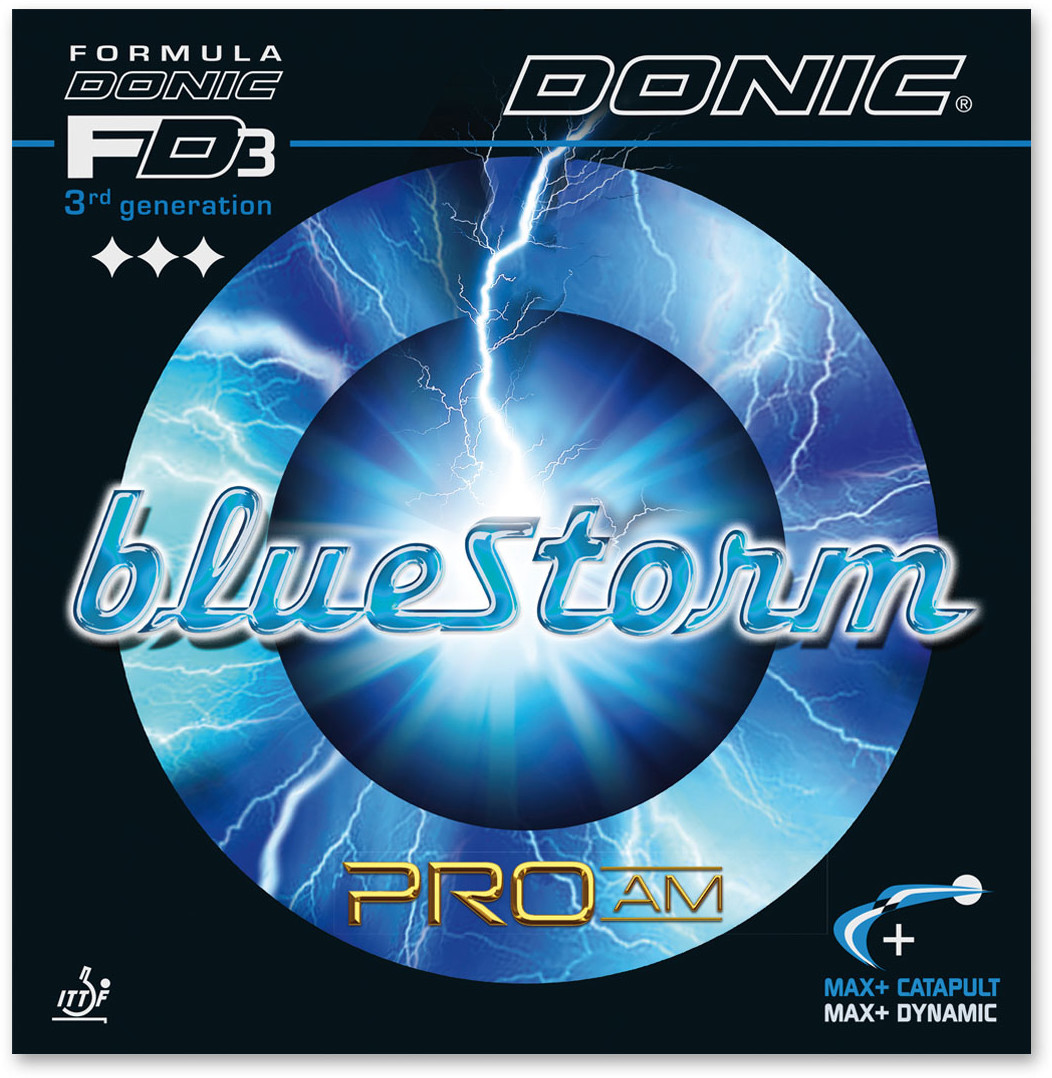
Donic Bluestorm Pro AM Review: Balanced Tensor for All-Round Offensive Players
Pros
- Loads heavy rotation on serves and topspins thanks to the slightly tacky topsheet
- Multi-gear feel: output scales with player technique and power
- Holds spin, speed, and control together rather than trading one for another
- Performs well in loops, blocks, counters, and short game
- Lighter weight (around 50g uncut) makes it easy to swing
- Solid durability reported by multiple long-term users
Cons
- Premium price point compared to similarly performing alternatives
- Mid-distance power drops off under very high-paced conditions
- Requires a fast blade and active technique to unlock full potential
- May disappoint players expecting Tenergy-level explosiveness out of the box
The Bluestorm Pro AM lands in the middle of the Bluestorm Pro range, between the entry-level Z-series and the harder 50-degree Bluestorm Pro. A 47.5-degree sponge and a slightly tacky inverted topsheet point it at all-round offensive players who want spin and control without the stiffness of the harder Pro. It built a strong reputation after release and at one point sat at the top of at least one major rubber database.
Performance
Spin is the thing reviewers keep coming back to. The slightly tacky topsheet holds the ball for a beat on contact and loads heavy rotation onto serves, topspins, and flicks. Several reviewers stacked it favorably against Tenergy 05, and one found his serves spinnier than with Stiga DNA Pro or Hexer Powergrip. Close to the table it does its best work: blocks come back controlled and placed, counterloops clear cleanly, and lifting backspin into topspin is easier than with most European rubbers in this hardness band.
The multi-gear behavior is the standout. How fast the ball comes off depends on how much force you put in, which pays off for clean strokes without punishing slower play, so it opens up to a wider range of players than a 50-degree sheet would.
The limit shows up at distance. At mid-distance or in power exchanges, some players feel it doesn’t pop like the harder Pro or rubbers like Rasanter R47. That’s the trade Donic made to give the AM its all-round character, and players who live in heavy mid-distance topspin battles will get more from the harder variant.
The backhand is where it sings. Forgiving in fast exchanges, grippy enough for spin in tight spaces, controlled enough to swallow heavy incoming topspin without the ball sailing long. Several experienced players who ran both the Pro and the AM picked the AM on the backhand for the extra margin. Forehand reactions split by style: loopers tend to love it, while flat-hit and power players sometimes want more speed.
What Reviewers Agree (and Disagree) On
Broad agreement that the AM is a quality rubber with strong spin, good control, and reliable play across most close-table strokes. The argument is about how it measures up to Donic’s pro-player marketing. Some experienced and ex-competitive players think the AM falls short for high-level backhand play and tell you to step up to the harder Pro or move to Rasanter R47 for power. Intermediates and technically minded advanced players push back and rate its spin and control ceiling high. Durability splits too: some get excellent life after months of regular use, others see early wear. Almost everyone agrees the price runs high next to alternatives like the Bluestorm Z2.
Who Should Buy It
The AM fits intermediate and advanced all-round attackers who put spin and control ahead of raw explosiveness. If you’re coming off a softer rubber like the Bluestorm Z2 and want more bite and arc without the full 50-degree stiffness, it’s a natural step up. It works best as a backhand rubber on carbon or composite blades in the OFF to OFF+ range. Senior players and those still building technique will lean on how forgiving it stays at lower contact speeds. Chasing maximum mid-distance power or a very explosive flat-hitting sheet? Look at the harder Bluestorm Pro or another brand.
FAQ
How does the Bluestorm Pro AM compare to the Bluestorm Pro?
The Pro runs a 50-degree sponge, so it’s stiffer and hits harder at mid-distance. The AM’s 47.5-degree sponge is more forgiving, easier to control, and the usual pick for the backhand. The Pro suits higher-level forehand or power styles; the AM aims at all-round offense and backhand-focused setups.
Is the Bluestorm Pro AM suitable for beginners?
Not really. This is a performance rubber that rewards good technique and wants consistent active play. Beginners will fight to control it, especially on faster blades. Intermediate players building an all-round offensive game get the most out of it.
What blades pair well with the Bluestorm Pro AM?
Reviewers keep naming inner carbon and arylate-carbon blades in the OFF to OFF+ range. Inner force style blades hold control while still feeding enough speed to wake the rubber’s upper gears. Steer clear of very stiff or very fast outer carbon blades unless your technique can handle the pairing.
Does the Bluestorm Pro AM need to be reboosted?
Some units show up with heavy factory tuning that feels great at first and fades over time. Most players never need to reboost it. If you want to hold peak performance, a thin layer of booster after a few months of use does the job.
How does it compare to Tenergy 05?
Several reviewers rate the AM close to Tenergy 05 on spin and speed, with the AM giving a bit more control and a more forgiving feel. Tenergy 05 has a stronger spring and higher automatic speed; the AM asks for more active input. The AM usually costs less than Tenergy 05, which is a big part of its appeal.
Is the Bluestorm Pro AM better on forehand or backhand?
It works on both sides, but most reviewers favor it on the backhand, where its control, spin, and forgiveness pay off. On the forehand, loopers will enjoy it, while flat power hitters tend to want something faster.
Sourced From
This review synthesizes opinions from 4 independent community sources:
- Revspin (forum)
- TableTennis11 (ecommerce)
- TableTennis-Reference (forum)
- TableTennisDaily (forum)