Donic Waldner Black Devil Carbon Balsa vs Donic Waldner Legend Carbon: Which Should You Buy?
| Donic Waldner Black Devil Carbon Balsa | Donic Waldner Legend Carbon | |
|---|---|---|
| Our rating | 7.8/10 | 8.3/10 |
| feel | stiff, minimal dwell | Stiff, hard, linear with clear ball feedback |
| handle | Anatomic / Flared / Straight | Concave (flared), Straight |
| plies | 7-ply: Koto outer + carbon + balsa core | 5-ply: kiso hinoki (outer) + carbon + kiri (core) + carbon + kiso hinoki |
| speed | OFF+ | OFF+ |
| thickness_mm | approx 6.0mm | 6.3 |
| weight_g | around 84g | 84-85 |
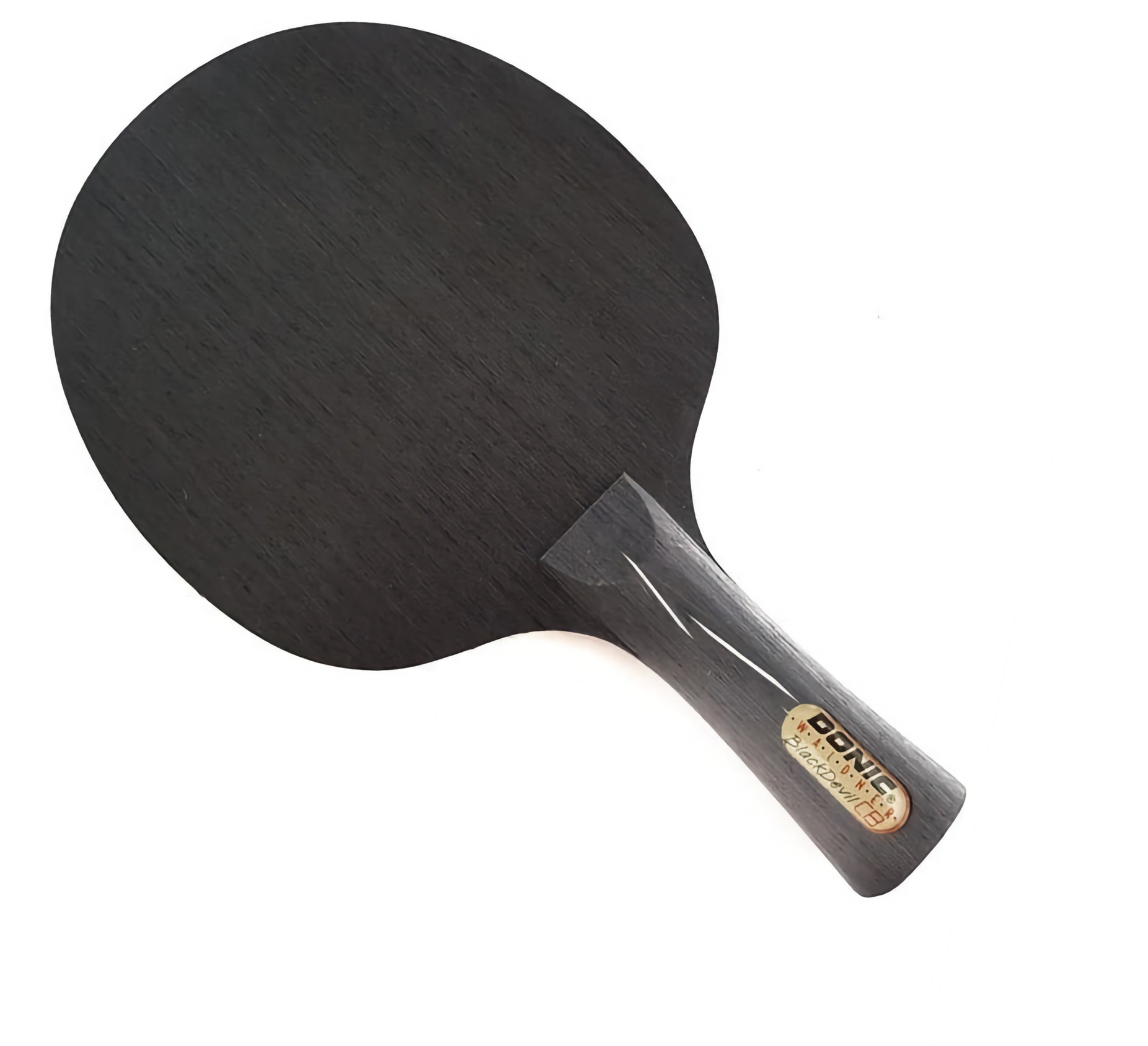
Donic Waldner Black Devil Carbon Balsa
Check price on AmazonRead the full Donic Waldner Black Devil Carbon Balsa review →
We may earn a commission from links on this page. Learn more.
The short answer
Both blades wear the Waldner name and share the same brand DNA, but Donic built them to solve different problems. The Black Devil Carbon Balsa (BDCB) is the flat-hitter’s tool: a balsa-carbon composite tuned for maximum pace with almost no dwell time. The Legend Carbon is the looper’s tool: a hinoki-carbon build that trades a little raw stiffness for control that aggregated scoring rates nearly a full point higher. If you rally mostly with topspin exchanges rather than finishing points flat, Legend Carbon is the better fit. If your game is built around the flat kill shot, BDCB still has an edge worth keeping.
What the axis numbers actually say
The five-axis comparison here is more useful than either blade’s overall rating, because the two ratings (7.8 for BDCB, 8.3 for Legend Carbon) hide how close some axes really are and how far apart others are.
Speed: BDCB scores 9.4 against Legend Carbon’s 9.1, a 0.3 gap. That is not a gap you will feel on the table — both blades are legitimately fast OFF+ builds, and this difference sits well inside the noise of how aggregated user ratings get generated in the first place. Anyone telling you BDCB is “the fast one” and Legend Carbon is “the slow one” is overstating a rounding error.
Control: this is where the two blades actually diverge, 8.0 for BDCB against 8.9 for Legend Carbon, a 0.9 gap. Nearly a full point on a control axis is the difference between a blade that punishes small technical errors and one that gives you a bit of room to be imperfect on the block or the touch shot. Legend Carbon’s enlarged sweet spot and hinoki outer plies are doing real work here, not just marketing copy.
Stiffness and hardness move the other way: BDCB reads 7.4 on both against Legend Carbon’s 6.5 and 6.6, gaps of 0.9 and 0.8. Combined with BDCB’s near-zero dwell time (a con flagged independently across multiple sources), this is the clearest signal that BDCB wants to be swung fast and flat, not loaded up for a loop.
Consistency is a dead heat at 9.1 for both. Whichever you pick, you are not trading away reliability.
Where these numbers come from
Both blades carry real third-party review history rather than single-source hype. BDCB’s specs and user reports are covered by Megaspin, Revspin, Donic’s own product page, and a TableTennisDaily forum thread specifically about the blade’s flex characteristics. Legend Carbon draws on Megaspin, PpongSuper, Table Tennis Spot, and Donic’s official listing. The consistent theme across sources on the Legend Carbon side is short-game control and blocking quality “for an offensive blade” — reviewers keep noting that it does not feel like a typical stiff carbon OFF+ blade at the net, which lines up with the 0.9-point control edge in the axis data.
Is it worth switching from one to the other
If you already own BDCB and loop-heavy opponents are giving you trouble at the table, Legend Carbon is a reasonable, low-risk upgrade — same brand, same signature series, near-identical weight (84g vs 84-85g) and speed class, so your rubber setup should transfer with minimal adjustment. The catch: Legend Carbon’s own notes flag that its control still “demands real technical competence to exploit,” so this is not a beginner-friendly control blade, it is a more forgiving version of an advanced tool.
Going the other way, from Legend Carbon to BDCB, only makes sense if you have specifically outgrown the looping game and want to commit to flat power hitting. Given BDCB’s cons — near-zero dwell making heavy topspin difficult, a smaller head that increases edge mishits, and fragile koto and balsa veneers that chip without edge tape — this is a narrower, more specialized purchase than Legend Carbon.
Who each blade actually fits
BDCB fits advanced attackers with a flat-hit, smash-dominant game who want to stay under 85 grams; Donic itself suggests pairing it with soft-to-medium-soft rubbers like Tenergy 05 FX to tame its stiff, fast character. Legend Carbon fits advanced offensive players who loop close to the table and want speed without sacrificing the forgiving sweet spot — its excellent topspin generation pairs particularly well with medium-soft rubbers, and reviewers consistently rate its build quality as rivaling blades that cost noticeably more.
For most players choosing between the two from scratch, Legend Carbon’s better control score and more balanced axis profile make it the safer first purchase; BDCB is the specialist’s second blade, not the average player’s first one.
Frequently asked questions
Is the Donic Waldner Legend Carbon faster than the Black Devil Carbon Balsa?
No, barely -- BDCB actually scores 0.3 higher on speed (9.4 vs 9.1), which is within rating noise. The real difference is control, where Legend Carbon leads by 0.9 points.
Should I upgrade from Black Devil Carbon Balsa to Legend Carbon?
If you're getting outlooped at the table, yes -- similar weight and speed class but meaningfully better control. If your game is purely flat power hitting, BDCB still does that job better.
Which blade is more beginner friendly?
Neither is really a beginner blade. Legend Carbon's own notes state its control rating demands real technical competence to exploit, so treat both as advanced-player equipment.
What rubbers pair well with each blade?
BDCB is tamed by soft-to-medium-soft rubbers like Tenergy 05 FX or Donic JO Platin. Legend Carbon's topspin game also comes out best with medium-soft rubbers, though its stiffer plies handle a wider rubber range.