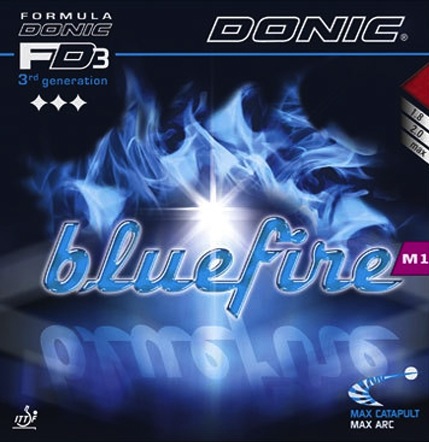
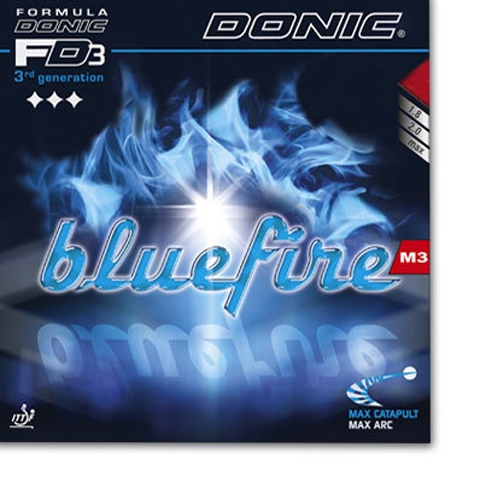
Donic Bluefire M1 vs Donic Bluefire M3: Which Should You Buy?
| Donic Bluefire M1 | Donic Bluefire M3 | |
|---|---|---|
| Our rating | 8.4/10 | 8.3/10 |
| best_side | Forehand | backhand |
| control | 9.1 / 10 | High |
| speed | 9.7 / 10 | Medium-high (ALL+ to OFF-) |
| spin | 9.0 / 10 | Very high |
| sponge_hardness | 47.5 degrees (medium-hard) | 40 degrees (ESN), approximately 33-34 degrees Shore A |
| type | Inverted / Tensor | inverted |
| weight_uncut_g | approx 49 g | 47 |
We may earn a commission from links on this page. Learn more.
Donic Bluefire M1 and M3 occupy opposite ends of the same product family. M1 is the hardest and fastest Bluefire M option, with high throw angle and heavy topspin loops. Competitive pricing versus Tenergy 05, long durability, and excellent close-to-table control suit advanced players. However, it demands advanced technique and fades after one to two months of use.
M3 is the softest and most control-oriented, emphasizing forgiveness and loop-friendly dwell. Long dwell time and forgiving contact suit spin-first games. Topsheet durability is below-average, and it incompletely satisfies flat hitters or smash players.
FAQ
Which is faster?
M1 rated 9.7 out of 10. M3 is medium-high. Speed gap is significant.
Which is more forgiving?
M3 far more forgiving. M1 demands advanced technique and penalizes weak swings.
Can both be used as backhand rubbers?
M3 is designed for backhand. M1 is forehand-oriented and not ideal for backhand use.
Which suits intermediate players?
M3 is more accessible. M1 requires 1500-plus USATT rating or equivalent.
Which has better spin generation?
M1 rated 9.0, M3 also very high. Spin is similar; M1’s higher throw angle suits looping.