Butterfly Tenergy 05 vs Stiga DNA Pro H: Which Should You Buy?
| Butterfly Tenergy 05 | Stiga DNA Pro H | |
|---|---|---|
| Our rating | 9.0/10 | 8.8/10 |
| Best side | Both wings | Forehand |
| Control (different scales) | medium-high | 8 |
| Speed (different scales) | 13.0/14 | 9 |
| Spin (different scales) | 11.5/12 | 9 |
| Sponge hardness (different scales) | 36° (Butterfly scale) | 50 degree |
| Type | tensor inverted | inverted |
| Uncut weight | 68 g | 54 g |
A row marked “different scales” puts two rating systems in one line. Those cells are not a single score you can subtract.

We may earn a commission from links on this page. Learn more.
A cost-effective claim worth checking against the numbers
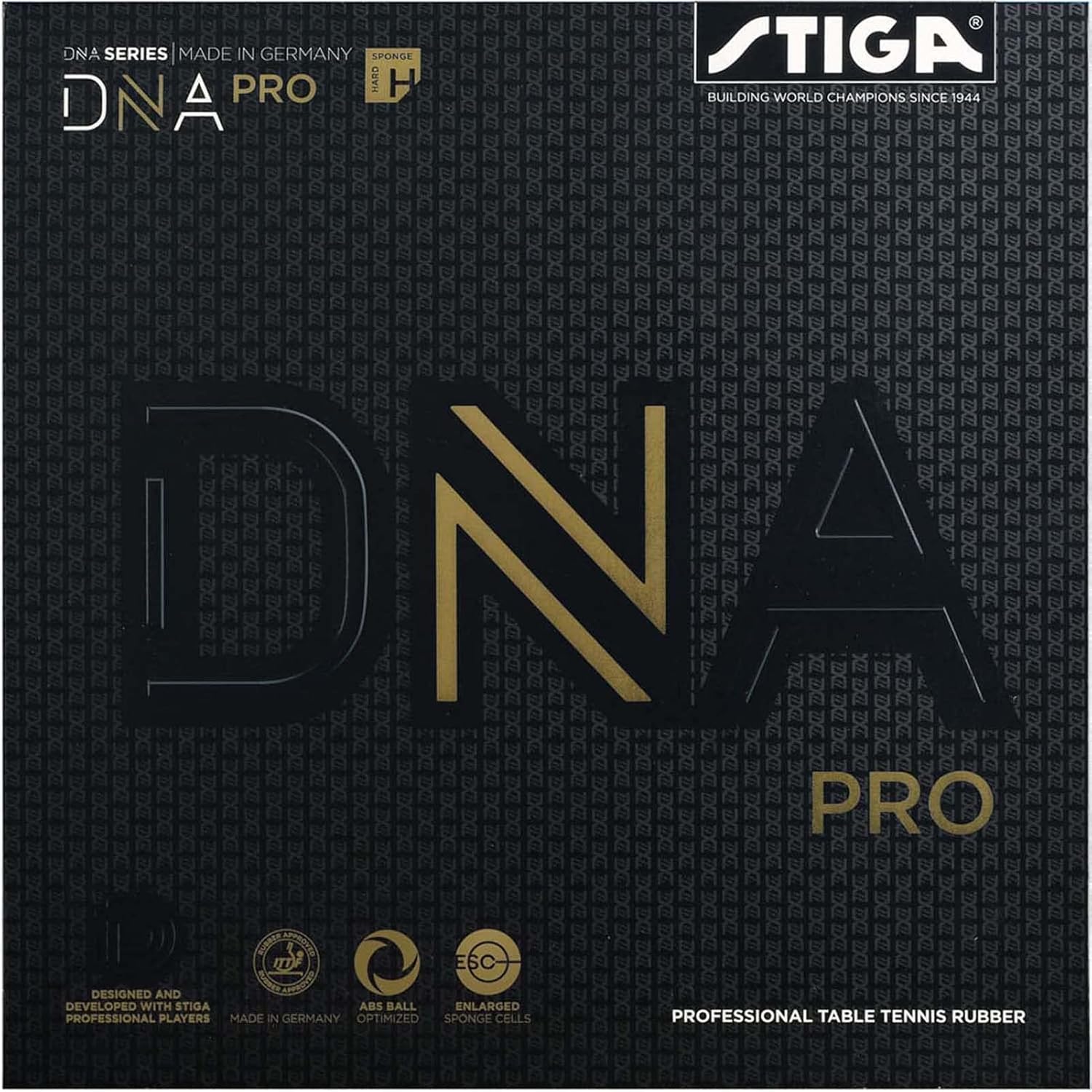
Stiga positions DNA Pro H as delivering roughly 95 percent of Tenergy 80’s performance without the premium price tag, and reviewers rate it close to Tenergy 05 in overall score, 8.8 versus 9.0. The aggregated axis data mostly supports treating DNA Pro H as a legitimate value alternative, with one clear exception worth flagging before you buy.
Throw is the biggest gap on the sheet
Tenergy 05 leads DNA Pro H by 1.4 points on throw (7.6 versus 6.2), the largest single-axis gap in this comparison. That sits in some tension with DNA Pro H’s own pros, which list “high throw angle makes topspin attacks safer over the net” as a selling point. Both things can be true: DNA Pro H’s throw is high relative to other mid-priced tensors in its price bracket, which is likely the comparison Stiga’s marketing has in mind, but it is still meaningfully below Tenergy 05’s benchmark-level arc in absolute terms. If a big, safe margin over the net on topspin is what you value most about Tenergy 05, DNA Pro H will feel like a real step down on that specific axis, even though it is a strong rubber overall.
Spin and speed favor Tenergy 05, but not dramatically
Spin shows a 0.8-point gap (9.4 versus 8.6) and speed a 0.5-point gap (9.3 versus 8.8). Both favor Tenergy 05 but stay in noticeable-not-decisive territory, consistent with community reviews rating DNA Pro H’s own grip and spin at “9.03 out of 10,” a very strong number in its own right, just shy of Tenergy 05’s ceiling.
Control is essentially tied
The control gap is just 0.1 points (8.3 versus 8.4, DNA Pro H fractionally ahead), functionally identical. This is a useful data point for anyone worried that DNA Pro H’s speed-first reputation comes at the cost of control: on the aggregated numbers, it does not.
Durability and tackiness lean toward Tenergy 05, modestly
Durability favors Tenergy 05 by 0.6 (7.7 versus 7.1) and tackiness by 0.4 (2.3 versus 1.9). Neither gap is large enough to be a standalone reason to choose one rubber over the other, though DNA Pro H’s own cons acknowledge “loop power against heavy backspin is only average,” which is consistent with its lower throw number limiting how easily it lifts backspin compared with Tenergy 05.
The weight surprise
One spec row is worth flagging on its own: DNA Pro H is dramatically lighter uncut than its firmness would suggest, at 54g versus Tenergy 05’s 68g. DNA Pro H’s own cons describe it as “heavy at around 51-54g uncut,” which reads as heavy in isolation but is actually 14 grams lighter than Tenergy 05 on this data. If you are chasing a specific racket weight, this gap matters more than any axis score.
Should you switch?
For a forehand-only mount, which is what DNA Pro H’s own spec data recommends versus Tenergy 05’s both-wing versatility, DNA Pro H is a defensible downgrade from Tenergy 05 with control held essentially even and speed, spin, and durability trimmed only modestly. The one place to think twice is throw: if the reason you play Tenergy 05 is its safety margin looping against backspin, the 1.4-point gap here is the largest in the whole comparison and the one place DNA Pro H genuinely gives something up, regardless of how its own marketing frames the throw angle. Per Revspin, Tabletennis11, and Tabletennis-Reference data, DNA Pro H earns its cost-effective-alternative label on most axes, throw being the clear exception.
The bottom line on the switch
Think of it this way: DNA Pro H is not a rubber pretending to be Tenergy 05 and falling short across the board. It is a rubber that matches Tenergy 05 on control, trims speed and spin by less than a point each, and gives up real ground specifically on throw and, to a lesser extent, durability. If your game does not lean heavily on a high, safe arc against backspin, the practical difference between these two sheets is smaller than the price gap implies. If it does, keep Tenergy 05 or budget for a rubber closer to its throw number.
Frequently asked questions
Does Stiga DNA Pro H really throw as high as Tenergy 05?
No. Tenergy 05 leads by 1.4 points on throw (7.6 versus 6.2), the largest gap in this comparison, despite DNA Pro H's own marketing calling out a high throw angle.
Is DNA Pro H's control worse than Tenergy 05's?
No, the gap is just 0.1 points and DNA Pro H is fractionally ahead (8.4 versus 8.3), essentially a tie.
Which rubber is heavier?
Tenergy 05, by a wide margin, 68g uncut versus DNA Pro H's 54g, despite DNA Pro H's own cons describing itself as heavy.
Is DNA Pro H a good budget alternative to Tenergy 05?
Mostly yes. Spin and speed trail by modest amounts, 0.8 and 0.5 points, and control is tied, but throw is 1.4 points lower, the one axis where the gap is significant.