Butterfly Tenergy 05 vs Loki RXTON 1: Which Should You Buy?
| Butterfly Tenergy 05 | Loki RXTON 1 | |
|---|---|---|
| Our rating | 9.0/10 | 8.0/10 |
| Best side | Both wings | Both wings |
| Control | medium-high | very high |
| Speed (different scales) | 13.0/14 | low to medium |
| Spin (different scales) | 11.5/12 | high |
| Sponge hardness (different scales) | 36° (Butterfly scale) | medium (around 38-39 degrees Chinese scale, roughly 50-52 ESN) |
| Type | tensor inverted | tacky inverted (budget) |
| Uncut weight | 68 g | 64 g |
A row marked “different scales” puts two rating systems in one line. Those cells are not a single score you can subtract.

We may earn a commission from links on this page. Learn more.
A premium rubber against a $15 rubber
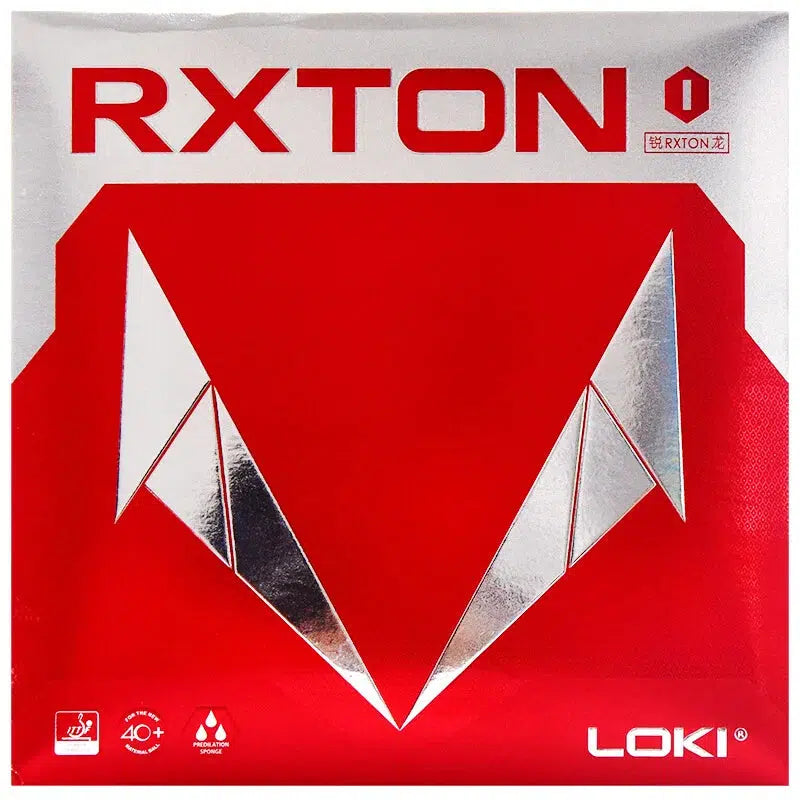
Butterfly Tenergy 05 and Loki RXTON 1 are not really competing products — one is the sport’s most benchmarked premium tensor, rated 9 out of 10 overall, and the other is a budget sheet built to cost roughly $15 a sheet and be replaced without a second thought. The interesting question is not “which is better,” since Tenergy 05 clearly is on most axes, but “how much better, on which specific axes, and is that gap worth the price difference for your level.”
Where Tenergy 05 actually pulls away
Three axes show real separation. Speed shows the largest gap on the whole sheet: 9.3 versus 6.0, a 3.3-point delta. Spin is next at 1.9 (9.4 versus 7.5), and durability follows at 2.7 (7.7 versus 5.0). These are the axes where premium tensor engineering earns its price: Tenergy 05’s Spring Sponge and High Tension build generate catapult and spin that a budget sheet’s simpler tacky-inverted construction cannot match, and Tenergy 05’s topsheet holds its throw angle “even as an old sheet ages, just slower” rather than going dead. Loki RXTON 1, by contrast, is explicitly positioned as disposable — its own pros list “so cheap you can replace it monthly without worry” as a selling point, which is the flip side of that durability gap.
Where the gap nearly disappears
Control is the number that should reframe how you think about this comparison: Tenergy 05 scores 8.3, Loki RXTON 1 scores 8.5 — RXTON 1 is marginally ahead, a -0.2 delta in the budget rubber’s favor. For a rubber costing a fraction of the price, that is a genuinely useful data point: you are not paying the Tenergy premium for more control. You are paying it for speed ceiling, spin ceiling, and a topsheet that survives years rather than months. Tackiness also favors RXTON 1 slightly (3.5 versus 2.3, a 1.2-point gap), though both sheets sit toward the low-to-mid end of the tackiness scale and the practical difference in serve grip is modest rather than dramatic.
What this means for a beginner or budget-conscious buyer
RXTON 1’s own review data backs up the control number: it is described as delivering “very high control that makes the table easy to hit and hard to miss” and is aimed squarely at “beginners and returning players building a first inexpensive custom racket.” If you are at that stage, Tenergy 05’s extra speed and spin are not just unnecessary, they can work against you — more spin sensitivity on serve receive, a punishing reaction to flat blocks and chops, and a bouncier, higher-throw feel that is harder to control precisely because there is more energy to manage, not less. The control score bears this out: on the aggregate number, RXTON 1 does not give up anything for being cheap.
What this means for an advancing or competitive player
Once you can consistently generate your own spin and timing rather than relying on the rubber to do it for you, the calculus flips. Tenergy 05’s 3.3-point speed edge and 1.9-point spin edge become weapons rather than liabilities, and its durability advantage (7.7 versus 5.0) starts to matter financially too — a rubber that holds its throw angle for longer needs replacing less often even at a higher unit cost, partially offsetting the price gap over a season.
The honest recommendation
There is no real case for a true beginner buying Tenergy 05 over RXTON 1 — the control numbers are essentially tied, and everything RXTON 1 gives up (speed, spin, durability) is exactly the stuff a new player cannot use safely yet. There is also no real case for a spin-dependent attacking player sticking with RXTON 1 once their technique outgrows it, because the axes where Tenergy 05 dominates are the axes that decide matches at that level. RXTON 1 is best treated as what its own review data says it is: a genuinely good stopgap or training rubber, not a compromise you settle for, per Revspin and TableTennisDaily community feedback.
Frequently asked questions
Is Loki RXTON 1 good enough for a beginner instead of Tenergy 05?
Yes, by the numbers. Its control rating (8.5) is essentially tied with Tenergy 05's (8.3), and RXTON 1's own review data is built around very high control that makes the table easy to hit and hard to miss.
What does Tenergy 05's higher price actually buy?
Mostly speed, spin, and durability. The gaps are 3.3 points on speed, 1.9 on spin, and 2.7 on durability -- not control, where the two are nearly tied.
How long does each rubber last?
Loki RXTON 1 scores 5.0 on durability versus Tenergy 05's 7.7, though RXTON 1's low cost, around $15 a sheet, makes frequent replacement inexpensive by design.
Should an intermediate player upgrade from RXTON 1 to Tenergy 05?
Once you can generate your own spin and timing rather than relying on the rubber, yes. The axes Tenergy 05 wins (speed, spin, durability) become genuine advantages rather than unmanageable extra energy.