Butterfly Korbel vs Yasaka Sweden Extra: Which Should You Buy?
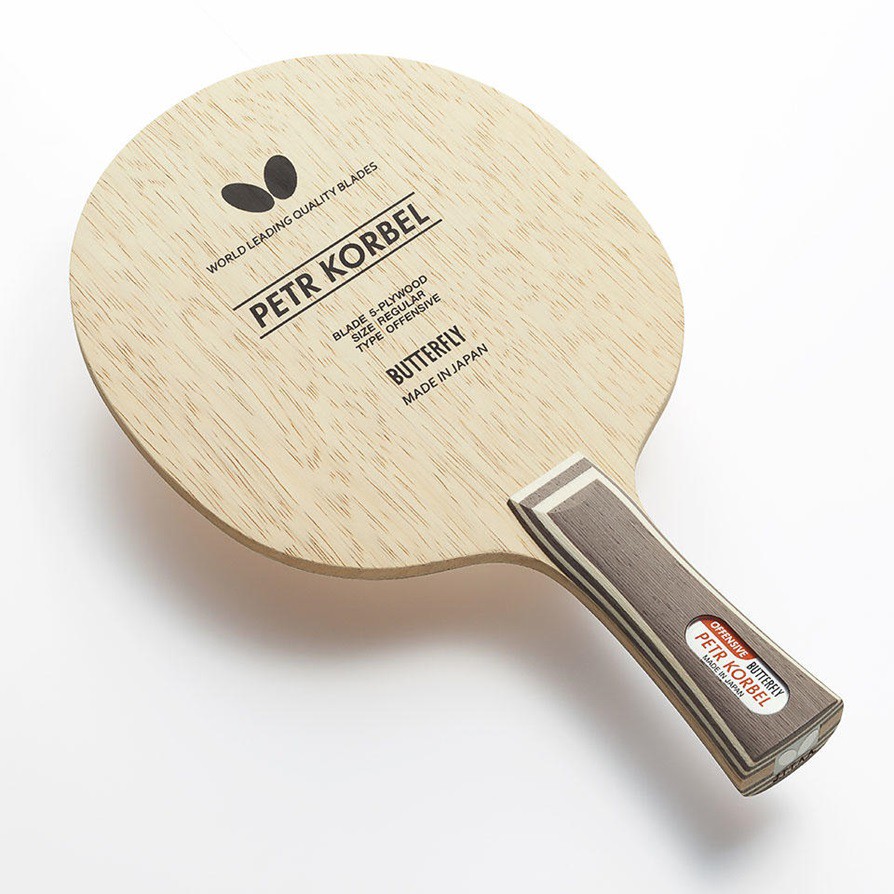
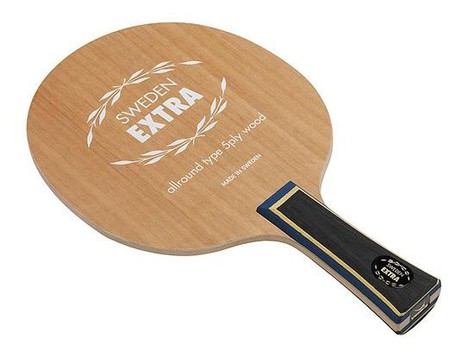
| Butterfly Korbel | Yasaka Sweden Extra | |
|---|---|---|
| Our rating | 8.6/10 | 8.7/10 |
| Feel | medium, soft and flexible all-wood with long dwell | soft-medium, high control |
| Handle | FL/ST | FL/ST |
| Plies | 5W (all wood) — limba-limba-ayous-limba-limba | 5W (all wood) |
| Speed | OFF- | ALL+ |
| Sponge thickness | 6 mm | 5.7 mm |
| Weight | 88 g | 85 g |
We may earn a commission from links on this page. Learn more.
The Stiffness Gap Is the Real Story
Five axes, and the widest split by far is stiffness: Korbel rates 4.8, the Yasaka Sweden Extra rates 3.6, a 1.2-point gap. That’s a meaningfully softer, more flexible blade than the Korbel, and it lines up with everything else in the Yasaka’s radar profile — control 0.3 points higher (9.1 versus 8.8), consistency 0.3 points higher (9.3 versus 9.0), and hardness 0.5 points lower (4.8 versus 5.3). Softer and more flexible blades tend to hold the ball longer and forgive timing errors more readily, and that pattern shows up here across three separate axes, not just one — which makes it more trustworthy than any single number in isolation.
Speed moves in the other direction but by a smaller margin: Korbel 8.3 versus Yasaka 7.8, a 0.5-point gap. Worth noting, but not dramatic — you’ll feel the softness difference in stroke feel more than you’ll feel a half-point of pace.
The “weight” axis shows the largest gap of the five — Korbel at 7.5, Yasaka at 6.4, a 1.1-point difference — despite the actual spec-sheet weights being close (88 grams for Korbel, 85 for the Yasaka). Read this as reviewers rating how heavy and powerful the blade feels in the hand, not a literal gram count; a softer, more flexible blade like the Yasaka can feel lighter in play even when it’s nearly the same mass. Don’t expect to feel a 3-gram difference on a scale — expect to feel a blade that plays lighter because it’s softer.
Value Is Part of the Story Here, Not a Footnote
The Yasaka’s own reviewers make an unusual claim worth repeating directly: it “plays like a blade several times its cost.” Its bestFor language explicitly frames it as a budget pick for developing and intermediate players — “a blade you can learn on and keep for years, simply changing rubbers as you improve.” Compare that to Korbel’s own value pitch, which describes it as “cheaper than comparable Butterfly all-wood blades” — both are positioned as affordable, long-haul blades rather than premium purchases, so this isn’t a case of paying more for the softer, more controllable option. If the Yasaka’s reported value holds for you, its higher control and consistency numbers come at little or no cost premium over the Korbel.
Should You Switch?
If you already own a Korbel and like its firmer, more direct feel, the Yasaka’s extra softness may register as mushy rather than as an upgrade — a 1.2-point stiffness drop is large enough that players who prefer more feedback through the blade could genuinely dislike it. This isn’t a strict upgrade; it’s a different feel built for a different preference.
If you’re a developing or intermediate player who wants more control and consistency headroom while staying on a budget, and you don’t need Korbel’s extra half-point of pace, the Yasaka is worth serious consideration — its own reviewers frame it explicitly as a blade to grow into, pairing best with medium or medium-soft rubbers, and suiting an offensive beginner if matched with a slightly faster rubber to compensate for the softer platform.
Fit Notes
Handles are identical on paper — both FL/ST — so fit isn’t a deciding factor here the way it is in some of the other Korbel comparisons. Thickness differs modestly (Korbel 6mm versus Yasaka 5.7mm), consistent with the stiffness and weight-feel gaps already discussed. Both take a similarly broad range of rubbers, so don’t expect rubber choice to erase the underlying softness difference between these two blades — it’s built into the wood, not the topsheet.
One more thing worth weighing before you buy either one: the Yasaka’s own bestFor note that it “suits an offensive beginner when matched with a slightly faster rubber,” which tells you the manufacturer and its reviewers expect you to compensate for the softer wood with your topsheet choice rather than expecting the blade alone to supply pace. Korbel’s own cons list, by contrast, warns that its head “can feel heavy once thick 2.1mm rubbers are mounted” — so stacking a thick, heavy rubber on Korbel risks tipping an already firmer, heftier-feeling blade into feeling front-loaded and hard to maneuver, while the same thick rubber on the lighter-feeling Yasaka is less likely to cause that complaint. If you already know you favor thick, tacky Chinese rubber or a heavy European tensor, that alone is a reason to lean toward the Yasaka’s lighter starting platform rather than adding more weight on top of Korbel’s already heftier feel.
Frequently asked questions
Is the Yasaka Sweden Extra softer than the Butterfly Korbel?
Yes, noticeably — its stiffness rating is 3.6 versus Korbel's 4.8, a 1.2-point gap, the largest difference in this comparison.
Is the Yasaka Sweden Extra a budget blade?
Its own reviewers describe it as playing like a blade several times its cost and position it explicitly as a value pick for developing and intermediate players.
Which blade is faster?
The Korbel, by 0.5 points on Revspin's aggregated speed rating — a real but modest gap compared to the 1.2-point stiffness difference between the two.
Should I switch from Korbel to the Yasaka Sweden Extra?
Only if you want more control and consistency and don't mind a softer, less direct feel. If you like Korbel's firmer feedback, the Yasaka's extra softness may feel mushy rather than better.