Butterfly Korbel vs Stiga Allround Classic Carbon: Which Should You Buy?
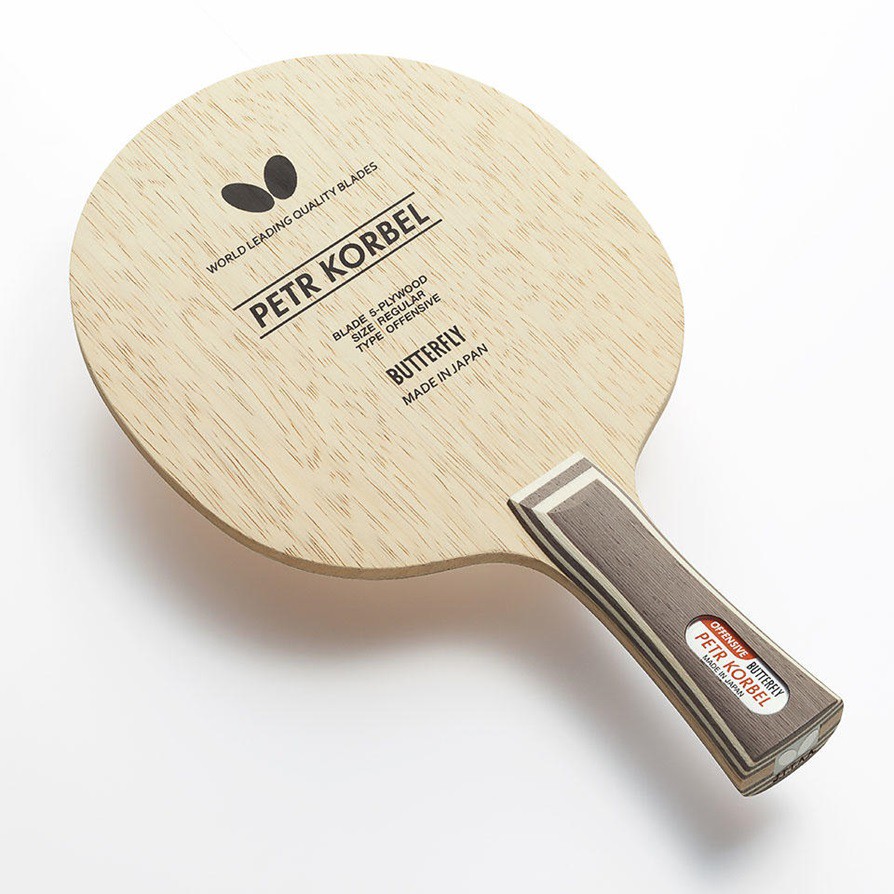
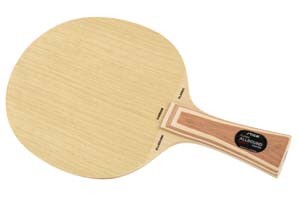
| Butterfly Korbel | Stiga Allround Classic Carbon | |
|---|---|---|
| Our rating | 8.6/10 | 7.8/10 |
| feel | medium, soft and flexible all-wood with long dwell | Medium stiffness, wood-like touch with carbon crispness, small vibration, large sweet spot |
| handle | FL/ST | FL, ST, WRB |
| plies | 5W (all wood) — limba-limba-ayous-limba-limba | 5 wood + 2 carbon |
| speed | OFF- | ALL+ |
| thickness_mm | 6 | 5.6 |
| weight_g | 88 | 81 |
We may earn a commission from links on this page. Learn more.
Close On Paper, Except For One Number
Line up the axes and three of five are near-identical: control (Korbel 8.8, Stiga Carbon 9.0, a 0.2-point gap), stiffness (4.8 versus 4.9, a 0.1-point gap), and hardness (5.3 versus 5.2, also 0.1). Practically speaking, these two blades feel similar in the hand on those three dimensions — don’t let marketing about “carbon” versus “all-wood” convince you they’re worlds apart in stiffness, because the measured numbers say otherwise.
Speed is where they diverge, and in the opposite direction you might expect: Korbel actually rates faster, 8.3 versus the Stiga Carbon’s 7.6, a 0.7-point gap. That’s notable because the Stiga Carbon is nominally the “faster class” blade on spec sheet terms (ALL+ versus Korbel’s OFF-), yet the real aggregated speed rating favors the plain all-wood Korbel. The Stiga Carbon’s own cons confirm this isn’t a data error: reviewers say it’s “not fast enough for off-table attacking or hard drives through the ball” and that aggressive, mid-distance players “will outgrow it quickly.” The carbon layer in this blade appears to buy sweet spot and consistency more than raw pace.
Consistency is the standout gap, and it runs the other way: Stiga Carbon rates 9.6 against Korbel’s 9.0, a 0.6-point edge — the largest gap in this comparison and large enough to matter. Reviewers back this up directly, praising a “wider sweet spot than the all-wood version” and “exceptional control and feedback — great for technique development.”
A Contradiction Worth Explaining: High Consistency, Lower Overall Rating
Here’s something you should know before you buy: despite that strong 9.6 consistency score, the Stiga Allround Classic Carbon carries the lowest overall rating in this whole comparison set, 7.8 versus Korbel’s 8.6. The reason isn’t performance — it’s manufacturing. Reviewers explicitly report “weight can vary noticeably between individual copies (73-91g range reported),” an 18-gram spread on a blade that’s supposed to weigh around 81 grams. That’s a real quality-control risk sitting underneath an otherwise well-reviewed blade: the “consistency” radar score describes how forgiving the blade feels shot-to-shot once you have it in hand, not how consistent one unit is against another off the production line. Those are two different things, and this blade illustrates the gap between them clearly.
If you buy this blade, weigh it on arrival if you can, and don’t assume the copy you get matches the “81g” spec row exactly — a heavier or lighter-than-expected copy will play differently than the reviews describe, through no fault of the design itself.
Who Should Buy Which
The Stiga Carbon’s own bestFor language is specific: beginners transitioning to their first custom setup, intermediate club players who prioritize touch over power, players who live at or near the table, and coaches wanting “a low-risk teaching tool.” Korbel’s bestFor overlaps on beginners and control-first players but doesn’t carry the same near-the-table framing, and its meaningfully faster real-world speed rating (0.7 points) makes it the better fit if you want more built-in pace while your technique is still developing.
Handle options favor the Stiga Carbon slightly — it adds a WRB (penhold-friendly) option alongside FL and ST, where Korbel only offers FL/ST. If you play penhold or are considering it, that alone may settle the decision regardless of the performance numbers above.
Switching Advice
If you already own a Korbel and are drawn to the Stiga Carbon’s stronger consistency and wider sweet spot, know that you’d be trading 0.7 points of real speed for 0.6 points of consistency — a fair trade if you’re a control-first, near-table player, a worse one if you rely on Korbel’s extra pace to finish points. And factor in the weight-variance risk either way; it’s the one variable neither blade’s radar score can tell you about in advance.
Frequently asked questions
Is the Stiga Allround Classic Carbon actually faster than the wood version?
It's faster than the standard Allround Classic in absolute terms, but it's still slower than the Butterfly Korbel (7.6 versus 8.3 on Revspin's aggregated speed rating) — the carbon layer here adds sweet spot and consistency more than raw pace.
Why does the Stiga Allround Classic Carbon have the lowest overall rating in this comparison despite good performance numbers?
Reported weight variance between individual copies — as much as 73 to 91 grams — is a real manufacturing consistency problem separate from how the blade plays shot-to-shot, and it appears to drag down the overall score.
Which blade is more consistent to play with?
The Stiga Allround Classic Carbon, by 0.6 points on Revspin's aggregated consistency rating — a real, noticeable edge tied to its wider sweet spot.
Does either blade support penhold players better?
The Stiga Allround Classic Carbon offers a WRB handle option in addition to FL and ST; the Korbel is only available in FL/ST.