Butterfly Dignics 05 vs Stiga DNA Pro H: Which Should You Buy?
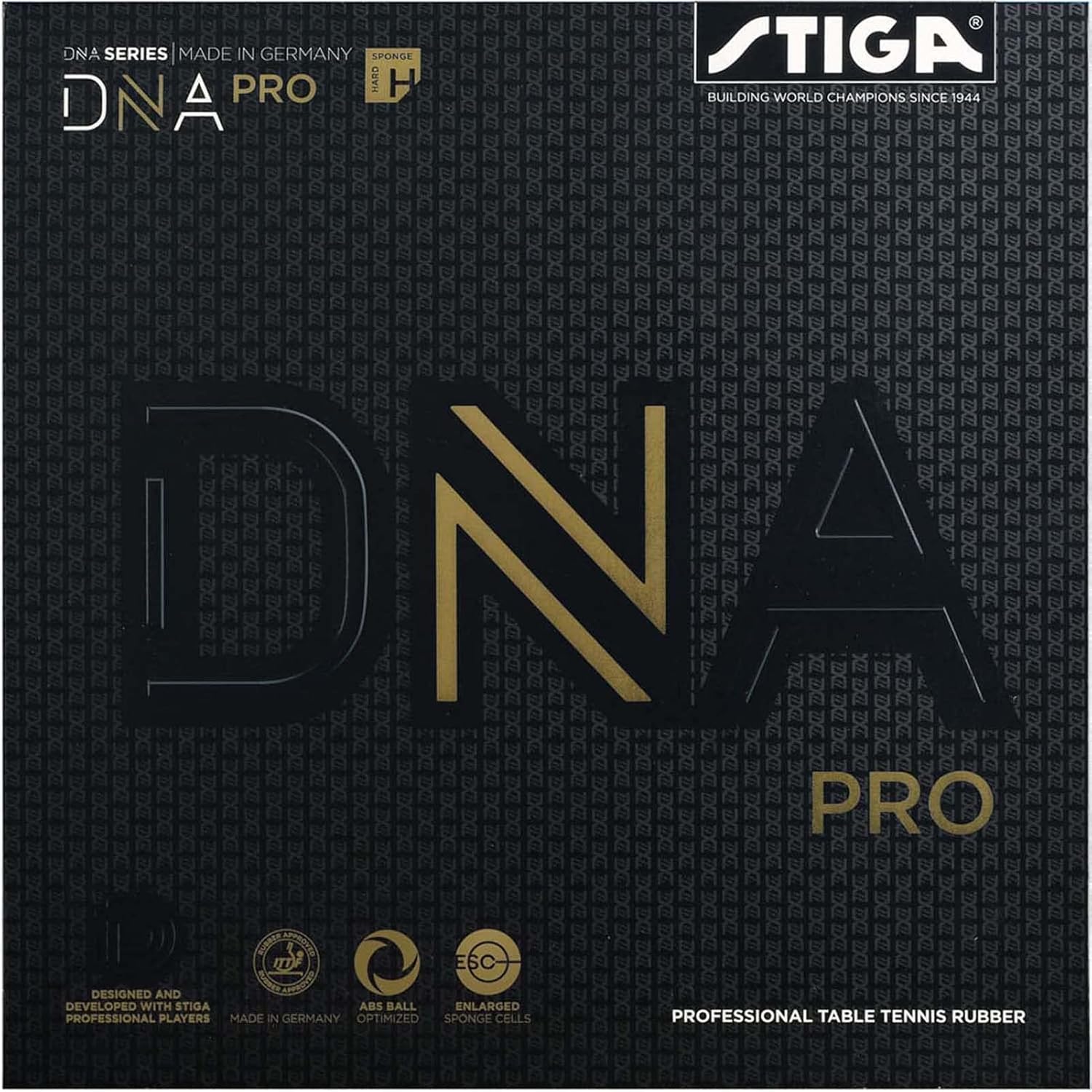
| Butterfly Dignics 05 | Stiga DNA Pro H | |
|---|---|---|
| Our rating | 9.0/10 | 8.8/10 |
| Best side | Both wings | Forehand |
| Control (different scales) | medium-high | 8 |
| Speed (different scales) | high (Butterfly rating 86) | 9 |
| Spin (different scales) | very high (Butterfly rating 85) | 9 |
| Sponge hardness (different scales) | 40 degrees (Butterfly scale) | 50 degree |
| Type | tensor inverted (Spring Sponge X) | inverted |
| Uncut weight | 70 g | 54 g |
A row marked “different scales” puts two rating systems in one line. Those cells are not a single score you can subtract.

We may earn a commission from links on this page. Learn more.
Two Real Gaps, Four That Barely Register
Durability is the largest delta in this comparison: Dignics 05 rates 8.5, DNA Pro H rates 7.1, a 1.4-point gap. Spin is the second-largest: 9.4 versus 8.6, a 0.8-point edge for Dignics 05. Those two numbers matter because they map directly onto the value proposition each rubber is actually selling — Dignics 05 as a premium, long-lasting, class-leading grip rubber, and DNA Pro H as a rubber explicitly marketed to deliver “around 95 percent” of Tenergy 80’s performance at a fraction of the cost.
Everything else here is close enough to call a wash. Control: 8.8 versus 8.4, a 0.4-point edge, small. Speed: 9.1 versus 8.8, 0.3 points, small. Throw: 6.3 versus 6.2, 0.1 points, negligible. Tackiness: 1.8 versus 1.9, 0.1 points, negligible. If you are deciding between these two rubbers based on feel at the table rather than price, the honest answer is that speed, control, throw and tackiness are not where the real difference lives.
What the Reviews Actually Say
Dignics 05’s case, from Revspin, RacketInsight, Megaspin and Reddit, rests on grip and durability — reviewers describe a “violently dipping” topspin and note it lasts roughly twice as long as Tenergy-class rubbers, at the cost of a premium price and a demand for high swing speed and clean technique to unlock any of it.
DNA Pro H’s case, per Revspin.net, the Tabletennis11 blog, Tabletennis-Reference.com and Table Tennis Hub, is built almost entirely around value: a community grip and spin rating of 9.03 out of 10, ESC enlarged sponge cells that boost catapult and arc, and a direct comparison reviewers make unprompted — that it delivers roughly 95 percent of Tenergy 80’s performance at a meaningfully lower price. Its listed cons are proportionate: heavy sponge relative to typical rubbers in its own category (which can unbalance lighter blade setups), only average loop power against heavy backspin, and a control rating that several reviewers put lower than softer alternatives.
Should You Switch?
If you are on DNA Pro H and considering Dignics 05, the honest question is whether the 0.8-point spin edge and 1.4-point durability edge are worth roughly doubling your rubber budget (Dignics 05 is explicitly one of the most expensive rubbers on the market). For players who are not yet generating fast, committed strokes consistently, the answer is probably no — Dignics 05’s own cons list warns it requires “high swing speed and clean technique to unlock its potential,” and DNA Pro H is already delivering competitive spin and speed numbers (8.6 and 8.8 respectively) at a fraction of the outlay.
Going the other way — from Dignics 05 down to DNA Pro H — makes sense for players who want to bank most of the premium-rubber feel while freeing up budget, particularly if durability at the very top tier is not a priority for you. You give up 1.4 points of durability and 0.8 of spin, but the throw, control and speed gaps are all small enough that most players will not notice them rally to rally.
Fit and Setup
Weight is worth checking directly against your blade: these listings put Dignics 05 at 70g uncut and DNA Pro H at 54g uncut, a real difference despite DNA Pro H’s own reviewers separately flagging its sponge as heavy within its own product category. A swap in either direction changes your paddle’s total weight and balance, so weigh your blade with each rubber before committing rather than assuming they are interchangeable. Both rubbers are rated for use on either wing per their bestFor guidance, though DNA Pro H’s spec row lists forehand as its best side — consider pairing it primarily on your attacking wing rather than assuming symmetric performance across both sides.
Frequently asked questions
Is Stiga DNA Pro H really comparable to Tenergy 80?
Reviewers describe it as delivering around 95 percent of Tenergy 80's performance at a lower price — it is a genuine value alternative, not a copy, and it trails Dignics 05 specifically on spin (0.8 points) and durability (1.4 points).
What's the biggest performance gap between these two rubbers?
Durability, at 1.4 points (8.5 vs 7.1) — Dignics 05 is built to last roughly twice as long as Tenergy-class rubbers, while DNA Pro H is positioned as a value alternative, not a durability leader.
Do I need advanced technique for either of these rubbers?
Dignics 05 explicitly does — it requires high swing speed and clean technique to unlock its potential. DNA Pro H is more forgiving but its 50-degree sponge still demands arm strength and proper technique.
Which rubber is heavier?
By the uncut weight listed here, Dignics 05 (70g) is heavier than DNA Pro H (54g) — though DNA Pro H's own reviews separately describe its sponge as heavy within its own product category, so weigh your specific blade before swapping.