Friendship 729 Battle II vs Donic Bluefire M1: Which Should You Buy?
| Friendship 729 Battle II | Donic Bluefire M1 | |
|---|---|---|
| Our rating | 8.5/10 | 8.4/10 |
| best_side | FH | Forehand |
| control | 8 | 9.1 / 10 |
| speed | 8 | 9.7 / 10 |
| spin | 9 | 9.0 / 10 |
| sponge_hardness | hard | 47.5 degrees (medium-hard) |
| type | tacky | Inverted / Tensor |
| weight_uncut_g | 68 | approx 49 g |

We may earn a commission from links on this page. Learn more.
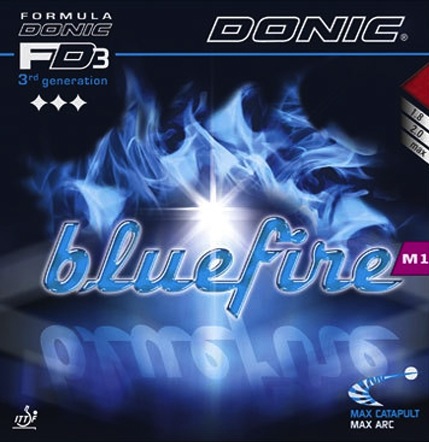
Battle II is a hard Chinese tacky built for spin and serve-receive; Bluefire M1 is a hardest-in-class tensor emphasizing speed and high throw angle. Battle II suits forehand attackers learning Chinese looping at rock-bottom cost, though tackiness degrades within weeks. Bluefire M1 targets advanced hitters (1500+ USATT) who want catapult feel and dipping loops on a European platform. Choose Battle II to explore Chinese-style spin without risk; pick Bluefire M1 if you have advanced footwork and want the speed race to premium tensors at lower cost.
FAQ
Which is faster?
Bluefire M1 delivers hard speed and catapult. Battle II is fast for a Chinese rubber but trades top-end speed for spin and control.
Which suits intermediate play?
Battle II is more forgiving for intermediate improvers. Bluefire M1 demands clean technique and high arm speed.
How do throw angles compare?
Battle II has low diving arc for close-table consistency. Bluefire M1 has high throw producing heavy, dipping loops at distance.
Which lasts longer?
Bluefire M1 maintains performance for one to two months after factory boost. Battle II loses spin after roughly two months.