Mysterious Questions About Table Tennis Equipment, Part 2

4. Does Black Rubber Produce More Spin?
A rubber’s color is determined by the pigment (dye) added to the topsheet. Butterfly states that the amount of dye used is extremely small, and in their mechanical testing, red and black rubbers register identical performance numbers.
ESN says the added black pigment, just like the red, has no impact on the body of the rubber. But table tennis has a strong psychological dimension, so rubber color may have some mental effect on the player.
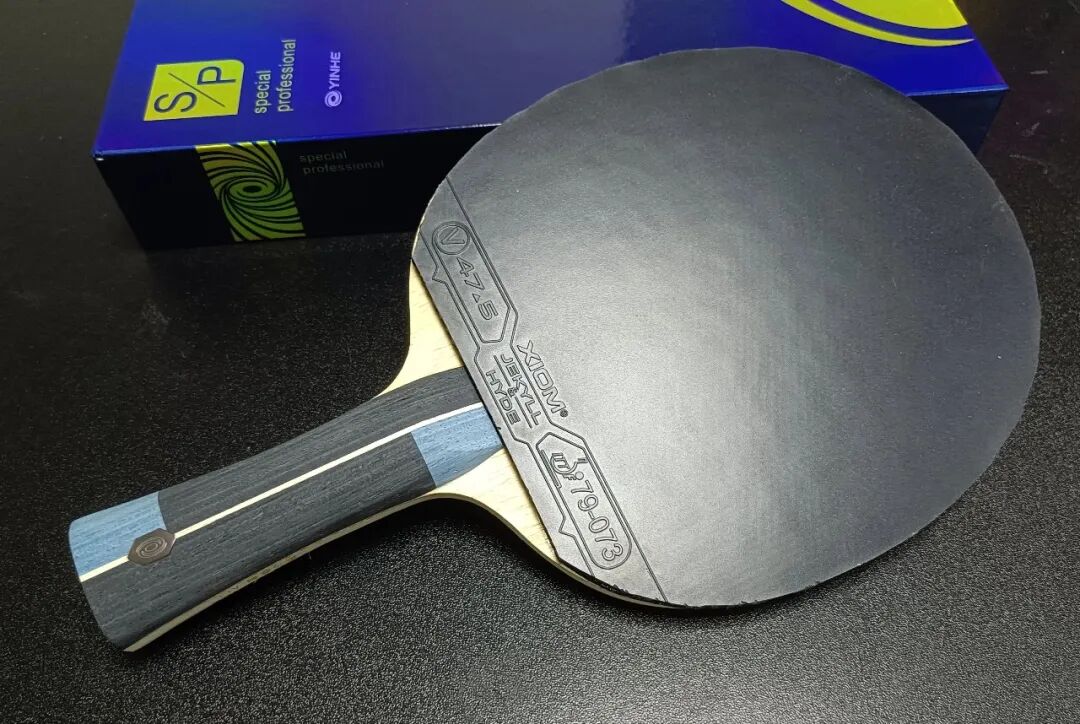
After the 1990s, Chinese players almost universally used black tacky rubbers on the forehand, which created the impression that “black equals more spin.” Dr. Zhang Xiaopeng (former vice president of the Chinese Table Tennis Association) wrote a book — I’ve read it — that mentions: because the pigments differ, black rubber generates more spin while red rubber is more bouncy.
There is also a specific situation: with Hurricane’s blue sponge, if the topsheet is red, the sponge color bleeds through and gives it a deep-red tint that is illegal under the rules. So national team players who love the blue sponge can only use black rubber on the forehand. Over time, some players felt that black Hurricane spins more…
5. Why Are Butterfly’s Sponge Hardness Ratings Different from Other Brands?
Butterfly explains that their sponge hardness measurement partly references international and Japanese industrial standards, and partly uses a proprietary method suited to table tennis rubber.
The commonly used instrument is the ASKER CL-150. We must recognize that if the measuring instrument changes, the numbers change too. Different brands may use different instruments — DHS (Double Happiness), for example, uses a different one.
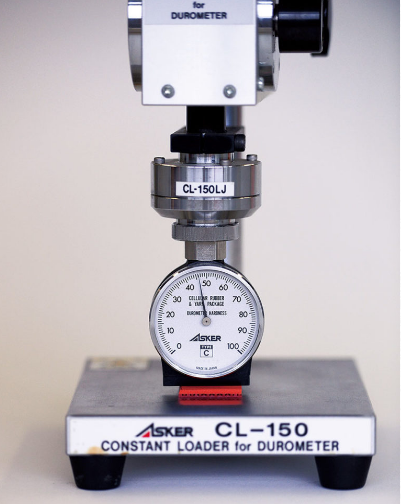
Generally, sponge hardness is measured right after the sponge comes out of the oven, and that reading is used as the official spec. In practice, the sponge becomes slightly harder once it cools.
Beyond that, measuring the sponge alone versus measuring it as a complete rubber sheet with the topsheet attached clearly gives different results. The Tenergy 05 sponge is rated 36 degrees, but when measured as a complete sheet, the average comes out to 47.44 degrees.
6. Does Higher Sponge Hardness Mean More Power?
ESN says that depending on playing style, hard-hitting attackers are better suited to harder rubbers, because the player can transmit maximum force into the ball. Conversely, if a hard hitter uses soft rubber, energy is lost between the force applied and the rubber’s compression and rebound.
Put simply: it doesn’t feel satisfying when you attack. The rubber’s energy ceiling can’t keep up with your big swing.
That said, whether a given hardness suits you is very personal. In my view: if your swing is on the slower side, you can go a bit softer — the rubber can still generate good spin. If you swing slowly but use a very hard sponge, you won’t be able to drive through it, which means less control and it becomes difficult to produce good spin or speed.
Hard sponge can indeed deliver more power, but only if your power output and swing speed are sufficient.

Take the recently hyped Tenergy 05 Hard — Zhu Yuling’s forehand rubber. If I were to use it, I could manage a drive or two without problem; my swing speed is enough for that. But I can’t sustain a continuous topspin rally with it, not for many shots. For my power level, it would feel like a struggle.
Of course, beyond swing speed and power level, high-hardness rubbers are also more demanding of the blade you pair them with. We’ll get into that another time.