Donic Bluestorm Z2 Review: Speed and Spin for the Modern Attacker
Pros
- Outstanding counterloop speed — solid and fast off the bounce
- Sponge feels softer than 47.5 degree rating implies — more forgiving than expected
- Excellent dwell time for a speed-oriented rubber
- High community rating: 9.07 out of 10 across 30 independent reviewers
- Strong performance at mid and far distance from the table
- Exceptional flick shots on both wings
- Good long-term durability reported after 80+ hours of use
Cons
- Requires committed, full-stroke technique — passive shots misfire
- Initial break-in period (first 1-2 weeks) can feel excessively catapult-like
- Lower throw angle than M-series rubbers surprises players transitioning from Bluefire M1
- Susceptible to heavy incoming spin — demands active reading of the ball
- Passive blocking is tricky; redirection is needed rather than simple absorption
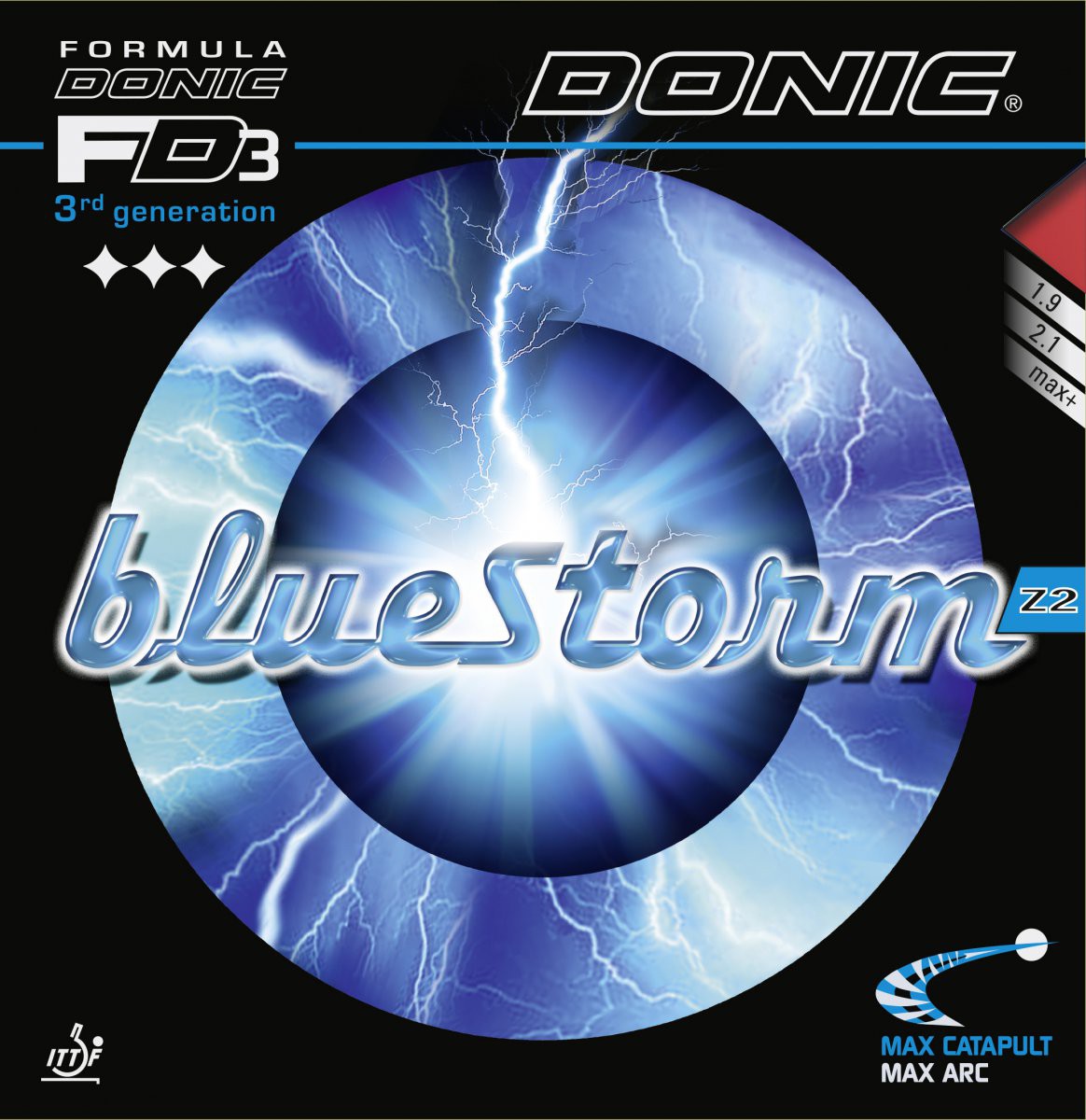
The Bluestorm Z2 sits dead center in Donic’s Bluestorm range, between the faster Z1 and the heavier-hitting Z3. Built for modern poly-ball play, it pairs a long, thin pimple structure with a large-pored, 47.5-degree medium-hard sponge in a maximum thickness of 2.33 mm. The official rating undersells it. Forum after forum reports it playing softer than 47.5 degrees, somewhere between a true medium and medium-hard. That softness, plus a strong catapult and a flat ball trajectory, gives the Z2 a personality apart from the Bluefire M series and from European rivals like Tenergy 05. A community aggregate of 9.07 out of 10 across 30 reviews on TableTennis Reference has won it respect from club and advanced players who want speed and spin without paying premium Japanese prices.
Performance
Speed hits you first. Hand the Z2 to anyone and the first word back, reviewers across platforms agree, is that it flies. It isn’t one-dimensional, though. The sponge catches the ball before launching it, opening a dwell window long enough to load topspin and heavy brushing shots. Counterlooping draws the most praise. The flat trajectory and fast rebound make mid-distance counterattacks lethal, and the rubber pays off players who commit to horizontal strokes instead of vertical lifts.
Looping away from the table is aggressive, with a flatter arc than the M-series. The flat line cuts both ways: attacks stay low and penetrating, but they demand precise timing and full-body commitment, since a partial swing clips the net. Topspin against backspin comes easy and powerful once your technique is dialed in. Flicks on both wings draw high marks for how the sponge loads spin even off short, compact movements.
Blocking needs care. In the first week or two after gluing, the catapult peaks and passive blocks sail long. You have to redirect, not just absorb. Once it breaks in, the rubber settles into a manageable range. One long-term user logged no performance drop after 80 hours of play, a good durability sign against older Donic tensors.
Its spin sensitivity is a strength and a liability at once. It reads and amplifies spin well in attacking exchanges, but if you aren’t controlling the contact angle, heavy topspin or sidespin from an opponent will catch you. Most non-tacky, high-speed tensors behave this way, so the Z2 isn’t unusual, but it’s worth flagging for anyone coming off more control-oriented rubbers. Community aggregate scores on Revspin and TableTennis Reference put speed near 8.8 and spin near 8.5, in line with the rubber’s premium ESN positioning.
What Reviewers Agree (and Disagree) On
All three sources line up: the Z2 rewards committed, technically sound play and penalizes half-strokes and passive contact. Revspin, TableTennisDaily, and TableTennis Reference all point to the counterloop and the fast topspin exchange as its best suits. Every source also agrees it feels softer than its 47.5-degree nominal hardness implies.
Throw angle draws mild disagreement. Some reviewers call the over-the-table arc comparable to Tenergy 05; others, switching from Bluefire M1, drop balls into the net because the trajectory sits noticeably lower. Blade pairing and stroke mechanics likely explain the gap. Stiffer blades and more horizontal strokes sharpen the flat line, while softer or spin-elastic blades lift the arc. Several reviewers name ALC or comparable carbon-composite blades as the best match. Durability reads mostly positive in recent reviews, perhaps reflecting improvements over early batches that older forum posts flagged for wearing out fast.
Who Should Buy It
The Z2 suits intermediate and advanced players with reliable topspin mechanics who want more speed and counterattacking punch without jumping to a rubber as demanding as Tenergy 05 FX or MX-P. If you loop from mid-distance, fire fast counterloops, and finish with flat drives, it’s an excellent tool, and it works best as a forehand rubber on ALC or carbon blades. Players with a short pimple-like direct-hitting game who don’t lean on heavy topspin loops will like the flat drive speed too. Choppers, close-table touch players, and beginners who rely on passive blocking or slow placement should pass. The catapult and lower throw make the short game less forgiving for developing players. Upgrading from Bluefire M1 or M2, expect a faster, slightly spongier feel, and give yourself two to three weeks of adaptation before judging the full range.
FAQ
How does the Bluestorm Z2 compare to the Bluestorm Z1?
The Z1 leans toward raw speed and a harder feel, built for players who want maximum forehand pace. The Z2 gives more dwell time, a spongier feel, and a bit more spin-oriented balance, so it’s easier to live with if you need some control margin while still hitting fast. Momentum-first players tend to take the Z1; those who want the same speed family with better touch feedback take the Z2.
Is the Bluestorm Z2 suitable for backhand use?
It works on the backhand, and several experienced players run it there, mostly those with strong counterloop technique. But the fast rebound and lower throw punish anyone who leans on passive blocks or soft placement on that wing. Most reviewers keep it on the forehand.
How long does the Bluestorm Z2 last before performance drops?
Recent reports lean positive on durability. One extended tester saw no real performance drop after 80 hours of play. Earlier generations drew some complaints, but current batches hold up well against typical ESN-sponge tensors.
What blades pair best with the Bluestorm Z2?
ALC (Arylate Carbon) composites and similar stiff-to-medium carbon blades top the recommendations. The rubber’s own speed runs high enough that an all-round or OFF- blade pulls it into a more controllable range, while a full OFF+ blade can make the pairing very hard to handle. Reviewers call out the TMB ZLC and similar ALC blades as good matches.
Is the Bluestorm Z2 good for beginners?
No. The rubber rewards full, committed strokes and punishes passive or tentative contact. Beginners still building consistent technique will struggle to manage the catapult and control the lower throw. It belongs to club-level and above players who already loop consistently with reasonable power.
Sourced From
This review synthesizes opinions from 3 independent community sources:
- Revspin (forum)
- TableTennisDaily (forum)
- TableTennis Reference (forum)