Yasaka Rakza X vs Yasaka Rakza Z: Which Should You Buy?
| Yasaka Rakza X | Yasaka Rakza Z | |
|---|---|---|
| Our rating | 8.4/10 | 8.6/10 |
| Best side | Both wings | Forehand |
| Control | medium-high | high |
| Speed | high | medium |
| Spin | high | extreme |
| Sponge hardness | 47.5 (medium-hard, roughly 45-50 degrees) | 50 degrees (medium-hard; Extra Hard version around 57 degrees) |
| Type | tensor inverted | hybrid tacky tensor |
| Uncut weight | 69 g | 72 g |
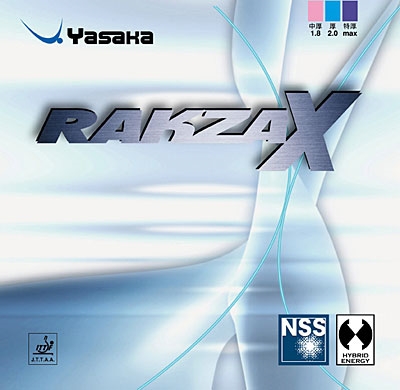
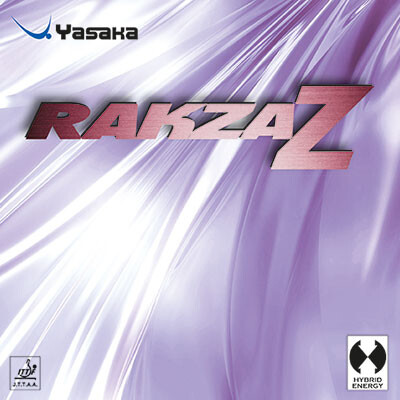
We may earn a commission from links on this page. Learn more.
Close on the surface, far apart underneath
Rakza X and Rakza Z rate close overall, 8.4 versus 8.6, but two axes tell you these are built on different chemistry entirely: tackiness and throw. Everything else, speed, spin, control, and durability, sits within half a point of each other and will not decide this comparison for you.
The axis that actually separates them
Tackiness is the standout gap at 4.4 points, 2.2 for Rakza X against 6.6 for Rakza Z. Rakza X is a smooth, low-tack tensor; Rakza Z is a tacky hybrid, and Revspin and RacketInsight both frame it as a budget-friendly alternative for players chasing the feel of tacky flagship sheets like Dignics 09C or boosted Hurricane 3 without paying flagship prices. That tack difference changes how each rubber grabs the ball off backspin: Rakza Z’s own pros describe low-slip spin generation on loops and backspin openings specifically because of that grip, a mechanism Rakza X’s smoother sheet does not rely on.
Throw is the second real gap, 1.8 points, 4.7 for Rakza X versus 6.5 for Rakza Z. This is worth flagging directly because it contradicts the marketing language: Rakza X’s own pros describe it as having a high, safe throw arc, but the aggregated axis rating actually puts its throw well below Rakza Z’s, not above it. Read Rakza X’s throw as high relative to older, flatter tensors, not as higher than Rakza Z specifically; Rakza Z’s own cons confirm the practical effect, its high throw angle requires a more closed blade angle to control.
Where the two rubbers are genuinely tied
Spin differs by only 0.5, 9.0 versus 9.5. Control differs by 0.1, 9.1 versus 9.2, essentially identical. Speed differs by 0.3, 9.0 versus 8.7, and durability by 0.3, 8.0 versus 8.3. None of these four axes should factor meaningfully into your decision; treat them as tied.
Weight and application matter more than the ratings suggest
Rakza Z carries a real practical cost that does not show up on any of the six axes: its own cons flag it as a heavy rubber that can cause arm or wrist fatigue, especially mounted on a carbon blade, a factor that matters more for two-winged attacking players than for someone running it on a single wing. Rakza X carries no such warning, and its bestFor note pitches it as a step up for players who liked the standard Rakza 7 but want more control in blocks and loop exchanges, playable on either forehand or backhand depending on the blade.
Rakza Z’s own bestFor language, by contrast, leans specifically toward proactive forehand loopers willing to commit to full strokes, and flags flat hitting, driving, and chopping strong loops as mediocre performance areas, a real weakness for all-round or defensive-leaning players.
Migration advice
If you play Rakza X and want more raw spin and grip for lifting heavy backspin, and you are comfortable with the added weight and a slightly more closed racket angle to manage the higher throw, Rakza Z is a reasonable step, the ratings edge, 8.6 versus 8.4, and the tackiness jump support it for a committed forehand looper. If you rely on flat hitting, driving through spin, or play a genuinely two-winged all-round game, stay with Rakza X, its lower tack and lower throw make it the more linear, predictable, and lighter rubber of the two, and Rakza Z’s own cons rule out exactly the shots you would be relying on.
One more consideration for anyone weighing this switch: sponge hardness moves in the same direction as the tackiness jump, 47.5 degrees for Rakza X against 50 degrees for Rakza Z, with an Extra Hard version of Rakza Z reported around 57 degrees. Harder sponge plus higher tack plus higher throw all point the same way, toward a rubber that wants a fuller, more committed stroke to control, and away from a rubber you can play passively. If your technique already generates that kind of swing on your forehand, the combination rewards you; if you are still building a consistent loop, the extra demands stack up rather than cancel out, and Rakza X’s more forgiving profile is the safer place to develop that stroke first.
Frequently asked questions
Is Rakza Z actually tackier than Rakza X?
Considerably. Tackiness rates 6.6 for Rakza Z against 2.2 for Rakza X, a 4.4-point gap, the largest single-axis difference between these two rubbers.
Does Rakza X really have a higher throw than Rakza Z, as its pros claim?
No, the aggregated data says the opposite: Rakza X rates 4.7 on throw against Rakza Z's 6.5. Read Rakza X's high, safe throw arc as high relative to older tensors, not higher than Rakza Z.
Which rubber is better for an all-round or defensive-leaning player?
Rakza X. Rakza Z's own cons name flat hitting, driving, and chopping strong loops as mediocre performance areas, while Rakza X stays more linear and predictable across shot types.
Is Rakza Z heavier than Rakza X?
Its own cons flag it as a heavy rubber that can cause arm or wrist fatigue, especially on carbon blades, a practical cost not captured in any of the six rated axes.