Yasaka Ma Lin Extra Offensive vs Yasaka Ma Lin Soft Carbon: Which Should You Buy?
| Yasaka Ma Lin Extra Offensive | Yasaka Ma Lin Soft Carbon | |
|---|---|---|
| Our rating | 8.5/10 | 8.1/10 |
| Feel | hard outer + soft core, linear | medium-soft and flexible for a carbon blade, with clear feedback and a large sweet spot |
| Handle | FL/ST/AN/CS | FL/ST/AN |
| Plies | 5W (all wood) | 7-ply (5 wood plus 2 very thin carbon layers) — same outer veneer as the Yasaka Extra |
| Speed | OFF | OFF- |
| Sponge thickness | 5.7 mm | 5.8 mm |
| Weight | 88 g | 87 g |
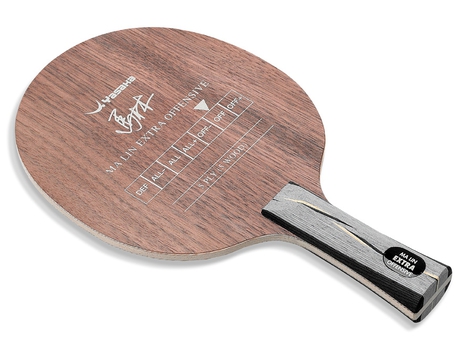
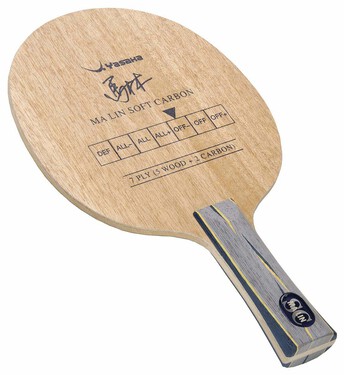
We may earn a commission from links on this page. Learn more.
Same family, same name, different blade
Both blades wear the Ma Lin name and both are Yasaka products, which is exactly why the axis data matters here more than the marketing copy. The Extra Offensive is an all-wood OFF blade, 5-ply, no carbon at all; the Soft Carbon is a 7-ply build with two thin carbon layers, using, according to Tabletennis11, the same outer veneer as the Extra Offensive. So the wood-facing feel starts from a similar place, and everything that separates them comes down to the carbon layer and a softer construction underneath it.
What the numbers say, axis by axis
The Extra Offensive rates higher on every single axis except weight, where the two are close, 7.5 versus 7.1, a 0.4-point gap that will not register in your hand. That is worth sitting with before assuming the Soft Carbon is simply a lesser blade. Look at where the gaps actually open up.
Hardness is the largest gap at 2.3 points, 6.8 for the Extra Offensive against 4.5 for the Soft Carbon. Consistency is next at 2.0 points, 8.7 versus 6.7. Speed follows at a full point, 8.6 versus 7.6, and stiffness trails at 0.9, 5.7 versus 4.8. Control, by contrast, is close, 8.6 versus 8.3, a 0.3-point gap that essentially says both blades will let you place the ball where you intend.
That consistency gap deserves a plain explanation. The Soft Carbon’s own listed cons include vibration and a sluggish feel when you miss the sweet spot, plus weight variance between individual blades, exactly the kind of unit-to-unit and shot-to-shot unpredictability that a lower consistency score is measuring. The Extra Offensive, being all wood with a simpler hard-outer, soft-core construction, is rated as far more uniform by comparison, and Revspin and Megaspin reviewers back that up by calling it essentially unbeatable value for what it does.
Why anyone would still pick the Soft Carbon
If the Extra Offensive wins on paper across five of six axes, the honest question is why the Soft Carbon exists as a real recommendation rather than a downgrade. The answer is in what those lower numbers buy you: comfort. A blade rated 4.5 on hardness and 4.8 on stiffness is going to feel noticeably softer and more flexible in the hand than one rated 6.8 and 5.7, and for a player moving up from a premade bat, that forgiveness is often worth more than an extra half-point of consistency. The Soft Carbon’s own bestFor language is explicit about this: it targets improving, control-oriented players making that exact jump, prizing an excellent short game and strong blocking over outright far-table pace, described in reviews as an unusually clear-feeling carbon blade for its softness.
The migration question
If you already play with the Extra Offensive and are considering the Soft Carbon, the case for switching is thin. You would be trading a blade that already tops out on control (8.6), speed (8.6), and consistency (8.7) for one that scores lower on all three, in exchange for a softer, more flexible feel that mainly helps players who have not yet built the swing the Extra Offensive rewards. Its own cons are blunt about this: it is linear with no carbon catapult, demands an aggressive, technically sound stroke, and is not a beginner blade. If your technique is already there, downgrading the hardness and stiffness numbers buys you very little.
The reverse move makes more sense: a Soft Carbon owner whose loops and blocks have gotten more consistent, and who wants a bit more outright pace and a firmer, more predictable response at the same all-wood weight class, will find the Extra Offensive a logical next step, not a sideways one. Both blades are handle-compatible, FL and ST and AN for both, plus CS on the Extra Offensive, so the swap does not require relearning grip.
Frequently asked questions
Is the Yasaka Ma Lin Soft Carbon worse than the Extra Offensive?
Not exactly worse, softer. It rates lower on hardness (4.5 versus 6.8), stiffness (4.8 versus 5.7), and consistency (6.7 versus 8.7), but that softness is deliberate, aimed at players moving up from premade bats who want a forgiving, comfortable feel over raw numbers.
Which blade has better control?
They are close: control rates 8.6 for the Extra Offensive and 8.3 for the Soft Carbon, a 0.3-point gap that will not be noticeable in most rallies.
Why does the Soft Carbon feel inconsistent for some players?
Its own listed cons include vibration and a sluggish feel when you miss the sweet spot, plus weight variance between individual blades, which explains its lower consistency axis score, 6.7 versus the Extra Offensive's 8.7.
Should I upgrade from the Soft Carbon to the Extra Offensive?
If your technique has developed past needing a soft, forgiving blade and you want more speed, consistency, and control headroom, yes, the Extra Offensive rates higher on nearly every axis while staying in the same all-wood weight class.