Stiga Carbonado 290 vs Stiga Offensive Classic: Which Should You Buy?
| Stiga Carbonado 290 | Stiga Offensive Classic | |
|---|---|---|
| Our rating | 8.3/10 | 8.4/10 |
| feel | very stiff, hard, crisp and direct carbon feel with a high-pitched sound; fast and linear with a low throw | thin, flexible, soft-medium springy all-wood with strong vibration and feedback |
| handle | FL | FL/ST/AN (WRB hollow-handle version also sold) |
| plies | 5 wood + 2 carbon (7-ply), TeXtreme carbon | 5W (all wood) — outer veneers commonly described as koto or limba over spruce and ayous |
| speed | OFF+ | OFF- (offensive minus; community-rated, occasionally felt as ALL+ to OFF) |
| thickness_mm | 6.2 | 5.4 |
| type | OFF+ | — |
| weight_g | 95 | 83 |
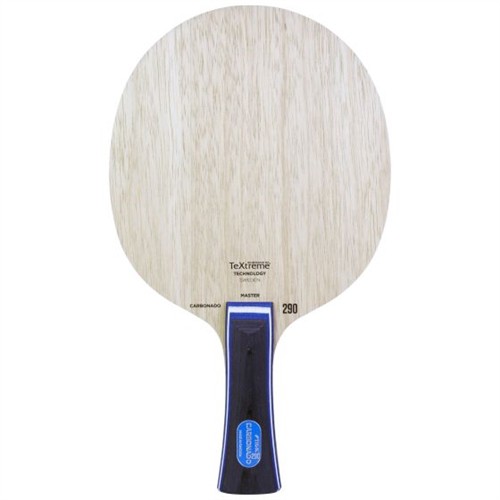
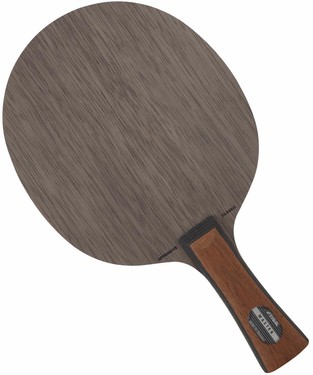
We may earn a commission from links on this page. Learn more.
Two blades, nearly identical overall scores, opposite ends of the spectrum
Revspin’s aggregate ratings put these blades a hair apart - 8.3 for the Carbonado 290, 8.4 for the Offensive Classic - and if that were the only number you looked at, you’d assume they’re interchangeable. They are not. Every axis delta here is large, several of them enormous, and they all point the same direction: the Carbonado 290 is a stiffer, harder, heavier, faster blade built for a completely different kind of player.
Stiffness: 7.3 vs 3.8, a 3.5-point gap, the largest stiffness spread in this entire batch of comparisons. Hardness: 8.1 vs 5.4, a 2.7-point gap. Weight: the Carbonado 290 sits at the ceiling of the scale, 10.0, against the Offensive Classic’s 5.7 - a 4.3-point spread, and unlike some of the smaller weight deltas elsewhere in this catalog, this one tracks a real spec difference too: 95 grams stock versus 83 grams. Speed: 9.4 vs 7.6, a 1.8-point gap that puts the Carbonado 290 in true OFF+ territory - reviewers rate it on par with a Jun Mizutani ZLC-class blade - while the Offensive Classic sits at OFF-, occasionally felt as slow as ALL+.
The one number that doesn’t follow the pattern
Control actually favors the Carbonado 290, 9.0 vs 8.3, a 0.7-point edge. That’s worth sitting with for a second, because the intuitive assumption is that a stiff, fast carbon blade trades control for power. The data - backed by lab testing from TTGearLab plus reviews from ExpertTableTennis and TableTennisDaily - says the opposite: this is “more feel than many other carbon-layered blades despite the stiffness,” and it’s rated “exceptional and very stable for blocking and counter-blocking.” Don’t assume the Offensive Classic wins on feel just because it’s the softer, slower wood blade; on the aggregated ratings, it doesn’t.
Why the similar overall score is misleading
An 8.3 and an 8.4 sound like two very good, roughly equivalent blades. What they actually mean here is two blades that excel for entirely different player profiles, each rated highly within its own lane. The Carbonado 290 is built for “advanced, aggressive attackers and offensive penholders who finish points fast with hard drives, smashes and blocking” - players who already have the technique to handle a very stiff blade with a notably low throw that “can cause netting until you adapt your bat angle.” The Offensive Classic is built for “improving and intermediate attackers who play close to the table” who prioritize forgiveness and feedback over outright pace. These aren’t two options for the same shopping cart; they’re answers to two different questions.
Migrating from one to the other
If you currently play with an Offensive Classic and are eyeing a Carbonado 290 as your next blade: understand this is a big technical jump, not an incremental upgrade. You’re moving into a blade with 3.5 points more stiffness and a very low throw angle that reviewers say requires you to adapt your contact angle to avoid netting balls you used to clear comfortably with the flexier wood blade. It rewards players who already generate their own power and spin rather than relying on the blade’s throw to do it for them. Go the other way - Carbonado 290 down to Offensive Classic - and you’ll gain forgiveness and a longer throw at the cost of the top-end pace and blocking stability the Carbonado is specifically known for.
Price and practical notes
The Carbonado 290’s own listed con flags it as a “premium price” that “puts it at the high end of the market,” and it draws reviews from six separate outlets - Revspin, ExpertTableTennis, TableTennisDaily, Reddit, TTGearLab, and Megaspin - unusually thorough documentation for a single blade, which adds confidence to its rating. It is explicitly not suited to chopping with long pimples, per its own review notes, so defensive players should look elsewhere regardless of how the axis numbers read.
Bottom line
Don’t compare these on overall rating alone - 8.3 vs 8.4 is noise. Compare them on stiffness, hardness, weight and speed, all of which show real, large gaps, and pick based on which profile - fast, stiff, advanced attacker, or forgiving, flexible, developing looper - actually describes your game today, not the game you’re hoping to grow into next season.
Frequently asked questions
Is the Stiga Carbonado 290 a good replacement for the Offensive Classic?
Only if your technique has caught up to it. The Carbonado 290 is 3.5 points stiffer and 1.8 points faster on Revspin's scale, and its low throw can cause netting until you adjust your bat angle.
Does the Carbonado 290 sacrifice control for speed?
No - it actually rates 0.7 points higher on control than the Offensive Classic, despite being far stiffer, harder and faster.
Is the Carbonado 290 suitable for chopping with long pimples?
No, its own review notes explicitly say it is not suited to chopping with long pimples.
How much heavier is the Carbonado 290?
About 12 grams stock (95g vs 83g), which shows up as the largest weight-axis gap in this comparison set.