Nittaku Violin vs Yasaka Sweden Extra: Which Should You Buy?
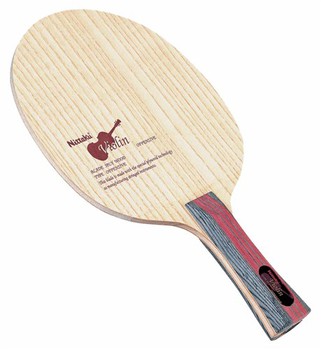
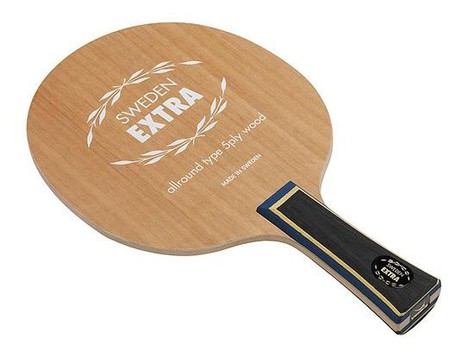
| Nittaku Violin | Yasaka Sweden Extra | |
|---|---|---|
| Our rating | 8.4/10 | 8.7/10 |
| feel | Soft, warm and flexible with long dwell, premium hand-crafted Japanese all-wood feedback | soft-medium, high control |
| handle | FL | FL/ST |
| plies | 5-ply all wood (Kiri core with White Ash outer plies) | 5W (all wood) |
| speed | ALL+ | ALL+ |
| thickness_mm | 5.3 | 5.7 |
| type | ALL+ | — |
| weight_g | 86 | 85 |
We may earn a commission from links on this page. Learn more.
The number that should surprise you: control is tied
Look at the axis data before you look at the price tags. Control comes out identical between these two blades, 9.1 for the Nittaku Violin and 9.1 for the Yasaka Sweden Extra, a delta of exactly zero. That is a genuinely useful piece of information, because the Violin is positioned and reviewed as a premium, Made in Japan blade, while the Sweden Extra is reviewed as a budget blade that “plays like a blade several times its cost.” The control data backs that framing up directly: on the axis that most defines a control-oriented all-round blade, there is no measurable gap at all.
Where the two genuinely differ, and where they do not
Speed favors the Violin by 0.4 (8.2 versus 7.8), a small but real edge. Weight, as an axis score, favors the Violin by 0.4 (6.8 versus 6.4), though the raw spec numbers put actual weight at 86 grams for the Violin and 85 grams for the Sweden Extra, essentially the same racket in hand. Consistency is close, 9.5 versus 9.3, a 0.2 gap. Hardness is close too, 5.0 versus 4.8, a 0.2 gap. The one axis with any real separation beyond speed is stiffness, where the Sweden Extra is slightly stiffer at 3.6 against the Violin’s 3.3, a 0.3 gap, though both numbers sit at the flexible end of the scale, meaning both blades are genuinely soft and whippy compared to a stiff carbon blade, just not identically so.
What actually differs: construction and options, not performance
The real differences between these two blades are not in raw performance numbers but in construction and configuration. The Violin uses a 5-ply all-wood build with a Kiri core and White Ash outer plies, reviewed by TTSensei, RevSpin and Megaspin as bringing “warm, soft feel with long dwell time” and described in its own pros as coming “alive with Tensor rubbers.” It is offered only in an FL (flared) handle at 5.3mm thickness. The Sweden Extra, reviewed at Revspin and Megaspin, is a 5-ply all-wood blade offered in both FL and ST handles, at a slightly thicker 5.7mm, and its own pros describe it as having “a larger sweet spot and a slightly faster, more direct response than the Stiga Allround Classic, without losing control,” a claim that is specifically benchmarked against another blade rather than the Violin, but which tells you where the Sweden Extra sits in its own product family.
Reading the cons side by side
The Violin’s own listed cons are about price and break-in: it is “slower than its OFF- billing suggests,” its “premium price” is “questioned versus cheaper blades like the Primorac,” and it is “relatively stiff when new” before it breaks in. The Sweden Extra’s cons are about ceiling, not entry cost: “limited power from well behind the table” on deep counter-loops and skylobs, and an All+ speed rating that means “out-and-out flat hitters chasing raw pace may eventually outgrow it.” Neither set of cons describes the other blade’s stated advantage, which is consistent with two blades that are close in raw numbers but positioned differently on price and long-term ceiling.
Should you switch
If you already own the Sweden Extra and are getting real results with it, the axis data gives you very little reason to pay a premium for the Violin purely on performance grounds: control is identical, weight is nearly identical, and speed differs by only 0.4. The case for moving to the Violin is about Japanese craftsmanship, the all-wood Kiri-and-White-Ash construction, and its specific synergy with Tensor rubbers, not about beating the Sweden Extra on any measured axis. Conversely, if you want a control blade with a straight (ST) handle option, the Violin will not give you that choice, since it is FL only.
Bottom line
These two blades are close enough on the numbers that the decision should come down to handle shape, construction preference, and price tolerance, rather than expecting the Violin to outperform the Sweden Extra in any measurable way. Both are explicitly recommended for developing and intermediate all-round or control players building a first custom setup, and reviewers describe the Sweden Extra in particular as “a blade you can learn on and keep for years, simply changing rubbers as you improve.
Frequently asked questions
Is the more expensive Nittaku Violin actually more controllable than the Yasaka Sweden Extra?
No, according to the axis data. Both blades score 9.1 on control, an exact tie. The Violin's advantage is in construction and craftsmanship reputation, not a measurable control edge.
Are these two blades the same weight?
Nearly. The listed weights are 86 grams for the Violin and 85 grams for the Sweden Extra, a difference too small to notice in hand.
Which blade offers a straight (ST) handle?
The Yasaka Sweden Extra is offered in both FL and ST handles. The Nittaku Violin is listed as FL only, so if you specifically want a straight handle, that alone settles the choice.
Is the Yasaka Sweden Extra a legitimate budget alternative to the Nittaku Violin?
The axis data supports that framing: control is identical, weight is nearly identical, and the gap in speed is only 0.4. Reviewers describe the Sweden Extra as playing well above its price point.
Which blade has more raw power for players well behind the table?
Neither is built for that role particularly well. The Sweden Extra's own cons state it has limited power from well behind the table on deep counter-loops and skylobs, and the Violin's cons note it is slower than its OFF- billing suggests at long distance.