Butterfly Viscaria vs Tibhar Stratus Power Wood: Which Should You Buy?
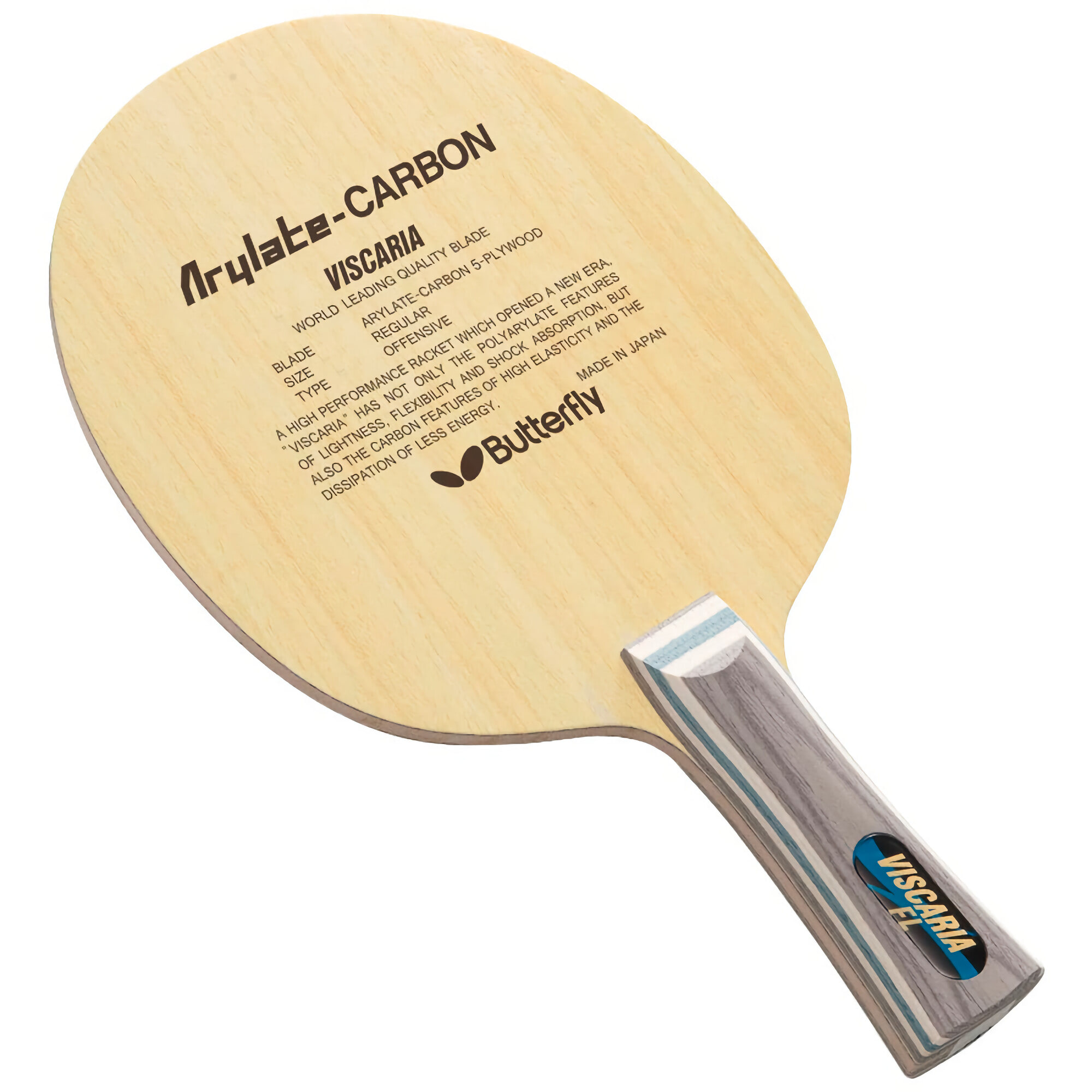
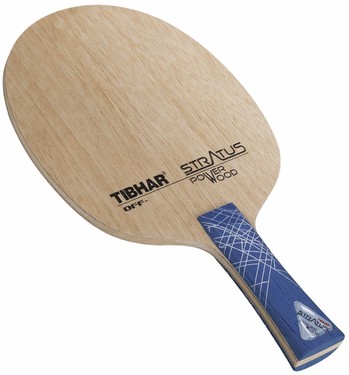
| Butterfly Viscaria | Tibhar Stratus Power Wood | |
|---|---|---|
| Our rating | 9.0/10 | 9.0/10 |
| Feel | medium-hard | Elastic with long dwell time, lively yet controlled, larger-than-average head and big sweet spot |
| Handle | FL/ST/AN | FL / ST / AN |
| Plies | 5W+2 Arylate-Carbon | 5-ply all wood (Limba-Limba-Ayous-Limba-Limba) |
| Speed | OFF | OFF- |
| Sponge thickness | 5.8 mm | 6.2 mm |
| Weight | 87 g | 90 g |
We may earn a commission from links on this page. Learn more.
Two very different construction philosophies scoring almost identically
This is the pair that breaks the assumption that carbon beats wood. Butterfly’s Viscaria (5-ply wood plus 2-ply arylate carbon, OFF) and Tibhar’s Stratus Power Wood (5-ply all-wood, OFF-) carry the same 9-out-of-10 overall rating, and on the speed axis they are essentially tied — 9.0 versus 8.9, a 0.1-point gap that is inside noise and won’t register on any rally. If you came here expecting the carbon blade to dominate on raw pace, the radar data says it doesn’t.
Where they actually diverge: control and weight
Control is the one axis with a real gap, and it runs the opposite direction from what the price tag suggests: Stratus Power Wood scores 9.3 against the Viscaria’s 8.8, a 0.5-point advantage for the cheaper all-wood blade. That tracks with its sourced pros — Reddit’s r/tabletennis threads and Tabletennis11’s blog both describe it as beginner-friendly control with enough speed for offense, while the Viscaria’s own cons explicitly warn it demands an active stroke and isn’t a beginner blade. The other real gap is on the weight axis: 8.2 for the Stratus versus 7.1 for the Viscaria, a 1.1-point difference that lines up with the spec sheet — the Stratus is physically 90g against the Viscaria’s 87g, and Megaspin’s reviews describe it as having a slightly head-heavy balance that some players find a touch heavy. If plow-through, heft-driven power appeals to you, that’s a real, measurable difference; if you prefer a lighter, quicker-feeling blade, the Viscaria wins that axis.
Stiffness, hardness and consistency: minor, not decisive
Stiffness (5.2 vs 4.9) and hardness (5.7 vs 5.4) both favor the Viscaria by a mere 0.3 points — real but small, the kind of gap you’d need a blind side-by-side to identify rather than something that changes how a rally plays out. Consistency is essentially tied (9.2 vs 9.1). None of these three differences should be a deciding factor on their own.
What the sources say about who each blade is for
Megaspin’s review page for the Viscaria repeatedly frames it around Fan Zhendong’s early ALC career and a large, forgiving sweet spot for players who already loop-drive the ball. Tabletennis11’s dedicated Stratus Power Wood write-up and the Megaspin reviews for it instead frame it as widely called the best value 5-ply all-wood blade, aimed at beginner-to-intermediate two-winged loopers. Those are genuinely different audiences even though the raw numbers sit close together.
Should you switch?
If you own a Stratus Power Wood and are tempted by the Viscaria’s reputation, the honest read of this data is: the speed ceiling is nearly identical, so you would mainly be trading away 0.5 points of control and some head-heavy plow-through weight for a lighter blade and a small stiffness and hardness bump. That’s a real but modest trade, not a categorical upgrade — you’re not buying more raw pace, you’re buying a different balance and a firmer, snappier feel. Going the other direction, from Viscaria to Stratus, makes more sense for a control-oriented player who wants near-identical speed with a more forgiving, higher-arc feel and doesn’t mind the extra 3 grams and head-heavy balance.
Bottom line by player type
Choose the Stratus Power Wood if you want beginner-to-intermediate-friendly control, a big sweet spot, and near-Viscaria speed at a fraction of the price — it’s the blade multiple sources independently call the best value proposition in 5-ply all-wood. Choose the Viscaria if you already have a complete, active loop-driving stroke and want the lighter, stiffer, slightly harder-hitting feel that carried Fan Zhendong through an early-career treble, and price is not the deciding factor.
Frequently asked questions
Is the Tibhar Stratus Power Wood really as fast as the Butterfly Viscaria?
Per the sourced per-axis ratings, yes almost exactly — 8.9 versus 9.0, a 0.1-point gap that is not meaningfully perceptible.
Which blade has better control?
The Stratus Power Wood, by a real 0.5-point margin (9.3 vs 8.8), consistent with reviewer descriptions of it as beginner-friendly and forgiving.
Why does the Viscaria cost so much more if the speed is nearly the same?
The premium reflects the arylate-carbon construction, brand pedigree (it's the blade associated with Fan Zhendong's early ALC career), and a lighter, stiffer, harder-hitting feel rather than a higher speed ceiling on this dataset.
Is the Stratus Power Wood too heavy?
It is the heavier of the two (90g vs 87g) and scores higher on the weight axis (8.2 vs 7.1); some players note a slightly head-heavy balance, so hand-feel matters if you're sensitive to that.