Butterfly Timo Boll W7 vs Donic Appelgren Allplay: Which Should You Buy?
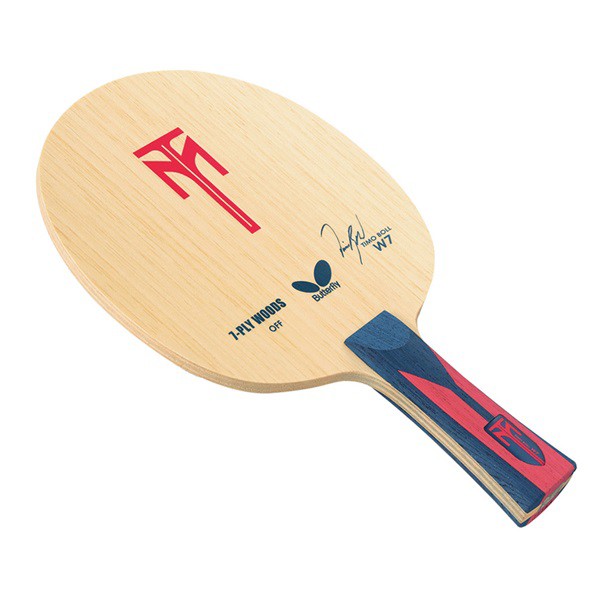
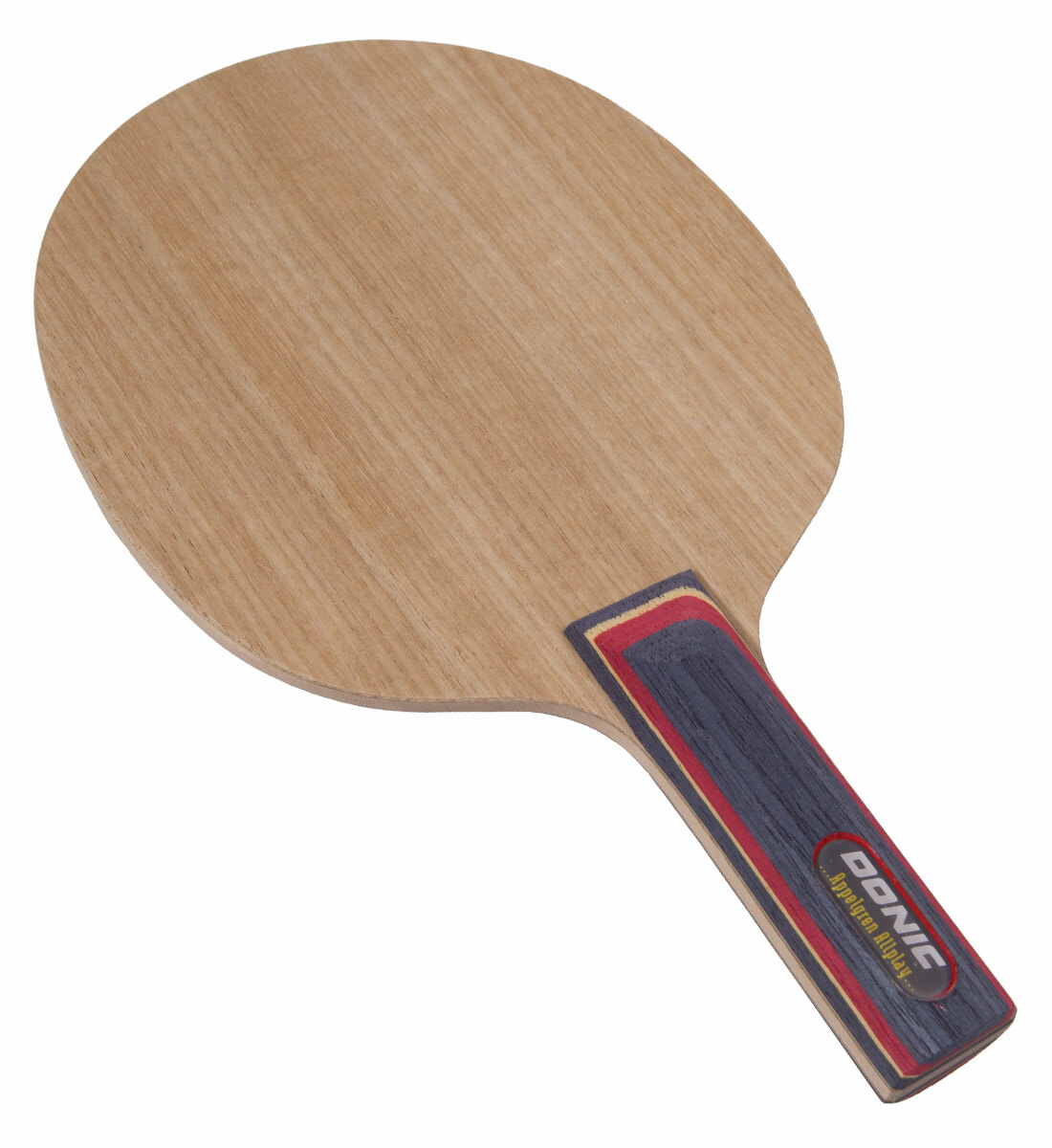
| Butterfly Timo Boll W7 | Donic Appelgren Allplay | |
|---|---|---|
| Our rating | 7.8/10 | 8.3/10 |
| feel | Hard, stiff, direct | medium, controlled |
| handle | FL, ST | FL/ST/AN |
| plies | 7-ply all wood (Limba / Ayous / Kiri) | 5W (abachi core + limba) |
| speed | OFF | ALL |
| thickness_mm | 6.7 | 5.8 |
| weight_g | 94 | 85 |
We may earn a commission from links on this page. Learn more.
Same Control Score, Almost Nothing Else in Common
Start with the strangest number in this whole comparison: control. The Timo Boll W7 and the Donic Appelgren Allplay score identically, 8.7 apiece, on the control axis. Everywhere else, these two blades could not be more different. Speed splits by a full 2.0 points, 8.9 versus 6.9, in the W7’s favor. Stiffness splits by 3.4 points, 7.1 versus 3.7. Hardness splits by 3.3 points, 7.5 versus 4.2. Weight splits by 3.2 points on the radar, matching the real-world gap of 94 grams versus 85 grams. These are not two variations on a theme. This is a fast, stiff, all-wood speed blade next to a soft, forgiving, do-everything blade that happen to land in the same place on one specific axis.
That tied control score is worth sitting with for a second, because it tells you something the marketing copy for either blade would not: raw control is not simply the opposite of speed. The W7 achieves its control through a huge sweet spot and a stable trajectory, according to Revspin and Bladerubber.net’s reviews, despite being a stiff, hard, direct-feeling blade. The Appelgren Allplay achieves the same control number through the opposite mechanism, softness and forgiveness, per Revspin’s aggregated reviews, which single out its feel and feedback on every stroke, from looping to blocking to the short game, as its standout quality.
Why the Ratings Diverge From the Radar
Despite the W7 beating the Appelgren Allplay on four of six radar axes, the Appelgren Allplay actually carries the higher overall rating, 8.3 versus 7.8. That is not a contradiction. It reflects that raw speed and stiffness are not universally desirable. The W7’s own cons list admits it has a very stiff feel not suited to beginners or intermediate players, and it causes hand vibration over long sessions. It is also discontinued, according to Tabletennis Reference, which makes it harder to source at fair prices, a real practical strike against it that has nothing to do with performance.
The Appelgren Allplay’s cons are much milder by comparison: adequate rather than high speed for attackers who want more as they improve, and some copies running a little heavy. Reddit’s r/tabletennis threads and Megaspin’s customer reviews both frame this as a blade that outperforms its price point rather than one with a real weakness to work around.
Should You Switch
This is one of the clearer non-comparisons in this dataset: these two blades serve almost entirely different players, so switching rarely makes sense in either direction. If you are already on a W7 and love its speed and stiffness for flat drives and smashes, moving to the Appelgren Allplay would mean giving up 2 full points of speed and over 3 points of stiffness and hardness. You would be changing your entire game, not upgrading equipment.
Going the other way, from Appelgren Allplay to W7, only makes sense if you have specifically outgrown the Allplay’s speed ceiling and want to trade its control-friendly feel for a much faster, stiffer, all-wood blade built for flat-drive-dominant styles. Given that the W7 is discontinued and harder to source at a fair price, per Tabletennis Reference, this switch also comes with a practical availability tax that the Appelgren Allplay does not.
Fit and Setup
The W7 pairs naturally with players who already attack aggressively and want an all-wood blade approaching composite speed without carbon’s stiffer, sometimes less communicative feel. The Appelgren Allplay is explicitly recommended by its own reviewers as a first real blade for players roughly under USATT 1800 or UK 1500, best paired with a non-tension rubber like Yasaka Mark V or DHS Hurricane 3 rather than a high-tension rubber, which its reviewers note pushes it toward offense at the cost of the control that makes it worth choosing in the first place.
Frequently asked questions
Why do the Timo Boll W7 and Donic Appelgren Allplay have the same control score if everything else is so different?
They arrive at the same 8.7 control rating through opposite mechanisms, the W7 through a big sweet spot and stable trajectory despite a stiff feel, the Appelgren Allplay through overall softness and forgiveness.
Is the Timo Boll W7 still available to buy?
It has been discontinued, according to Tabletennis Reference, which makes it harder to source at a fair price. Factor that into any decision to switch toward it.
Is the Donic Appelgren Allplay good for beginners?
Yes. It is recommended for beginners and all-round or modern-defensive players roughly under USATT 1800 or UK 1500, paired with a non-tension rubber like Yasaka Mark V or DHS Hurricane 3.
Which blade is faster?
The Timo Boll W7 by a full 2.0 points on the radar, 8.9 versus 6.9. It also runs 3.2 points heavier and over 3 points stiffer and harder, so the speed comes with a real change in feel.