Butterfly Timo Boll ALC vs Tibhar Stratus Power Wood: Which Should You Buy?
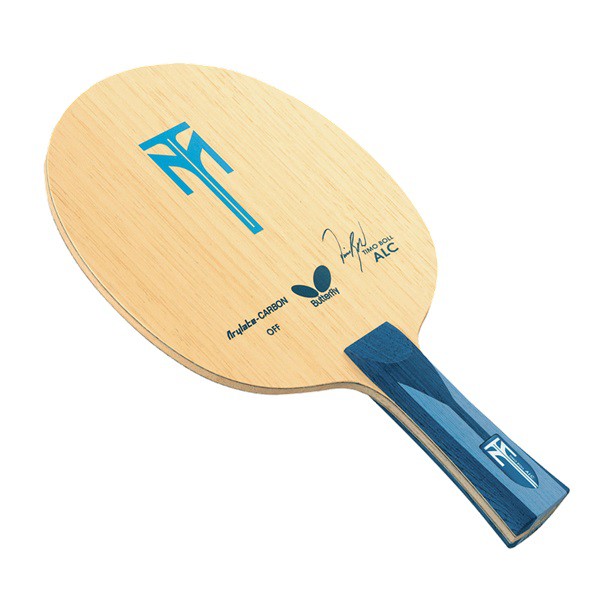
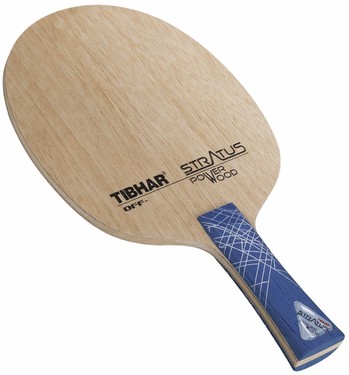
| Butterfly Timo Boll ALC | Tibhar Stratus Power Wood | |
|---|---|---|
| Our rating | 9.0/10 | 9.0/10 |
| Feel | medium | Elastic with long dwell time, lively yet controlled, larger-than-average head and big sweet spot |
| Handle | FL/ST/AN | FL / ST / AN |
| Plies | 5W+2 Arylate-Carbon | 5-ply all wood (Limba-Limba-Ayous-Limba-Limba) |
| Speed | OFF | OFF- |
| Sponge thickness | 5.8 mm | 6.2 mm |
| Weight | 86 g | 90 g |
We may earn a commission from links on this page. Learn more.
Butterfly Timo Boll ALC and Tibhar Stratus Power Wood share the same overall rating — 9.0 apiece — despite one being a premium arylate-carbon blade and the other being, by its own reviewers’ account, “widely called the best value 5-ply all-wood blade” on the market. That tie in the headline score is exactly why the axis data matters more than the rating here.
The gap that actually shows up in play
Control is the widest split between these two: ALC scores 8.7, Stratus Power Wood scores 9.3, a 0.6 point edge to the Tibhar. That is consistent with what its own pros list says — “beginner-friendly control with enough speed for offense” and a “larger head and big, forgiving sweet spot.” Reddit’s r/tabletennis threads on this blade and Tabletennis11’s write-up both describe it as unusually forgiving for its price point, and the control number backs that up directly.
Stiffness and hardness move together in the other direction: ALC is stiffer (5.8 vs 4.9, delta 0.9) and harder (6.2 vs 5.4, delta 0.8) than Stratus Power Wood. Both of those numbers point at the same underlying difference — Stratus Power Wood is a softer, more elastic all-wood build with a longer dwell time, while ALC’s carbon layers make it feel firmer and more direct at contact. Megaspin’s reviews of Stratus Power Wood specifically call out its “lively, elastic feel with crisp feedback,” which is the softer-blade signature you’d expect from those lower stiffness and hardness scores.
Where the difference basically disappears
Speed (9.0 vs 8.9, delta 0.1) and consistency (9.3 vs 9.1, delta 0.2) are both close enough to ignore. This matters because it undercuts the assumption that a carbon blade must be meaningfully faster than a good all-wood blade — on the aggregated data, ALC’s speed edge over Stratus Power Wood is not something you would notice mid-match. Weight shows a real 1.4 point gap in Stratus Power Wood’s favor on the axis (heavier), which tracks with its slightly head-heavy balance mentioned in its own cons list, though the raw gram difference is modest (86g vs roughly 90g).
What the ratings tie is actually telling you
When two blades in completely different material classes and price tiers land on the same 9.0 overall score, it usually means each is close to the ceiling of what its category can deliver. Stratus Power Wood’s own cons list is short and mild — a touch head-heavy, plays faster than its OFF- rating suggests, and backhand blocks reward precise timing. That is a remarkably clean sheet for a blade priced as an entry-to-intermediate option.
Fit by playstyle and budget
ALC’s case is attacking shakehand players with a developed, technically sound stroke who want a balanced high-spin blade and are willing to pay a premium for it. Stratus Power Wood’s case, per its own bestFor line, is “beginner to intermediate two-winged loopers who want a forgiving, spin-friendly all-wood blade with real attacking speed at an unbeatable price.” These are not really competing for the same buyer — one is a technique-rewarding premium tool, the other is a value pick that a Reddit and Tabletennis11 audience keep coming back to.
Should you upgrade from Stratus Power Wood to ALC
This is the honest answer this page exists to give: often, no. If your stroke is still developing and you are getting 9.3 control and 9.1 consistency out of Stratus Power Wood already, spending premium money to move to ALC buys you a small stiffness and hardness bump and essentially nothing in speed or consistency — while giving up 0.6 points of control. The case for upgrading is really about wanting ALC’s firmer, more direct feedback once your stroke is developed enough that the extra forgiveness of Stratus Power Wood stops being useful and starts being a ceiling.
Bottom line
This is one of the rare matchups in this dataset where the cheaper, simpler blade is not the compromise pick. The axis data says Stratus Power Wood actually wins on control and ties on speed and consistency; ALC’s real advantages are limited to stiffness and hardness — a firmer, more carbon-typical feel that only pays off once your technique has outgrown a forgiving all-wood blade.
Frequently asked questions
Is Butterfly Timo Boll ALC actually better than Tibhar Stratus Power Wood?
Not across the board — both carry the same 9.0 overall rating, and Stratus Power Wood actually scores higher on control (9.3 vs 8.7).
Is Tibhar Stratus Power Wood fast enough for attacking play?
Its own reviewers note it "plays faster than its OFF- rating suggests," and the aggregated speed score (8.9) is only 0.1 point behind ALC's 9.0.
When is it worth upgrading from Stratus Power Wood to ALC?
Once your stroke has outgrown the extra forgiveness of an all-wood blade and you want firmer, more direct feedback — the stiffness and hardness gaps (0.9 and 0.8 points) are where ALC actually pulls ahead.
Which blade is more forgiving for developing players?
Stratus Power Wood, per both the control axis and its own bestFor description targeting beginner to intermediate loopers.