Butterfly Tenergy 80 vs Donic Bluefire M1: Which Should You Buy?
| Butterfly Tenergy 80 | Donic Bluefire M1 | |
|---|---|---|
| Our rating | 8.8/10 | 8.4/10 |
| best_side | both | Forehand |
| control | medium-high | 9.1 / 10 |
| speed | 13.5/14 | 9.7 / 10 |
| spin | 11.2/12 | 9.0 / 10 |
| sponge_hardness | 36° | 47.5 degrees (medium-hard) |
| type | tensor inverted (Spring Sponge) | Inverted / Tensor |
| weight_uncut_g | 67 | approx 49 g |

We may earn a commission from links on this page. Learn more.
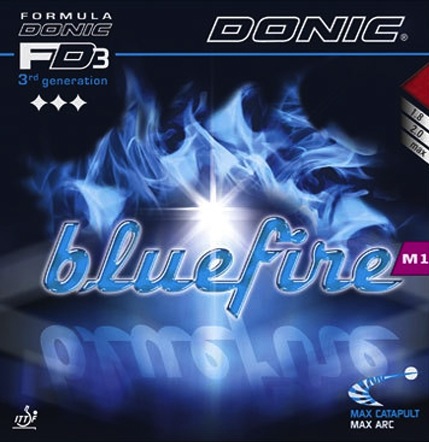
Butterfly Tenergy 80 is faster and more direct than Tenergy 05 with perfect topspin arc, excellent forgiving blocking and outstanding offensive versatility across loops, flat hits, blocks and serves. It suits upper-intermediate and advanced players wanting faster, forgiving Tenergy ideal on 5-ply off wood blades. Donic Bluefire M1 is the hardest and fastest Bluefire generating heavy dipping topspin loops with high throw, competitive to Tenergy 05 at lower price but very unforgiving. Bluefire M1 requires advanced technique and arm acceleration; performance fades after one to two months as factory boost expires. Bluefire M1 not ideal far from table or backhand; Tenergy 80 excels at mid-distance and blocks reliably. Tenergy 80 is more accessible and versatile; Bluefire M1 is technical and spin-dominant for close-to-mid table attackers.
FAQ
Which rubber is more forgiving?
Tenergy 80. Bluefire M1 is very unforgiving and requires advanced technique.
Which rubber is better for mid-distance play?
Tenergy 80. It excels at mid-distance with perfect arc and versatile offense. Bluefire M1 is best close-to-table.
Which rubber has better blocking feel?
Tenergy 80. Its medium-low throw enables excellent, forgiving blocks. Bluefire M1 is less ideal for passive blocks.
Which rubber is cheaper?
Bluefire M1 is competitive to Tenergy 05 at lower price than Tenergy 80.