Butterfly Tenergy 19 vs Donic Bluefire M1: Which Should You Buy?
| Butterfly Tenergy 19 | Donic Bluefire M1 | |
|---|---|---|
| Our rating | 8.7/10 | 8.4/10 |
| best_side | forehand | Forehand |
| control | high — extended dwell time provides greater margin for error than other Tenergy variants | 9.1 / 10 |
| speed | 132 | 9.7 / 10 |
| spin | 117 | 9.0 / 10 |
| sponge_hardness | 36 degrees (approx 48 degrees ESN) | 47.5 degrees (medium-hard) |
| type | inverted / pimples-in tensor | Inverted / Tensor |
| weight_uncut_g | approx 49 g | approx 49 g |

We may earn a commission from links on this page. Learn more.
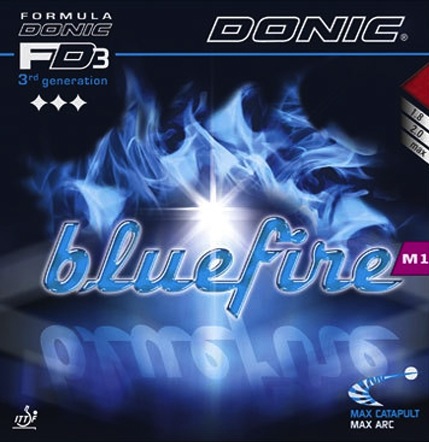
Tenergy 19 is the forgiving, spin-biased tensor with extended dwell time on forehand loops and customizable thickness (1.7–2.1 mm). Donic Bluefire M1 is the hardest and fastest of the M-series, competitive with Tenergy 05 at lower price, with high throw angle and excellent close-to-table control. M1 is very unforgiving—it demands advanced technique and proper acceleration. Performance fades after one to two months as factory boost expires. Tenergy 19 is softer, more spin-focused, and more durable. M1 suits advanced attackers (1500+ USATT) who want hard speed; Tenergy 19 suits intermediate-to-advanced players who value forgiveness and spin.
FAQ
Which is faster?
M1 is rated 9.7/10 speed vs. Tenergy 19’s 132. M1 is the faster rubber, but it’s also harder and less forgiving.
Which is more forgiving?
Tenergy 19 by far. M1 requires advanced technique and proper arm acceleration; it’s not for learners.
Who should pick M1?
Advanced offensive players (1500+ USATT) who want a hard, fast forehand tensor with high throw angle for spin-dominant looping.
Who should pick Tenergy 19?
Intermediate-to-advanced players who want good spin, high control margin, and durability without needing elite technique.
Durability difference?
Tenergy 19 is more durable long-term. M1 performance fades after 1–2 months as factory boost expires.