Butterfly Tenergy 05 vs JOOLA Dynaryz AGR: Which Should You Buy?
| Butterfly Tenergy 05 | JOOLA Dynaryz AGR | |
|---|---|---|
| Our rating | 9.0/10 | 8.7/10 |
| best_side | both | FH |
| control | medium-high | 7 |
| speed | 13.0/14 | 9.6 |
| spin | 11.5/12 | 9.3 |
| sponge_hardness | 36° (Butterfly scale) | Hard (around 50 degrees EUR, purple Hyperbounce sponge) |
| type | tensor inverted | inverted |
| weight_uncut_g | 68 | 71 |

We may earn a commission from links on this page. Learn more.
The scoreboard is closer than the price tags suggest
Butterfly Tenergy 05 and JOOLA Dynaryz AGR are priced like rivals and, on paper, perform like near-twins on two of the six tracked axes. Revspin’s aggregated ratings put both rubbers at an identical 9.3 for speed and an identical 9.4 for spin. If you were deciding purely on those two numbers, there would be no decision to make. The rubbers separate elsewhere, and the gaps that do exist are large enough to matter.
The throw gap is the whole story
The single biggest difference between these two sheets is throw angle: Tenergy 05 sits at 7.6, Dynaryz AGR at 5.5, a 2.1-point gap that is the largest swing on this sheet. In practical terms, throw angle describes how high and forward the ball launches off the rubber for a given stroke. Tenergy 05’s high throw is why generations of loopers describe its topspin as forgiving over the net — you get more margin for a slightly flat or slightly early contact, and the ball still clears with topspin to spare. Dynaryz AGR’s lower throw produces a flatter, lower trajectory. That is not a flaw; it is the rubber doing exactly what JOOLA built it to do. The pros list for Dynaryz AGR explicitly calls out “powerful, low, fast loops” and positions the rubber for “close-to-table aggressive attack, third-ball attacks and finishing strokes” — a low, flat trajectory is an asset for that style, not a limitation, provided your technique is clean enough to generate your own arc rather than borrow it from the rubber.
Control: the number that contradicts the marketing
Here is the honest surprise in the data: Dynaryz AGR actually scores higher on the control axis, 9.0 versus Tenergy 05’s 8.3, a 0.7-point edge. That sits awkwardly next to Dynaryz AGR’s own listed con of “limited passive control and a low, unforgiving short game.” Both things are true at once. The control number reflects how consistent and predictable the rubber is once you commit to an active stroke — Dynaryz AGR rewards clean, fully committed technique with very consistent results, which is a form of control. What it does not reward is passive blocking, half-hearted pushes, or hesitant short game, which is where Tenergy 05’s greater forgiveness and higher throw actually bail out imperfect contact more often. If your idea of control is “doesn’t punish a slightly late block,” Tenergy 05 is the safer sheet even though its aggregate control score is lower.
Tackiness and durability barely move the needle
Tenergy 05 edges Dynaryz AGR by 0.7 on tackiness (2.3 versus 1.6) and by 0.4 on durability (7.7 versus 7.3). Neither gap is large enough to be a deciding factor on its own. Both rubbers sit at the low end of the tackiness scale, which tracks with both being modern tensor sheets rather than classic tacky Chinese rubber, and both last in the same general ballpark — Dynaryz AGR’s own cons acknowledge it is “often dead in roughly four to six months under heavy use,” which is a normal lifespan for a premium tensor rather than an outlier weakness relative to Tenergy 05.
Weight and hardness
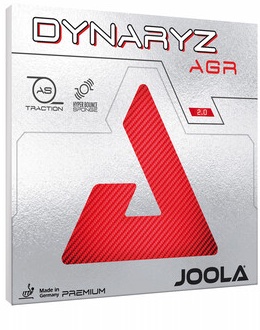
Dynaryz AGR runs firmer and heavier: its purple Hyperbounce sponge is rated around 50 degrees on the European scale versus Tenergy 05’s 36 degrees on Butterfly’s own scale, and it is about 3 grams heavier uncut (71g versus 68g). That firmness is consistent with the low-throw, high-speed profile — a harder sponge compresses less and returns energy faster and flatter.
Should you switch?
If you already play Tenergy 05 and attack mostly close to the table with a clean, forehand-dominant game, Dynaryz AGR is a legitimate speed-and-control upgrade for that specific style, at the cost of the safety net Tenergy 05’s arc provides. If you rely on Tenergy 05’s forgiveness in serve receive, blocking, or an all-around two-wing game, switching to Dynaryz AGR will expose those exact weaknesses — its own cons list is blunt that it is “too much rubber for players rated around 1600 and below.” For most players who are not already close-to-table forehand attackers with committed technique, Tenergy 05 remains the safer, more versatile choice, per RevSpin, Megaspin, and TT-Spin data on both sheets.
Frequently asked questions
Is JOOLA Dynaryz AGR actually faster than Butterfly Tenergy 05?
No. Per Revspin's aggregated ratings both score identically at 9.3 for speed and 9.4 for spin. The real difference is throw angle, not raw speed or spin ceiling.
Which rubber has better control?
Dynaryz AGR scores higher in the aggregate control number (9.0 versus 8.3), but that reflects consistency under committed, active strokes. Tenergy 05's higher throw angle makes it more forgiving on passive contact, blocks, and short game.
Should I switch from Tenergy 05 to Dynaryz AGR?
Only if you already attack close to the table with clean, committed technique on the forehand. Dynaryz AGR's own listed cons flag it as too much rubber for players rated around 1600 and below, plus a low, unforgiving short game.
How much heavier is Dynaryz AGR?
About 3 grams uncut (71g versus 68g), and its Hyperbounce sponge is markedly firmer at around 50 degrees EUR versus Tenergy 05's 36 degrees on Butterfly's scale.