Butterfly Rozena vs Yasaka Rakza X: Which Should You Buy?
| Butterfly Rozena | Yasaka Rakza X | |
|---|---|---|
| Our rating | 8.4/10 | 8.4/10 |
| Best side | Both wings | Both wings |
| Control | high | medium-high |
| Speed (different scales) | 13.0/14 | high |
| Spin (different scales) | 10.8/12 | high |
| Sponge hardness | ~35° | 47.5 (medium-hard, roughly 45-50 degrees) |
| Type | tensor inverted (Spring Sponge) | tensor inverted |
| Uncut weight | 67 g | 69 g |
A row marked “different scales” puts two rating systems in one line. Those cells are not a single score you can subtract.

We may earn a commission from links on this page. Learn more.
Same aggregate score, different tool for the job
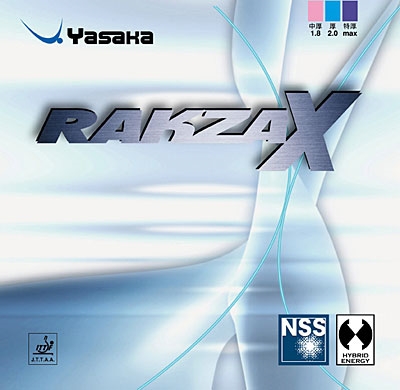
Butterfly Rozena and Yasaka Rakza X both land at 8.4 overall, same as the Rozena-versus-Rakza-7 matchup, but the shape of this comparison is different. Rakza X is priced and positioned as a step up from Rakza 7, and the axis data backs that up: it beats Rozena on spin, control, tackiness and durability, while giving up ground only on throw.
The durability gap is the biggest single number
At 8.0 versus 6.8, Rakza X’s durability edge is the largest gap on the sheet (1.2 points), matching the pattern from Rakza 7: Yasaka’s grippy tensors simply hold their surface longer than Rozena’s softer Spring Sponge build. If you replace rubber often this is moot; if you want a season out of one sheet, it counts.
Spin, control and tackiness: real but moderate
Rakza X out-spins Rozena by 0.6 points (9.0 vs 8.4) and out-controls it by 0.4 (9.1 vs 8.7), and its topsheet reads 0.7 points tackier (2.2 vs 1.5) on the tackiness axis. None of these are enormous, but they are consistent in one direction: Rakza X is simply the more capable attacking rubber across the board, which fits its reviews. Revspin and TableTennisDaily both describe it as a rubber whose grip “produces high spin and overrides incoming spin,” with a response reviewers call linear and predictable “for a fast tensor” — in other words, more forgiving than its speed rating would suggest.
An honest wrinkle: the throw numbers don’t match the reputation
Here is a case where the aggregated axis data complicates the simple story. Rakza X’s own pro list praises its “high, safe throw arc that excels on loops and counter-topspins,” yet the throw axis actually gives Rozena the edge, 5.5 versus 4.7 — a 0.8-point gap in Rozena’s favor. That does not mean Rakza X throws low in absolute terms; it means that relative to Rozena specifically, the throw arc is not where Rakza X pulls ahead, whatever its general reputation among reviewers. If throw angle and a high, safe arc are your priority above all else, this pairing does not deliver the advantage the marketing language implies — Rozena’s arc is at least as generous.
Weight and sponge hardness explain the feel difference
Sponge hardness diverges sharply on paper: Rozena sits around 35 degrees against Rakza X’s medium-hard 47.5, and that difference alone explains most of what reviewers describe as heavy and harder to control coming from soft rubbers in Rakza X’s own con list. The weight gap is modest on the sheet, 67g versus 69g uncut, so the harder sponge — not raw mass — is doing the work of making Rakza X feel like the more demanding rubber to swing.
Who should make the switch
Rakza X’s own reviewers frame it explicitly as an upgrade path for players who “liked Rakza 7 but want more control in blocks and loop exchanges,” and the axis data supports that framing when set against Rozena too: more spin, more control, more durability, at the cost of being a stiffer, less forgiving rubber overall. If you are already on Rozena because you value its softness and fault tolerance, especially on developing backhand technique, Rakza X is a step toward a harder-hitting, less forgiving game — worth it if you are ready to trade some ease of use for ceiling, not worth it if Rozena’s forgiveness is the reason you picked it.
Rakza X’s own con list is candid about the tradeoffs: grip fades after a couple of months of heavy use, passive blocking and lobs are weaker, and players coming straight from soft rubbers will find it harder to control at first. None of that shows up as a rating penalty on the axis chart, but it is exactly the kind of adjustment period Rozena is designed to avoid.
Bottom line
This is not a close call across the board — Rakza X wins on spin, control, tackiness and durability — but the throw axis is a genuine surprise that favors Rozena, and the practical cost of switching is a harder sponge and a real break-in period, not just an upgrade in numbers.
Frequently asked questions
Does Yasaka Rakza X really have a higher throw arc than Butterfly Rozena?
No — this is one case where the marketing description and the data disagree. Rakza X's own pro list praises its high, safe throw arc, but the aggregated throw axis actually favors Rozena, 5.5 versus 4.7.
What is the biggest real difference between Rozena and Rakza X?
Durability. Rakza X rates 1.2 points higher (8.0 versus 6.8), the largest gap between the two on any axis.
Is Rakza X a good upgrade from Rakza 7?
Reviewers frame it that way, as a step up in control and blocking for players who already like Rakza 7, and against Rozena it also wins on spin, control and tackiness, at the cost of a harder, less forgiving sponge.
Is Rakza X harder to control coming from a soft rubber like Rozena?
Yes, according to its own con list. Its sponge rates around 47.5 degrees versus Rozena's roughly 35, and that hardness gap, not weight (67g vs 69g uncut), is what makes it feel more demanding to swing.